


- Kyber Network says neither it nor its KyberSwap platform operates out of Singapore or falls under licensing by the Monetary Authority of Singapore, as the city-state’s digital-token rules push unlicensed local firms serving overseas users to relicense or shut down.
- KyberSwap’s own Terms of Use, dated April 2025, already named a British Virgin Islands company and a Cayman Islands foundation as the platform’s operators, more than a month before Singapore’s licensing deadline was even announced.
- Kyber ran nearly the same jurisdiction shift once before, leaving Malta for the British Virgin Islands in 2020 to get ahead of new European anti-money-laundering rules.
Kyber Network says it isn’t regulated by Singapore’s Monetary Authority of Singapore, and that KyberSwap doesn’t operate out of Singapore at all.
The statement comes as Singapore closes a gap crypto firms have used for years. Under the Financial Services and Markets Act, digital-token firms incorporated in Singapore but serving only customers abroad now need a license from MAS or must stop operating in the city-state. MAS has said it will “generally not issue” those licenses and expects most affected firms to wind down their Singapore operations instead.
REGULATORY ANNOUNCEMENT: It has come to our attention that there are online publications by third parties that suggest that Kyber Network / KyberSwap has a Singapore presence which could lead to the inference by the public that its activities are conducted out of Singapore even…
— Kyber Network (@KyberNetwork) August 24, 2026
What Kyber’s own contracts already said
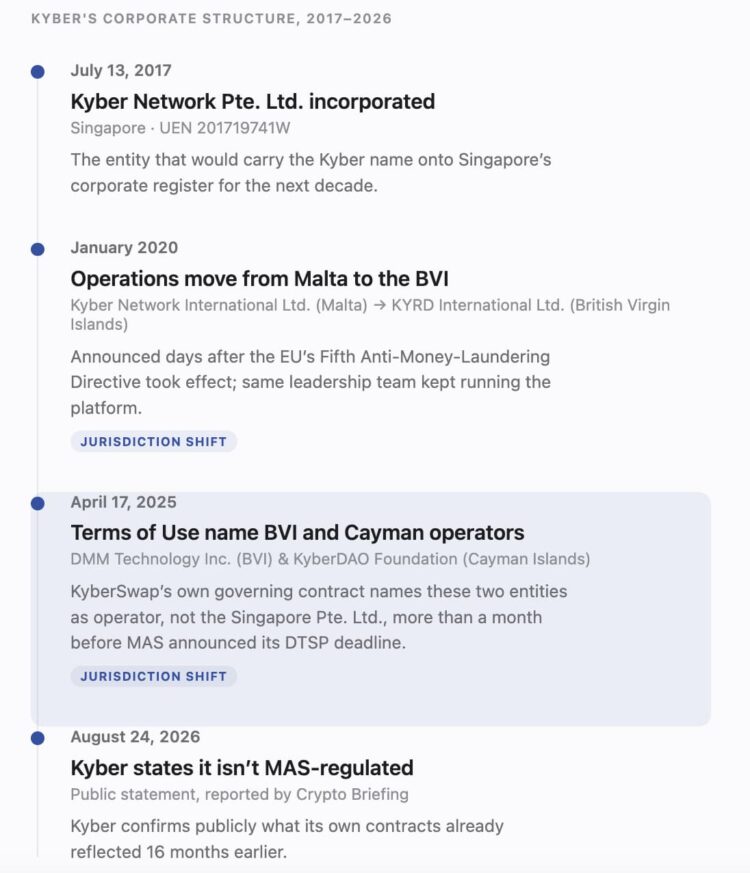
Kyber Network Pte. Ltd. has sat on Singapore’s corporate register since 2017. But KyberSwap’s Terms of Use, last updated April 17, 2025, name a different set of operators entirely: DMM Technology Inc., incorporated in the British Virgin Islands, and KyberDAO Foundation, based in the Cayman Islands. he distinction is particularly important as Singapore digital asset licensing requirements increasingly focus on where a crypto business is actually operated and which entity provides the relevant services. That document predates MAS’s own deadline announcement by more than a month, which means Kyber wasn’t restructuring in response to Singapore’s crackdown. The offshore operating structure was already written into its governing contract before the rule that supposedly explains it even existed.
Kyber has run this play before
This isn’t the first time Kyber has moved the entity actually running its platform away from a jurisdiction tightening its rules. In January 2020, Kyber shifted KyberSwap’s operations from Malta to the British Virgin Islands, citing the cost and compliance burden of the European Union’s incoming anti-money-laundering directive. The leadership team stayed the same. Only the corporate address changed.
Read against that history, Kyber’s Singapore entity looks less like an operator being forced out by regulation and more like a shell that stopped doing the operating years ago.
A project with reason to stay quiet
Kyber has other incentives to keep a low profile right now. The Singapore crypto freeze has added another layer of regulatory pressure for digital-asset firms with links to the city-state. KyberSwap’s Elastic product lost $48.8 million to a reentrancy exploit in November 2023, and the company cut its workforce roughly in half afterward. A platform still working through the fallout of a nine-figure exploit has little to gain from a public fight with a regulator. Kyber’s statement reads like a project confirming, as quietly as possible, a structure it already had in place.
Disclaimer: Cryip's content is strictly for educational and informational purposes and does not constitute financial, legal, or investment advice. Cryptocurrency involves significant risk, and readers assume full responsibility for their own financial decisions. Asset references are never endorsements.
To make complex crypto topics accessible to readers at all experience levels, our team uses AI tools strictly to refine language, correct grammar, and simplify terminology. AI is never used to draft facts, source information, or form conclusions. Every article is fact-checked and approved by a human editor before publication. Read our full AI Use & Content Policy.