



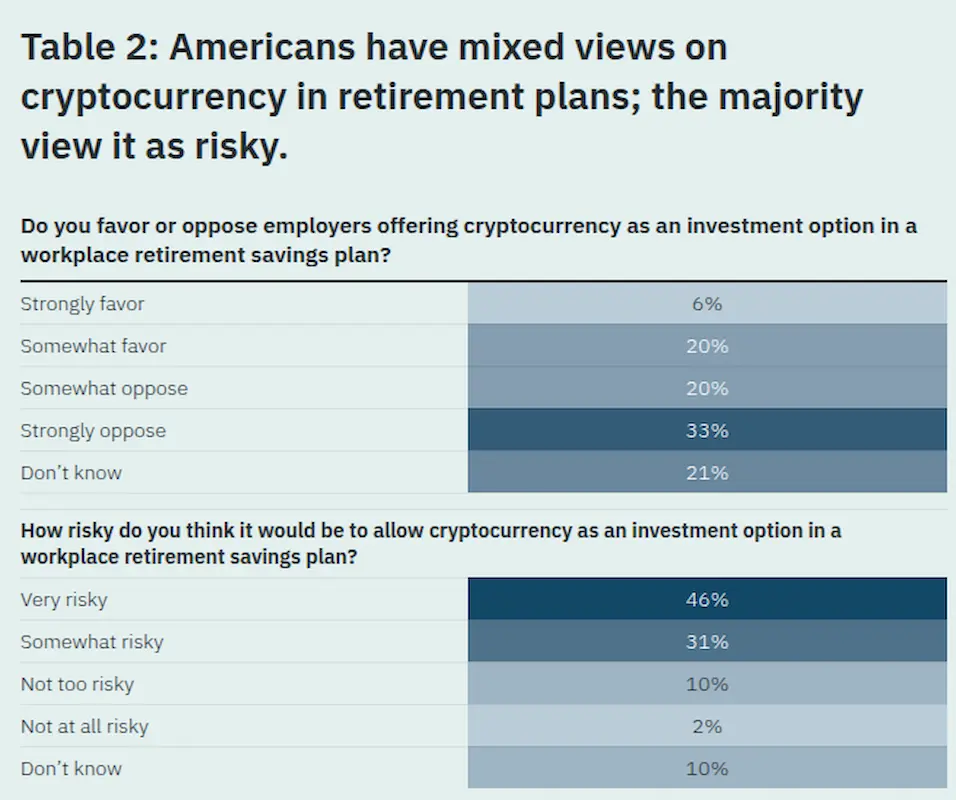
Seventy-seven percent of Americans consider cryptocurrency too risky for their workplace retirement plans. Federal regulators are moving the opposite direction, clearing the way for exactly that.
The finding comes from Retirement Insecurity 2026, a National Institute on Retirement Security survey of 1,203 adults conducted by Greenwald Research between October and November 2025. Beyond the risk concern, 53% of respondents oppose employers offering crypto as a 401(k) investment option, including 33% who strongly oppose it. Familiarity is low across the board: 47% of Americans say they have only heard of crypto but are not familiar with it, or have never heard of it at all.
That skepticism runs directly against where policy has moved. The Labor Department spent 2022 through 2025 reversing itself on crypto in retirement plans four separate times, each shift widening access rather than narrowing it. It began in 2022 guidance urging fiduciaries to use “extreme care” before adding crypto to plan menus, a caution the department rescinded in May 2025. President Trump then signed an executive order in August 2025 directing agencies to widen 401(k) access to crypto and other alternative assets. The White House cleared the resulting rule for release that March, and the Labor Department formally proposed a safe-harbor rule days later that would shield employers who add crypto and other alternative assets to plan menus.
The stakes are higher than the policy fight alone suggests. NIRS separately found in a February 2026 report that the typical American worker has just $955 saved for retirement, with 18% having no retirement savings at all. A savings cushion that thin leaves little room to absorb the price swings that come with a volatile asset class, which is part of why Sens. Bernie Sanders and Elizabeth Warren wrote to the Labor Department on June 1 urging it to scrap the proposed rule. They called the safe harbor a co
nflict of interest for an administration with financial ties to the crypto industry, writing that it “would strip long-held investor protections from retirement savers and encourage the use of more risky, complex, and expensive investments.” Dan Doonan, NIRS executive director, said the survey reflects a broader affordability squeeze rather than crypto alone.
“Americans are telling us that retirement security is becoming harder to achieve as they struggle with the affordability of everyday life.”
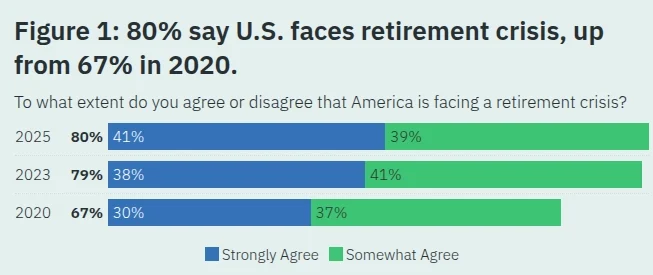
Eighty percent of Americans now say the nation faces a retirement crisis, up from 79% in 2023 and 67% in 2020, and 68% say preparing for retirement is getting harder.
Crypto is not the only new technology Americans are wary of bringing into retirement planning. The same survey found 63% have used an AI tool for something, but 61% have not used one for a finance, investment, or retirement question, and 45% say they are uncomfortable with AI playing a role in delivering financial advice.
Whether the proposed rule takes effect will depend on what survives the comment period and any legal challenges that follow. For now, the gap between what regulators are building and what savers say they want remains wide open.
Disclaimer: Cryip's content is strictly for educational and informational purposes and does not constitute financial, legal, or investment advice. Cryptocurrency involves significant risk, and readers assume full responsibility for their own financial decisions. Asset references are never endorsements.
To make complex crypto topics accessible to readers at all experience levels, our team uses AI tools strictly to refine language, correct grammar, and simplify terminology. AI is never used to draft facts, source information, or form conclusions. Every article is fact-checked and approved by a human editor before publication. Read our full AI Use & Content Policy.