
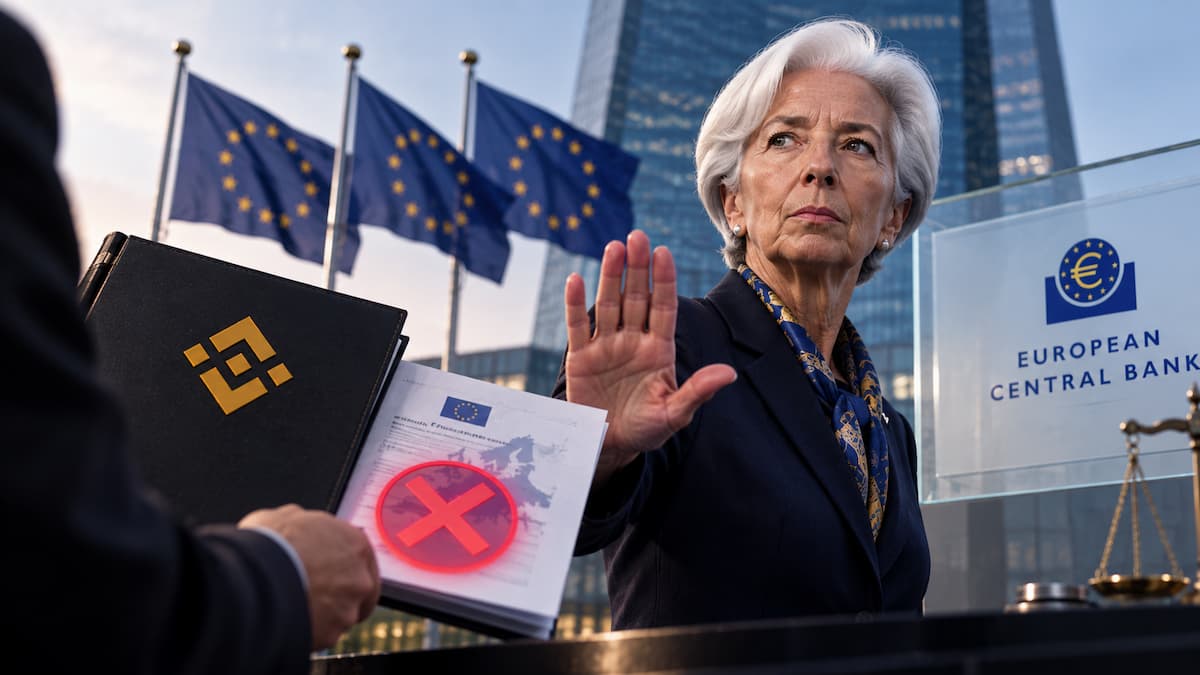


- A report says European Central Bank President Christine Lagarde intervened to block Binance from obtaining an EU-wide license through Greece
- Binance says the report will not affect its plans to seek MiCA compliance in Europe
- The report has drawn pushback from industry figures questioning the ECB’s authority over national licensing decisions
A report says European Central Bank President Christine Lagarde personally intervened to block Binance from obtaining an EU-wide license through Greece, under the bloc’s Markets in Crypto-Assets regulation, known as MiCA. The framework allows a crypto firm to obtain a license in any single EU member state and then operate across the entire bloc under that one approval, a structure known as passporting.
MiCA licensing decisions are formally made by national regulators, in this case Greece’s financial authorities, rather than by the ECB directly, which is why the report’s central claim, that Lagarde personally intervened in a national licensing process, has drawn scrutiny from industry figures questioning whether and how the ECB would have the standing to influence that decision. The ECB has not issued a detailed public response confirming or denying the specific intervention described in the report.
Binance responded by saying it remains committed to pursuing full MiCA compliance across the EU and does not view the report as changing its regulatory strategy in the region. The exchange has spent much of the past two years working to obtain licenses across individual EU jurisdictions after MiCA came into full effect, following years of more informal operation across the bloc that drew criticism from several national regulators.
The report lands at a sensitive moment for European crypto policy more broadly, with the EU currently running a targeted consultation on revising MiCA itself, three years after the framework became law. If accurate, the report would suggest political considerations at the highest levels of European monetary policy are shaping crypto licensing outcomes in ways not fully reflected in MiCA’s formal, decentralized licensing structure, a claim that, if it holds up under further scrutiny, could feed directly into arguments from crypto firms that the framework needs clearer, more centralized rules to prevent inconsistent treatment across member states.
Binance has faced regulatory scrutiny across multiple jurisdictions in recent years, including a large US settlement over anti-money-laundering compliance failures, a history that has made some European regulators more cautious about approving the exchange for a license that would grant it access to the entire EU market at once. Whether that history, rather than direct ECB intervention, better explains the reported friction in Binance’s Greek licensing process is one of the open questions the report has not fully resolved, and one likely to shape how EU regulators handle other exchanges’ passporting applications going forward.
Disclaimer: Cryip's content is strictly for educational and informational purposes and does not constitute financial, legal, or investment advice. Cryptocurrency involves significant risk, and readers assume full responsibility for their own financial decisions. Asset references are never endorsements.
To make complex crypto topics accessible to readers at all experience levels, our team uses AI tools strictly to refine language, correct grammar, and simplify terminology. AI is never used to draft facts, source information, or form conclusions. Every article is fact-checked and approved by a human editor before publication. Read our full AI Use & Content Policy.