


- US appeals court ruled 2-1 in favor of Kalshi against New Jersey regulators
- Commodity Exchange Act cited as overriding state gambling laws
- CFTC authority reaffirmed over sports-related event contracts
- Decision upholds lower court ruling supporting Kalshi’s position
- Dissent warns contracts resemble traditional sports betting
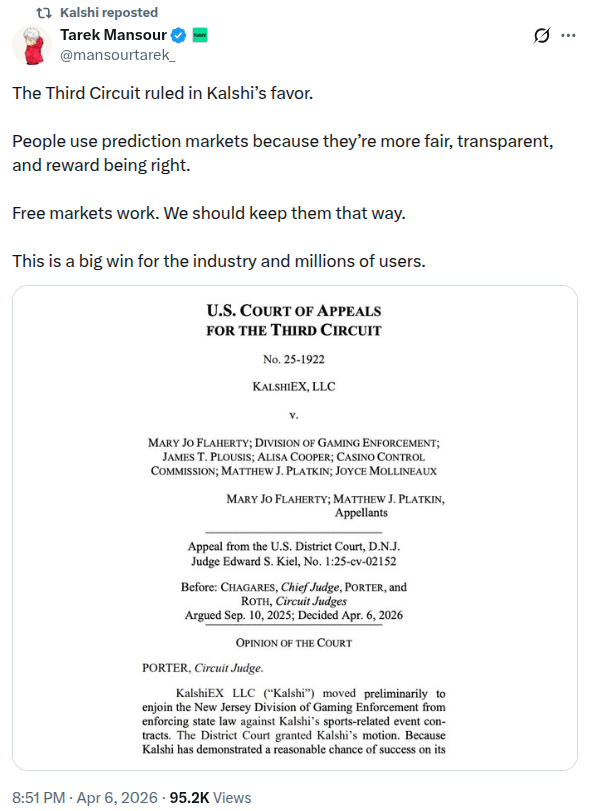
Court Sides With Kalshi on Federal Jurisdiction: A US appellate court has ruled against New Jersey gaming authorities in their enforcement action targeting prediction market platform Kalshi over sports event contracts. In a 2-1 decision issued Monday, judges in the US Court of Appeals for the Third Circuit found that Kalshi demonstrated a “reasonable chance of success” in arguing that federal law preempts state regulation.
The court affirmed a prior lower court ruling, agreeing with Kalshi’s claim that the Commodity Exchange Act grants the US Commodity Futures Trading Commission (CFTC) exclusive jurisdiction over such contracts.
Writing for the majority, Circuit Judge David J. Porter stated that allowing New Jersey to enforce its gambling laws would interfere with the federal regulatory framework. He noted that such enforcement would prevent Kalshi, a licensed designated contract market under CFTC oversight, from offering sports-related event contracts within the state.
The ruling emphasized that Congress established the CFTC to avoid a fragmented regulatory system, describing state-level enforcement as the type of “patchwork” the federal framework was designed to replace.
Dissent Raises Concerns Over Gambling Classification
In a dissenting opinion, Circuit Judge Jane Roth argued that Kalshi’s event contracts are effectively equivalent to sports gambling products. She described the company’s approach as a “performative sleight” and stated that the contracts are “virtually indistinguishable” from offerings on traditional betting platforms.
Roth also highlighted the broader implications of the case, noting that determining whether sports-event contracts qualify as swaps could significantly reshape the legal framework governing the gambling industry. She expressed concern that the majority opinion did not sufficiently address these complexities.
CFTC Maintains Position on Prediction Markets
The ruling comes as the CFTC continues to assert its authority over prediction markets. CFTC Chair Michael Selig has identified event contracts as a key regulatory focus, reiterating that the agency has exclusive jurisdiction in this area.
In recent months, the CFTC has taken multiple actions supporting its stance, including opening a proposed rule for public comment and filing an amicus brief in a separate case involving Nevada gaming authorities. The agency also filed lawsuits against Arizona, Connecticut, and Illinois, seeking to block what it described as unlawful attempts by those states to regulate prediction markets.
Speaking at a policy summit, Selig stated that the agency’s definition of commodities is broad and includes events across sports, politics, and agricultural markets. He noted that the regulatory approach does not distinguish between different types of event contracts but acknowledged exceptions for those susceptible to manipulation. Recently, Kalshi secured approval for a margin trading license aimed at institutional investors.
Disclaimer: Cryip's content is strictly for educational and informational purposes and does not constitute financial, legal, or investment advice. Cryptocurrency involves significant risk, and readers assume full responsibility for their own financial decisions. Asset references are never endorsements.
To make complex crypto topics accessible to readers at all experience levels, our team uses AI tools strictly to refine language, correct grammar, and simplify terminology. AI is never used to draft facts, source information, or form conclusions. Every article is fact-checked and approved by a human editor before publication. Read our full AI Use & Content Policy.