



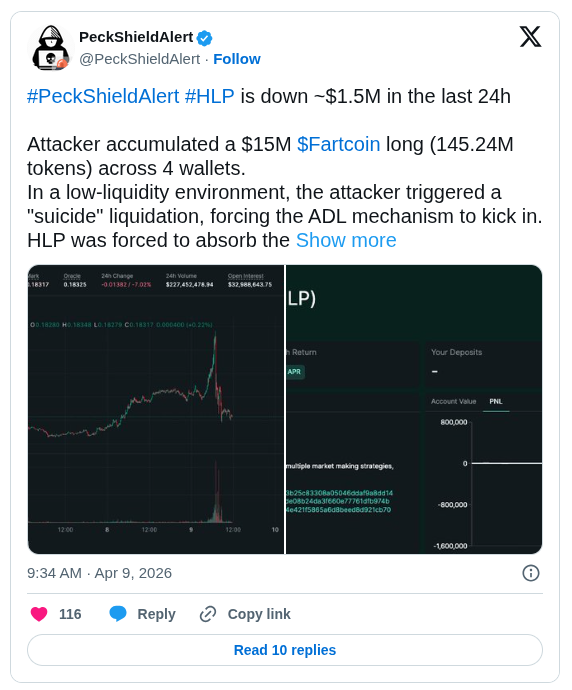
Attackers executed a deliberate market manipulation on Hyperliquid’s perpetual futures platform, resulting in approximately $1.5 million in losses to the HLP liquidity vault over the past 24 hours. The incident targeted the low-liquidity $FARTCOIN perpetual market, triggering the platform’s auto-deleveraging (ADL) mechanism and shifting significant risk onto liquidity providers. Blockchain security firm PeckShield first highlighted the event, noting how thin order books allowed rapid price distortion.
This type of exploit reflects a broader trend in DeFi, where attackers increasingly target structural weaknesses rather than just code bugs. A recent example is the Drift Protocol hack, where governance-level access was compromised to drain hundreds of millions, showing how both liquidity design and control mechanisms can become attack vectors
Suicide-Style Manipulation in Low-Liquidity Perp
The perpetrators built a roughly $15 million leveraged long position in $FARTCOIN, equivalent to 145.24 million tokens, spread across four distinct wallets in the hours before the incident. In Hyperliquid’s shallow liquidity pool for newer meme perpetuals, they aggressively pushed the price up by approximately 20 to 27 percent within minutes. Once bids were withdrawn, the market reversed sharply, triggering cascading liquidations.
Hyperliquid’s auto-deleveraging (ADL) protocol then activated, automatically assigning portions of the distressed position to the HLP vault, which acts as the protocol’s ultimate liquidity backstop and insurance layer. This mechanism, designed to prevent systemic insolvency, instead forced the vault to absorb a toxic position with limited offsetting counterparties available.
Reports indicate the long position suffered a realized loss of around $3 million, with some sources citing $3.02 million. Meanwhile, certain short positions benefited from the ADL process, realizing combined profits of approximately $849,000.
HLP Vault Bears the Burden
The HLP liquidity providers absorbed an on-paper loss approaching $3 million from the forced position takeover, with the actual realized impact on vault value reported at $1.5 million within the 24-hour window. PeckShield and on-chain analysts noted that the attackers may have maintained offsetting short positions or hedges on centralized exchanges or spot markets, potentially turning the apparent self-inflicted loss into a net gain through cross-venue arbitrage.
This effectively transferred risk from sophisticated traders onto passive HLP depositors, who provide the protocol’s insurance-like liquidity. The incident has renewed discussions about the sustainability of current ADL parameters, especially for highly volatile meme-driven perpetuals where liquidity can disappear instantly.
Similar manipulation tactics have been observed in recent months on other low-liquidity pairs, though this marks one of the more notable recent hits on the HLP vault involving a meme asset.
Key Incident Summary
- Attackers accumulated a 145.24 million token long position worth approximately $15 million across four wallets.
- They pumped the $FARTCOIN price by 20 to 27 percent in minutes before the market reversed sharply.
- This triggered liquidations and activated Hyperliquid’s auto-deleveraging (ADL).
- HLP vault incurred approximately $1.5 million realized loss, with on-paper impact closer to $3 million.
- Some short traders benefited via ADL, realizing approximately $849,000 in profits.
- The event highlights ongoing risks in auto-deleveraging mechanisms when applied to thinly traded meme perpetual markets.
Hyperliquid has previously adjusted leverage caps and maintenance margins in response to similar events. However, low-liquidity meme pairs continue to remain exploitable vectors for draining the insurance vault.
Disclaimer: Cryip's content is strictly for educational and informational purposes and does not constitute financial, legal, or investment advice. Cryptocurrency involves significant risk, and readers assume full responsibility for their own financial decisions. Asset references are never endorsements.
To make complex crypto topics accessible to readers at all experience levels, our team uses AI tools strictly to refine language, correct grammar, and simplify terminology. AI is never used to draft facts, source information, or form conclusions. Every article is fact-checked and approved by a human editor before publication. Read our full AI Use & Content Policy.