

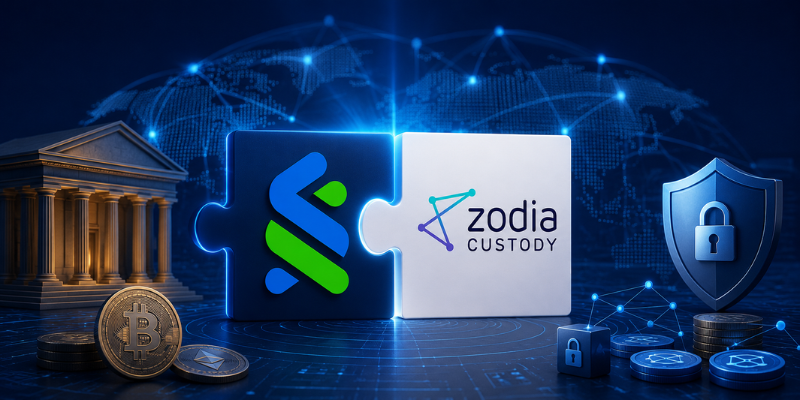


Standard Chartered Plc has taken a decisive step to integrate the crypto custody business of its majority owned subsidiary Zodia Custody Ltd directly into its own operations. The London based bank non binding offer to acquire the custody business has been accepted by other shareholders and noteholders. This marks a key consolidation in its digital assets strategy.
This move, which builds on discussions reported in April, aims to eliminate overlapping functions between Zodia and the bank in house digital asset capabilities within its Corporate and Investment Banking (CIB) division. While the client facing custody services will shift under Standard Chartered direct control, Zodia will continue as a standalone Software as a Service (SaaS) platform. It will be positioned as Zodia Solutions for technology licensing and infrastructure services.
Evolution of Zodia Custody
Zodia Custody was launched in late 2020 by SC Ventures, Standard Chartered innovation arm, in collaboration with Northern Trust. It was designed to offer institutional grade custody for digital assets. The company combines banking level security, compliance, and operational excellence. Zodia quickly attracted strategic investments from major players including SBI Holdings, National Australia Bank, and Emirates NBD. This created a strong consortium of traditional finance institutions.
Over the years, Zodia has built a solid reputation by providing custody for over 75 crypto assets and tokenized assets. Key innovations include its Interchange solution. This enables trading from cold storage with off venue settlement. It also offers white label custody infrastructure for other financial institutions. Zodia has served as custodian for products from firms like 21Shares, Invesco, and Bitwise. It formed partnerships such as with Securitize for tokenized real world assets (RWAs) and Deloitte in markets like Taiwan.
Reasons Behind the Integration
As Standard Chartered expanded its own CIB digital assets offerings including trading, tokenization, and custody services, internal overlaps with Zodia became more pronounced. Integrating the core custody business allows the bank to streamline operations, improve efficiency, enhance risk management, and deliver a more unified service to institutional clients under one regulated entity.
Commenting on the acquisition, Margaret Harwood-Jones, Global Head of Financing and Securities Services at Standard Chartered said:
This acquisition will accelerate the growth of Standard Chartered’s global digital assets custody portfolio and support the growth of our Financing and Securities Services business. It also reflects the group’s continued focus on building an end-to-end Digital Assets offering and further strengthening our position as the trusted bridge between TradFi and DeFi.
Julian Sawyer, CEO of Zodia Custody, added:
Digital asset custody is increasingly being delivered within banking environments. At the same time, financial institutions are increasingly seeking specialist infrastructure partners to support the launch and scale of digital asset services. We have seen strong and accelerating demand for our Solutions platform, as institutions look for trusted, bank-grade infrastructure that enables them to design, deliver and grow digital asset capabilities at scale.
Alex Manson, CEO of SC Ventures, said:
This is a strong example of how SC Ventures translates emerging technologies and market opportunities into commercially relevant capabilities for the bank. It reinforces the value of the SC Ventures’ model in enabling the bank to participate in emerging ecosystems through scalable ventures and strategic partnerships.
This restructuring reflects a broader industry trend in 2026. Traditional banks are moving from experimental joint ventures to deeper integration of digital assets into core banking activities. With regulatory clarity improving in key jurisdictions, rising ETF inflows, and growing interest in stablecoins and RWAs, institutional adoption of crypto is accelerating.
The global institutional crypto custody market is experiencing robust growth. This growth is driven by demand for secure and compliant solutions that bridge traditional finance and blockchain infrastructure.
Market Implications and Stakeholder Impact
For Standard Chartered, the absorption strengthens its position as a serious player in digital finance. The bank has been actively expanding its crypto footprint. Its research notes strong potential in Ethereum, stablecoins, and tokenization. This move provides greater control and synergy across its digital asset offerings.
Minority shareholders including Northern Trust and others have accepted the offer. Financial terms are not disclosed. Zodia Solutions can now focus on technology innovation and serve a broader client base. This may potentially include other banks and fintechs as a neutral infrastructure provider. It will operate without bearing the full weight of direct custody regulation.
Industry analysts see this as part of an ongoing consolidation wave. As major banks like Standard Chartered scale internal capabilities, specialized custodians must differentiate through advanced technology or niche services. Bank backed models like Zodia brought credibility. Full integration signals maturing mainstream adoption.
Challenges in the Crypto Custody Landscape
Despite the positive momentum, challenges persist. Crypto custody remains exposed to cybersecurity risks, regulatory evolution, and market volatility. High profile incidents in past years have underscored the need for robust solutions like cold storage trading mechanisms. Standard Chartered must ensure smooth client transitions while upholding standards such as SOC 1, ISO 27001, and Travel Rule compliance.
Looking forward, tokenization of real world assets is viewed as a multi trillion dollar opportunity. Reliable custody will play a foundational role in this space. Family offices and asset managers continue to increase allocations to digital assets. This creates sustained demand for trusted infrastructure.
This development positions Standard Chartered as a more integrated digital finance provider. It may influence how other banks manage their crypto ventures. Clients stand to benefit from tighter integration with traditional banking services, potentially faster settlements, and expanded product suites.
While exact timelines for full implementation are not yet public, the acceptance of the offer indicates meaningful progress. The move will be closely monitored as a signal of how traditional banks are balancing innovation speed with operational control in the evolving digital asset ecosystem.
Disclaimer: Cryip's content is strictly for educational and informational purposes and does not constitute financial, legal, or investment advice. Cryptocurrency involves significant risk, and readers assume full responsibility for their own financial decisions. Asset references are never endorsements.
To make complex crypto topics accessible to readers at all experience levels, our team uses AI tools strictly to refine language, correct grammar, and simplify terminology. AI is never used to draft facts, source information, or form conclusions. Every article is fact-checked and approved by a human editor before publication. Read our full AI Use & Content Policy.