
Bitcoin is nearing a pivotal milestone, with nearly 20 million of its 21 million total coins now in circulation. This leaves just one million bitcoins to be mined a process designed to unfold gradually over more than a century. This deliberate scarcity mechanism underpins Bitcoin’s value proposition in an era of abundant fiat currencies.
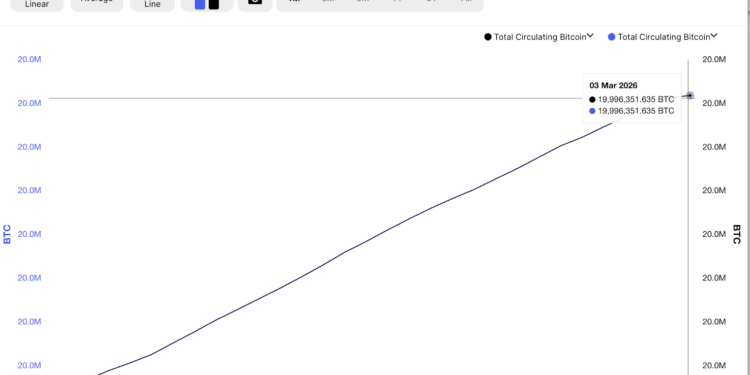
As of March 3rd 2026 (11:40 AM UTC), over 19,996.351 bitcoins have been produced. Miners secure the network by solving complex computational puzzles, earning new coins as block rewards. These rewards halve approximately every four years, ensuring a predictable and diminishing supply issuance.
The Mechanics of Bitcoin’s Supply Cap
Launched in 2009, Bitcoin began with a 50-coin block reward. Halvings in 2012, 2016, 2020, and 2024 progressively reduced this to the current 3.125 coins per block. The upcoming 2028 halving will cut it further to 1.5625 coins.
With blocks produced every 10 minutes, daily issuance stands at around 450 bitcoins today. Post-2028, this drops to 225, halving again in subsequent cycles. Mathematical models project the final satoshi the smallest unit won’t be mined until approximately 2140, extending the supply curve far into the future.
Notably, up to 20% of existing bitcoins (roughly 4 million) are considered permanently lost due to misplaced private keys or deceased holders. This effective supply constraint amplifies Bitcoin’s deflationary nature.
Implications for Value and Adoption
Bitcoin’s fixed supply contrasts sharply with traditional assets. Gold’s annual production grows 1-2% from mining, while central banks expand fiat supplies amid inflation pressures. Bitcoin’s hard cap fosters long-term value appreciation as demand rises.
Institutional adoption accelerates this trend. MicroStrategy holds over 250,000 bitcoins, while spot ETFs from BlackRock and Fidelity have attracted billions since 2024 approvals. Bitcoin surpassed $100,000 in 2025, buoyed by these inflows. Analysts like Willy Woo note, “Scarcity meets surging demand textbook economics.”
Nation-states are entering the fray. El Salvador’s Bitcoin legal tender policy has inspired others, with treasury strategies emerging globally, as detailed in our report on global governments’ Bitcoin holdings.
Challenges on the Horizon
Energy consumption remains a focal point. Bitcoin mining now derives over 50% of its power from renewables, per Cambridge Centre for Alternative Finance data, as operators migrate to hydro and solar-rich regions.
Transaction fees will increasingly sustain miners as block rewards diminish, already comprising 10-20% of revenue. The network’s hash rate, exceeding 700 exahashes per second, underscores its robust security.
Regulatory scrutiny and cybersecurity risks persist, yet Bitcoin’s 16-year uptime without core failures attests to its resilience.
Looking Ahead
The 2028 halving looms as a potential catalyst, historically preceding multi-fold price surges. With broadening adoption from payments to reserves Bitcoin positions itself as digital gold for the 21st century.