

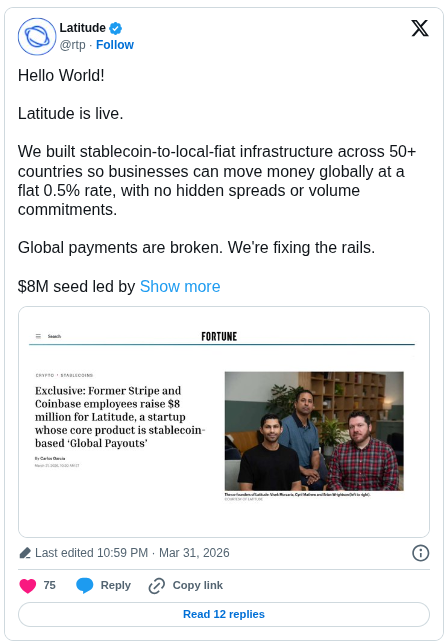
Latitude, a fintech startup founded by former employees of Stripe and Coinbase, announced on March 31, 2026, that it raised $8 million in a funding round. The company develops infrastructure for fast and affordable international payments using stablecoin rails. NEA led the round, with Lightspeed Faction, Coinbase, Paxos, and Solana Foundation participating as investors.
Funding Overview
Latitude secured $8 million in its latest funding round. NEA invested in Latitude as the lead investor, with Lightspeed Faction, Coinbase, Paxos, and Solana Foundation also investing in the startup; additional investors participated but remained unnamed.
The round’s valuation remains undisclosed, as confirmed by Latitude CEO Cyril Mathew in an interview with Fortune. Latitude generates revenue through transaction fees during its current beta launch and employs 11 people.
About the Company
Latitude provides stablecoin-based infrastructure that simplifies international payments for businesses. Its core product, Global Payouts, enables U.S. businesses to send payments to individuals in over 50 countries.
When a U.S. firm sends dollars via Latitude, the network converts them into stablecoins and then into the recipient’s local currency. Zencastr, a content creator platform, uses Latitude to pay podcasters in India and other countries. This approach reflects a broader industry shift toward stablecoin-powered rails, as seen in major funding developments like OpenFX Secures $94M, highlighting growing confidence in next-generation cross-border payment infrastructure.
Latitude’s second product targets crypto-native applications. These platforms use Latitude’s infrastructure to let international users convert local currency into stablecoins. Examples include prediction market companies expanding to Mexico or the Philippines. Co-founders Cyril Mathew (CEO), Vivek Morzaria, and Brian Wrightson draw from prior roles at Uber, Coinbase, Meta, and Stripe. Latitude remains in beta.
Investors
- NEA led the investment in Latitude.
- Faction
- Coinbase
- Paxos
- Solana Foundation
- Other unnamed investors joined the round.
Market Context
International payments face high costs and delays through traditional systems. Latitude competes with banks that rely on legacy rails like Swift for foreign exchange. Latitude uses stablecoin networks for faster, cheaper transfers while handling conversions. Co-founder Vivek Morzaria stated that small businesses pay too much and receive too little from incumbents.
Cyril Mathew positioned Latitude’s rails as more efficient than those of traditional banks. The startup targets gaps in global payouts for U.S. firms and crypto platforms serving international users.