

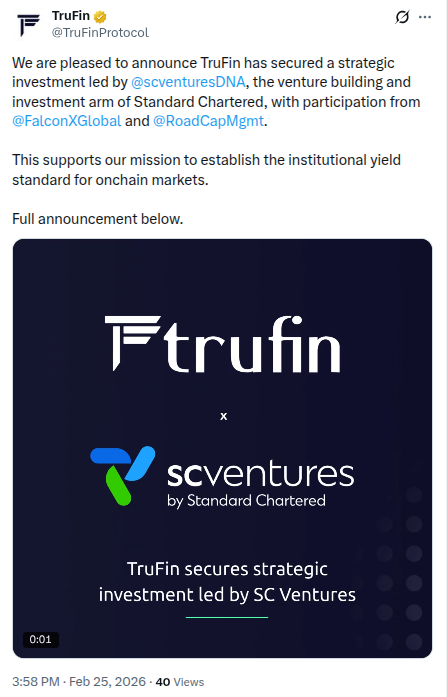
TruFin has raised a new, undisclosed strategic investment led by SC Ventures, the venture arm of Standard Chartered, with FalconX and Road Capital also joining the round. The company says this funding will help it build out products that give institutions a more controlled, “bank‑style” way to earn yield on crypto and tokenised assets.
What TruFin does
TruFin builds technology that lets institutions earn rewards from crypto and tokenised assets while keeping strong controls around custody, compliance, and operations. In simple terms, it sits between traditional finance and DeFi: institutions keep their assets with trusted custodians, but can still access onchain yield strategies such as liquid staking and, increasingly, tokenised real‑world assets (RWAs).
The firm has already launched products like TruStake, a liquid staking solution, and works with partners across custody, staking, and DeFi so that its yield products plug into existing institutional workflows rather than forcing clients to manage wallets and protocols directly.
What this new funding round is
- Type of round: Strategic investment.
- Lead investor: SC Ventures, the venture building and investment arm of Standard Chartered.
- Other investors: FalconX and Road Capital.
- Amount raised: Not disclosed; none of the official or media sources give a number.
SC Ventures has highlighted TruFin on its site as part of its digital‑assets theme, placing the company alongside other ventures that focus on tokenisation and institutional crypto infrastructure.
Why SC Ventures, FalconX, and Road Capital matter
SC Ventures backs and builds companies that sit at the intersection of banking and new technology, including digital‑asset ventures and tokenisation platforms. TruFin fits that theme by trying to make onchain yield look and feel more like a controlled, institutional product rather than an experimental DeFi strategy.
FalconX is a major institutional digital‑asset prime broker that already has a separate strategic partnership with Standard Chartered for banking and FX services, aimed at improving cross‑border settlement for large crypto clients. Having FalconX on the cap table gives TruFin a direct link into an existing network of funds, trading firms, and other big allocators active in digital assets. Road Capital as a participant but do not provide further detail on its role beyond being an investing partner in the round.
How TruFin says it will use the money
TruFin has outlined several priorities for the new capital, framed around making institutional onchain yield more standardized and easier to adopt:
- Expanding beyond liquid staking into other yield products, including tokenised RWA strategies and curated yield portfolios.
- Improving the “plumbing” around permissioned access, approvals, policy controls, and monitoring so that large institutions can fit these products into existing risk and compliance processes.
- Strengthening audit readiness, reporting, and operational resilience.
- Deepening integrations with custodians, exchanges, and digital‑asset management platforms, so institutions can access TruFin products through tools they already use.
Where this sits in the market
This investment comes at a time when banks and large intermediaries are focusing less on pure trading and more on infrastructure: custody, tokenisation, settlement, and yield products that can be explained and audited in familiar terms. Tokenised RWAs, such as onchain Treasury‑style products have become a key theme, with platforms like Libeara (also tied to SC Ventures) working on regulated tokenised funds. Similar momentum can be seen across the sector in updates like YOM Raises $3M Strategic Investment, underscoring how infrastructure-focused crypto firms are attracting strategic backers rather than purely speculative capital.
TruFin’s strategy of combining liquid staking with tokenised RWA yield, wrapped in institutional controls, positions it within this shift toward “safer‑looking” onchain products designed for regulated investors. However, neither the investment nor the partnerships change the basic risks of deploying capital into digital‑asset markets, and nothing in the disclosed materials suggests that the funding itself alters TruFin’s regulatory status.
What to watch next
From here, key things to watch will be:
- Whether TruFin can launch and scale new RWA‑linked yield products that are actually adopted by large institutions.
- How deeply its products get integrated into major custodians, exchanges, and asset‑management platforms.
- Any future disclosures on licensing, regulatory status, or additional funding rounds.
For now, the SC Ventures‑led strategic round confirms that parts of the banking and prime‑broker ecosystem are still putting money into institutional DeFi and tokenisation plays, even if exact deal sizes are being kept private.