

Vitalik Buterin, the co-founder of Ethereum, has shared his perspective on how artificial intelligence could shape the next generation of cryptocurrency wallets, emphasizing both the potential benefits and the critical need for security safeguards.
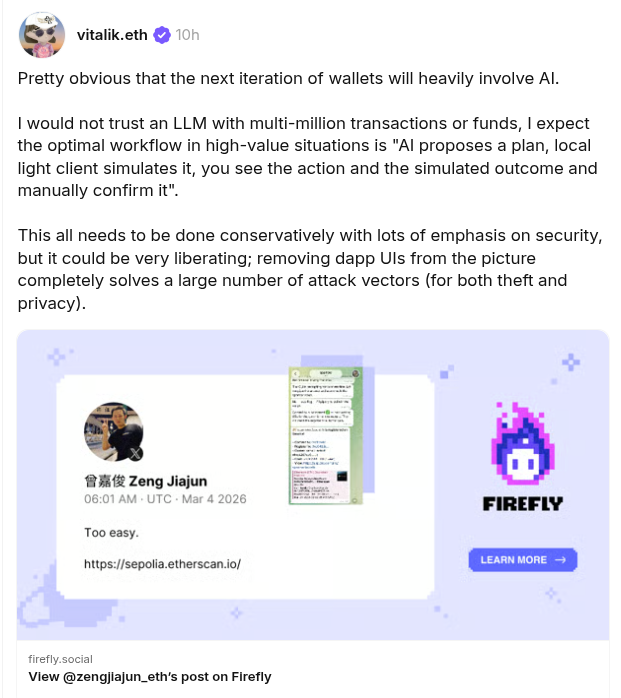
According to Buterin, future wallet designs are likely to integrate artificial intelligence extensively. AI systems could help users interact with blockchain applications more efficiently by proposing transaction plans or suggesting optimal actions based on a user’s intent.
However, he cautioned against granting large language models (LLMs) full control over financial decisions, particularly when dealing with high-value transactions involving millions of dollars.
AI as a Planning Tool, Not a Decision Maker
Buterin outlined what he believes could be a safer workflow for AI-assisted crypto transactions. In this model, the AI would act as an assistant that proposes a transaction plan rather than executing actions autonomously.
The proposed process includes several steps:
- AI proposes a plan: The system interprets the user’s intent and prepares a transaction strategy.
- Local simulation: A local light client simulates the transaction and its potential outcomes.
- User review: The wallet displays the simulated results and all actions that would occur.
- Manual confirmation: The user reviews the information and manually confirms the transaction.
This workflow ensures that users maintain direct control over funds while still benefiting from AI-driven assistance.
Eliminating Risk From dApp Interfaces
Buterin also highlighted a structural security advantage that AI-driven wallets could introduce: reducing reliance on decentralized application (dApp) interfaces. Currently, many blockchain interactions require users to connect wallets to third-party websites. These interfaces can become attack surfaces where phishing, malicious scripts, or privacy leaks occur. By allowing AI to interpret user intentions and interact directly with smart contracts, the need for traditional dApp user interfaces could be significantly reduced. Removing this layer could help mitigate several common security risks associated with web-based crypto interactions.
Security Remains the Priority
Despite the technological promise, Buterin stressed that any AI integration must be implemented conservatively with strong security emphasis. Autonomous decision-making by AI systems remains a sensitive area, especially when managing significant financial assets. Instead, he suggested that AI should function primarily as an advisory layer while users retain final authority over transaction execution.
The concept reflects a broader trend within the blockchain industry, where developers are exploring ways to simplify user experience without compromising security. If implemented successfully, AI-assisted wallets could make blockchain interactions more intuitive while reducing the number of vulnerabilities present in current dApp-based workflows. Meanwhile, the Ethereum Foundation recently unveiled a Strawmap to guide future protocol development discussions.