



Changpeng “CZ” Zhao isn’t apologizing for it. Asked directly about a community token sale tied to his education nonprofit, the Binance co-founder laid out the arrangement in blunt terms: send Giggle Academy a token it didn’t ask for, and the nonprofit reserves the right to sell it. “If you called it a donation, then expect them to use it,” he wrote, adding that anyone who’d expect a donated token to be treated differently, burned rather than sold, should feel embarrassed for assuming so. He said the organization keeps to a rule-of-thumb of converting most of what it receives into BNB near the end of each month, and that he doesn’t personally manage the donation wallet.
Thanks for digging this up👇. Thought it was made clear.
I had no communication with the Giggle Team about the recent selling (of donated tokens), but @GiggleAcademy do have a rule-of-thumb to convert/sell most donated tokens to BNB near the end of each month. I don’t manage… https://t.co/ez9QjhZLjP
— CZ 🔶 BNB (@cz_binance) July 30, 2026
The Accusation: A $78K Question Over a MAME Donation
CZ’s statement was a response, not an announcement. It followed a post from the X account @mamebnb, which said on-chain data appeared to show a wallet linked to Giggle Academy transferring and selling roughly $78,000 of a 2% community donation from Mame Inu (MAME), a meme token on BNB Chain unrelated to Giggle Academy itself. The account asked CZ, Binance, and BNB Chain to clarify the authorization, purpose, and destination of the funds, a request phrased explicitly around transparency, not fraud.
Today, Giggle Academy sold their entire MAME allocation.
For those who don’t know, we previously donated around $162,000 worth of MAME to Giggle Academy because we genuinely believe in supporting education and giving back.
Giggle Academy, backed by @cz_binance , is doing… pic.twitter.com/YPPBqyNDZf
— MAME (@mamebnb) July 29, 2026
Tracing the Wallets: What the Blockchain Actually Shows
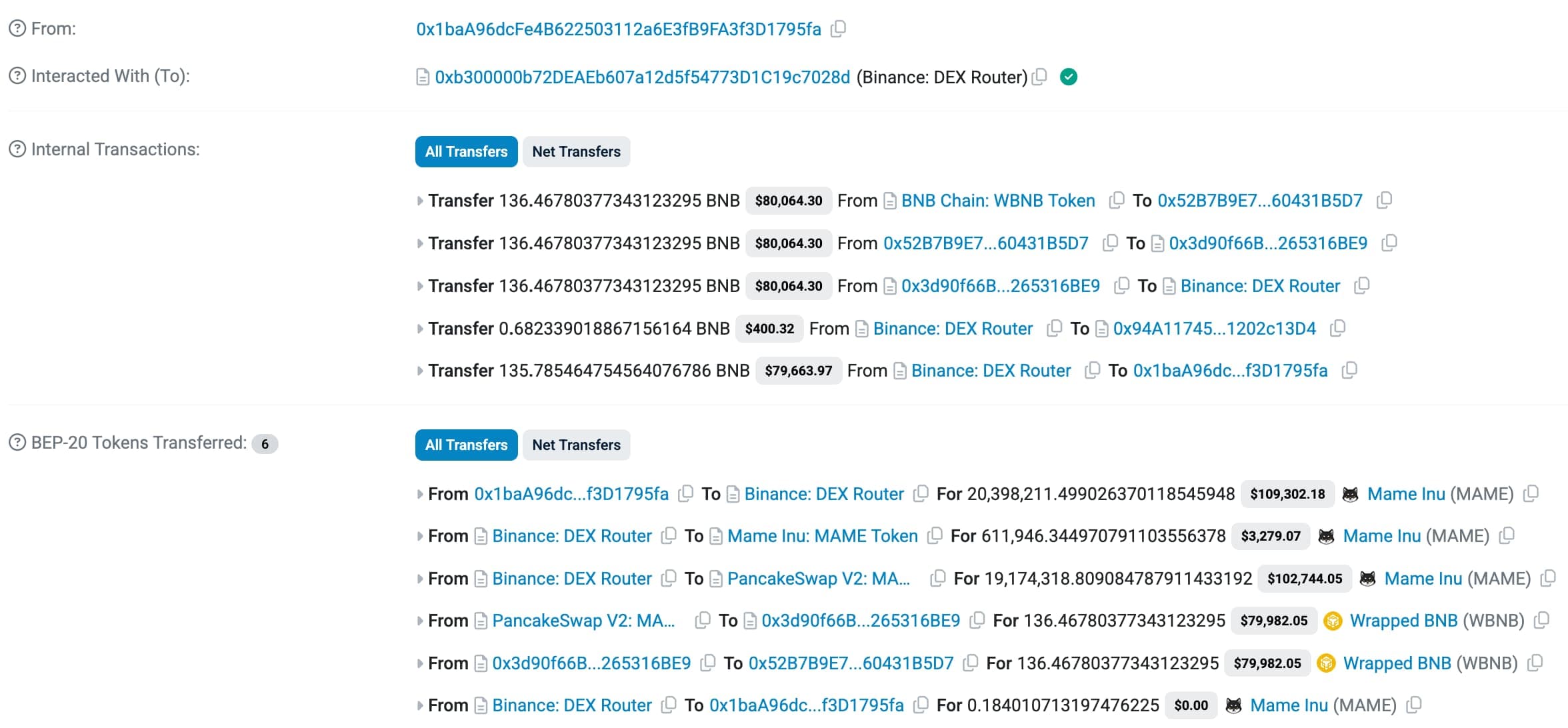
Two separate BscScan transactions back this up.
The first transaction shows a wallet labeled “Mame Inu: Community Reserves” sending 20,000,000 MAME (worth $107,168.39 at the time) to 0xC7f501D25Ea088aeFCa8B4b3ebD936aAe12bF4A4. That receiving address belongs to Giggle Academy’s public donation wallet.
A second wallet, 0x1baA96dcFe4B622503112a6E3fB9FA3f3D1795fa, confirmed as a Giggle Academy-controlled wallet, swapped 20,398,211 MAME through Binance’s on-chain DEX router and a PancakeSwap pool, netting roughly 135.8 BNB (worth $79,663.97). The quantity matches the donation amount, and the proceeds match @mamebnb’s original $78,000 figure, describing the same tokens moving from donation to sale.
“Then Expect Them to Use It”: CZ’s Case for Selling
CZ didn’t dispute that donated tokens get sold. He defended it as the whole point. His argument, in effect: nobody agreed in advance to accept a specific token, so nobody is owed a specific outcome for it. He said he wasn’t personally involved in this particular sale, but stood behind the practice itself, pointing to a reach he put at more than a million children educated in under two years.
Not the First Time: Giggle Academy’s Meme-Coin Money Problem
This isn’t the first time an unaffiliated meme coin’s donations to Giggle Academy have produced this exact argument. A separate token, $GIGGLE, sent large sums to the same donation address in September and November 2025, and Giggle Academy responded then with a public commitment to burn half of what it received and convert the rest to BNB, a more specific policy than the “rule-of-thumb” CZ described this time. Whether that more formal split still applies to non-$GIGGLE donations like MAME’s, or whether the looser monthly conversion habit is the actual current practice, isn’t something either statement resolves.
Disclaimer: Cryip's content is strictly for educational and informational purposes and does not constitute financial, legal, or investment advice. Cryptocurrency involves significant risk, and readers assume full responsibility for their own financial decisions. Asset references are never endorsements.
To make complex crypto topics accessible to readers at all experience levels, our team uses AI tools strictly to refine language, correct grammar, and simplify terminology. AI is never used to draft facts, source information, or form conclusions. Every article is fact-checked and approved by a human editor before publication. Read our full AI Use & Content Policy.