



Strategy’s Q2 call didn’t introduce a new Bitcoin-sales policy, it reported results under a framework the board had already adopted a month earlier, on June 29. The mechanical driver is STRC, not a change of conviction on BTC.
The policy didn’t start on this call, it started June 29
Every recap of the July 30 call published elsewhere treated this as the moment Strategy shifted from pure accumulation to a dynamic BTC/USD split. It wasn’t. On June 29, 2026, Strategy’s board formally adopted the Digital Credit Capital Framework, which authorized a BTC Monetization Program permitting sales of up to $1.25 billion in Bitcoin, alongside a board-approved USD Reserve policy. That’s a documented, dated corporate action, per the company’s own release, a full month before anyone heard Saylor say the words “active capital management” on an earnings call.
What the July 30 call actually did was report a quarter’s worth of results under a policy that already existed: 3,620 BTC sold in-quarter, a USD Reserve that grew through the period, and a restated commitment to keep selling “when advantageous.” Reporting on execution of a standing policy is a different story than reporting on a new one, and it changes how the next quarter’s numbers should be read as continuation, not inflection.
MSTR jumps 4.7% on a quarter that reads worse than it looks
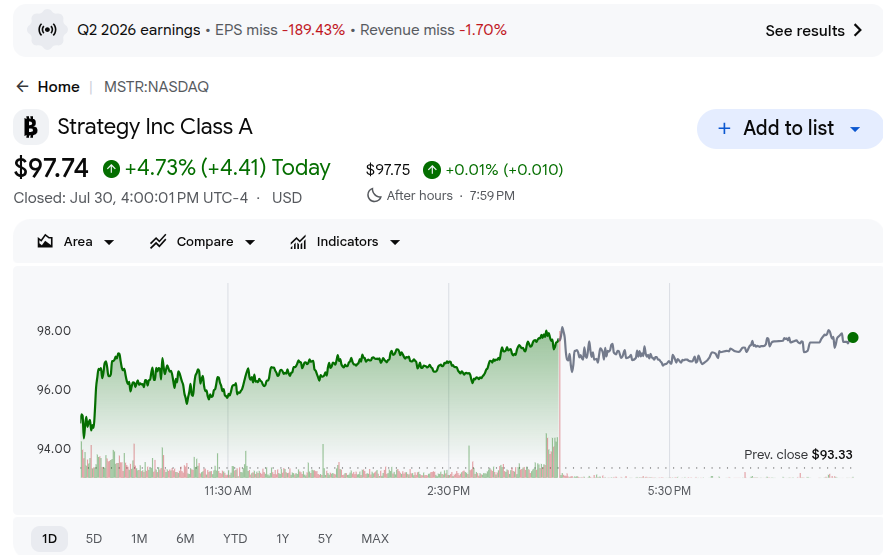
MSTR closed July 30 at $97.74, up 4.73% on the day, according to trading data on Google Finance. The company reported a net loss of $8.22 billion for the second quarter of 2026. That gap likely comes down to how preferred dividends get netted against the common-stock loss line, but it isn’t resolved here against the primary exhibit, so treat the exact figure as provisional. Diluted EPS is reported at -$24.45 against a consensus that different aggregators put anywhere from -$2.19 to -$2.90, a spread wide enough that “beat or miss” is the wrong question; the more useful one is why analyst models keep missing fair-value BTC swings by this margin, quarter after quarter.
None of it is cash. It’s a mark-to-market hit from carrying Bitcoin below the company’s roughly $75,700 average cost basis, per its own May 31 filing, and the market’s 4.7% reaction says investors had already priced much of that in before the call started. What they were actually pricing was the capital-policy language, which, as the rest of this piece lays out, wasn’t actually new.
Timeline: how the policy actually rolled out
| Date | Event |
|---|---|
| December 2022 | MicroStrategy sold 704 BTC for tax-loss harvesting, repurchased two days later, not treated as a policy shift at the time |
| Q1 2026 earnings call | Saylor tells listeners the company would “probably sell some bitcoin” to fund a dividend |
| May 26–31, 2026 | Sold 32 BTC (~$2.5 million) – first net disposal since 2022, disclosed in a June 1 8-K |
| June 29, 2026 | Board adopts the Digital Credit Capital Framework; authorizes BTC Monetization Program up to $1.25 billion |
| Early July 2026 | ~$216 million BTC sale – the largest single sale in company history |
| July 30, 2026 | Q2 earnings call reports 3,620 BTC sold in-quarter, reaffirms the policy |
How Strategy got here: a 2022 tax sale, a $2.5 million test, then a $1.25 billion mandate
The “never sell” framing that made this newsworthy at all wasn’t literally true even before 2026. The company, then MicroStrategy, was previously reported to have sold 704 BTC for tax-loss harvesting in December 2022, repurchasing it two days later, though that trade wasn’t treated as a policy shift at the time. The real crack came earlier this year: on the Q1 2026 call, Saylor told listeners the company would sell some Bitcoin to send a signal to the market.
“We will probably sell some bitcoin to pay a dividend just to inoculate the market and send the message that we did it.” – Michael Saylor, Q1 2026 earnings call
The sale came on schedule: 32 BTC, about $2.5 million, disclosed in a June 1 filing covering the last week of May, the company’s first net disposal since that 2022 tax trade. The June 29 framework followed, authorizing up to $1.25 billion in future sales, and the first real test of that mandate’s size came days later: a roughly $216 million sale in early July, reported as the largest single BTC sale in the company’s history. Read end to end, the July 30 call isn’t the start of anything. It’s the fourth data point in a sequence that had been running since at least Q1.
Why STRC, not Bitcoin conviction, is driving the sales
Strategy’s own language, “discipline” and “active capital management,” describes the company’s framing rather than its actual incentive. The June 29 framework didn’t just authorize BTC sales. It raised the dividend rate on STRC, the company’s Variable Rate Series A Perpetual Stretch Preferred Stock, to 12% annually, and it set a board-mandated USD Reserve sized specifically to cover preferred dividends and interest, not general corporate spending. The first sale under the new regime, back in May, was earmarked to fund a STRC dividend payment directly.
Put together, the sequence reads less like a strategic pivot toward flexibility and more like a fix for a narrower problem: a preferred stock that needed a higher yield and a visible cash backstop to stay investable, at a moment when issuing more of it at the old terms wasn’t working. Selling Bitcoin to protect the preferred stack is a materially different story than selling Bitcoin because the company is rethinking its treasury philosophy, and the two get conflated in most of the coverage running right now.
Bitcoin-per-share rose 5% in the same quarter Strategy sold BTC
Set against that mechanical read, the balance-sheet moves in Q2 are real, not cosmetic.
| Metric | Start of quarter | End of quarter / latest |
|---|---|---|
| USD Reserve | $2.1 billion | $2.4 billion (quarter-end); $3.75 billion as of July 26 |
| Convertible debt | $8.2 billion | $6.7 billion (-18%, via ~$1.5B buyback below par) |
| Bitcoin-per-share | 201,170 sats | 210,824 sats (+5%) |
Bitcoin-per-share, the metric Strategy wants shareholders anchored to instead of net income, rose 5% even in a quarter where the company was a net seller of BTC, which is the point of the metric, since debt reduction and buybacks flow through it too. On the borrowing side, management was explicit that Bitcoin-backed debt isn’t under consideration, citing counterparty and margin risk. Selling the asset outright, rather than pledging it, keeps Strategy’s Bitcoin off any collateral schedule. The company still holds 843,775 BTC, which by its own count makes it the largest institutional holder globally.
What actually resolves this: STRC trading back at par
Strategy announces Q2 2026 results:
– Increased $BTC Holdings by 11%
– Reduced Convertible Debt by 18%
– Increased USD Reserve by 12%
– Increased BPS by 5%https://t.co/2hQp4Rvhji— Michael Saylor (@saylor) July 30, 2026
Michael Saylor’s Q2 results summary is posted on X. The open question isn’t whether Strategy sells more Bitcoin next quarter, under the framework, it already can, up to the authorized $1.25 billion, without another board vote. The open question is whether STRC recovers to something near its par value. If it does, the cheaper preferred-issuance channel reopens, and the mechanical pressure driving these sales eases: active capital management could quietly look a lot more like the old one-way pipeline again. If it doesn’t, expect the USD Reserve to keep growing past its current 12-month-minimum floor, and expect more sales sized like the July one rather than the token-scale May trade.
That’s the actual variable to watch heading into Q3, not whether Saylor says something new on the next call, since on this evidence, the policy tends to run ahead of what gets said on stage.
Disclaimer: Cryip's content is strictly for educational and informational purposes and does not constitute financial, legal, or investment advice. Cryptocurrency involves significant risk, and readers assume full responsibility for their own financial decisions. Asset references are never endorsements.
To make complex crypto topics accessible to readers at all experience levels, our team uses AI tools strictly to refine language, correct grammar, and simplify terminology. AI is never used to draft facts, source information, or form conclusions. Every article is fact-checked and approved by a human editor before publication. Read our full AI Use & Content Policy.