


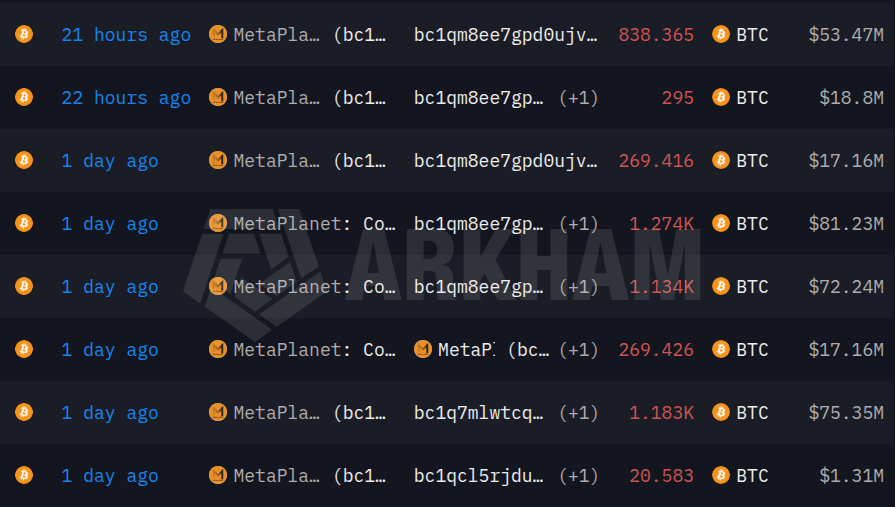
Metaplanet moved 5,014 bitcoin, worth about $322 million, between its own custodial wallets over a 24-hour span. None of it was sold, CEO Simon Gerovich said Thursday, and the company’s holdings remain unchanged at 43,000 BTC.
Metaplanet, the Tokyo-listed firm that built the world’s third-largest corporate bitcoin treasury behind Strategy and Twenty One Capital, is working toward a stated target of 100,000 BTC by the end of 2026 and 210,000 BTC by the end of 2027, a pace it has kept even as bitcoin’s price has fallen through much of the year.
We transferred 5,014 BTC between Metaplanet custodial addresses over the past 24 hours. This was a routine custody operation. No bitcoin was sold, and our holdings remain 43,000 BTC.
All of our addresses are published, which is why the transfers were observable in real time.…
— Simon Gerovich (@gerovich) August 12, 2026
How a $247 million estimate became a $322 million confirmation
Early on-chain tracking Wednesday had caught only part of the movement, putting the total near 3,881 BTC, or about $247 million, across a handful of transactions. That activity was real, but it covered only part of the 24-hour window Gerovich later described. By Thursday, wallet-level data for the same addresses matched his tally: 5,014 BTC, 1,133 more than Wednesday.
Wallet-to-wallet, not wallet-to-exchange
The bitcoin moved between addresses Metaplanet already controlled, not into an exchange account. Transfers of that kind don’t add to the coin’s tradable supply the way a deposit to an exchange would.
Consolidating large cold-storage holdings into new addresses looks identical, on-chain, to preparing coins for sale, until the wallet owner says otherwise. Metaplanet’s wallet addresses are public, and the movement was visible on-chain as it happened. Moving the full $322 million cost about $8 in network fees, Gerovich said.
How the treasury got here
Metaplanet’s bitcoin strategy runs on a funding plan the company published in January 2025, the 21 Million Bitcoin Plan. Under it, Metaplanet raises capital through stock acquisition rights rather than debt, targeting up to 116.6 billion yen while capping dilution at 53.6 percent, with the rights exercisable from February 2025 through February 2027. Metaplanet Q1 loss was driven largely by Bitcoin valuation losses during the quarter.
- The company measures success by BTC Yield, the ratio of bitcoin held to fully diluted shares, rather than by a bitcoin price target.
- Metaplanet has described bitcoin as permanent capital with no planned exit.
That accumulation has moved in large steps. Metaplanet digital credit is also part of the company’s broader digital-asset strategy.
- A single quarter last October added 5,288 BTC..
- The purchase lifted the blended cost at the time to about $107,912 per coin, based on one account of the purchase.
- Gerovich cited a 2025 Bitcoin Yield of 497.1 percent under that framework.
- Metaplanet’s average cost has since fallen to about $96,191 per coin as it kept buying through 2026’s lower prices.
Holdings unchanged, still third in the world
Metaplanet’s total holdings stand at 43,000 BTC. Metaplanet Q2 Bitcoin holdings reached this level as the company continued its accumulation strategy. With bitcoin trading near $63,600 this week, that position is worth about $2.73 billion, against roughly $4.14 billion in cost, a gap consistent with the company’s stated $1.4 billion unrealized loss. Metaplanet’s shares traded modestly higher Thursday, around 223 yen.
The company has also been expanding beyond its core bitcoin holdings. It set up Metaplanet Ventures in March and has said it plans to put $25 million into Japan’s bitcoin and digital-asset infrastructure over the next two to three years, as one account of the plan describes it, part of a broader push around Japan’s bitcoin ecosystem.
Disclaimer: Cryip's content is strictly for educational and informational purposes and does not constitute financial, legal, or investment advice. Cryptocurrency involves significant risk, and readers assume full responsibility for their own financial decisions. Asset references are never endorsements.
To make complex crypto topics accessible to readers at all experience levels, our team uses AI tools strictly to refine language, correct grammar, and simplify terminology. AI is never used to draft facts, source information, or form conclusions. Every article is fact-checked and approved by a human editor before publication. Read our full AI Use & Content Policy.