


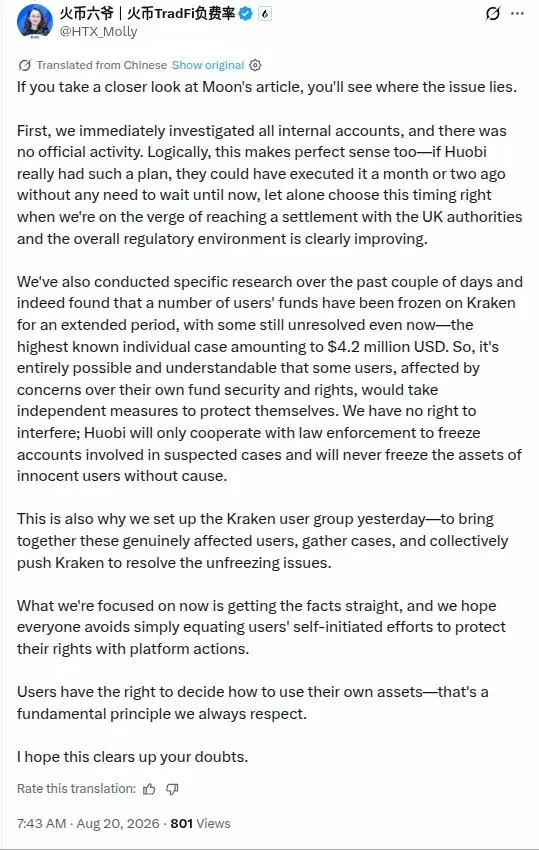
- HTX’s compliance representative says an internal review found no evidence the exchange sent the disputed transfers, and disclosed a $4.2 million case as the largest known frozen balance tied to the dispute at Kraken.
- Kraken’s own sanctions rules require it to block and freeze incoming funds from HTX, a platform on both the UK and EU sanctions lists, and bar releasing them without special permission.
- At least one frozen account traces to a July 20 withdrawal, weeks before the wave of disputed transfers began on August 17, raising doubts that a single attack explains every case.
HTX_Molly, an HTX representative said Thursday that the exchange checked its internal accounts and “there was no official activity” behind small, unsolicited crypto transfers that have left some Kraken users locked out of their funds. She disclosed that the largest known case involves $4.2 million.
The transfers at the center of the dispute are tiny amounts of USDT and other tokens, worth a few dollars or less, sent from a wallet without the recipient’s request. Some users say the deposits triggered automatic compliance freezes at Kraken and other exchanges because the sending wallet is tagged as belonging to HTX, which the UK sanctioned in May and the European Union sanctioned in July over alleged links to Russian financial networks.
Justin Sun, the entrepreneur who backs HTX, said on social media that an investigation showed “the truth: it was all made up.” HTX itself has said it “has not conducted any related transfers or testing activities” and is still reviewing whether outside services mislabeled the wallet.
The Wallet Tagged “HTX 48”
The address at the center of the dispute, 0xa03400E098F4421b34a3a44A1B4e571419517687, is labeled “HTX 48,” “HTX,” “Exchange” and “Deposit Address” on Etherscan, which credits the tag to an outside researcher’s compilation rather than to HTX or Etherscan itself. That distinction matters: a label applied by a third party is not the same as on-chain proof that HTX controls the wallet, which is the gap HTX is pointing to in its denial.
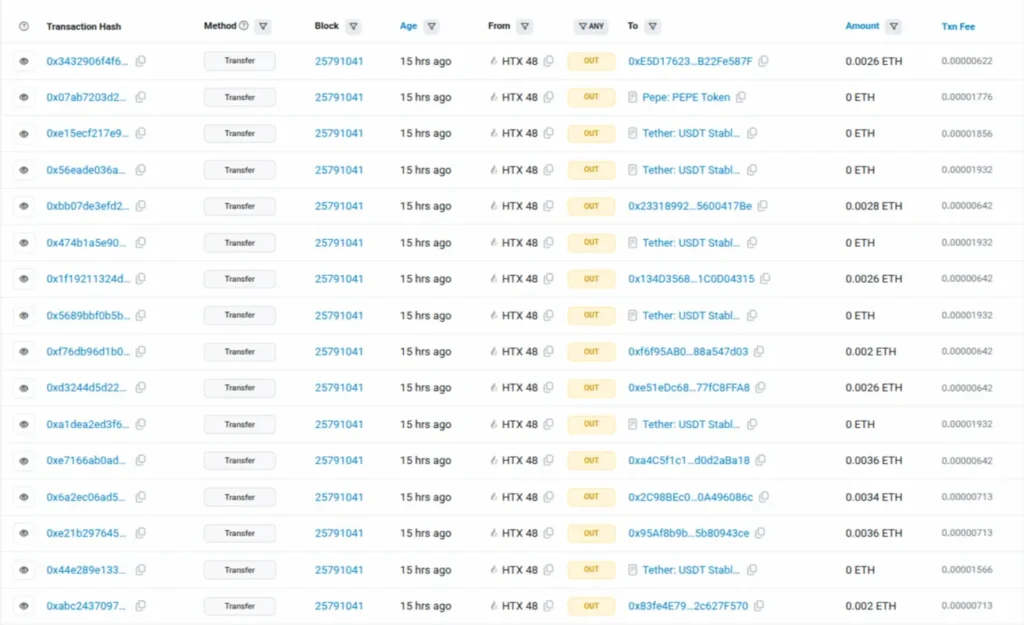
The wallet’s own transaction history shows a pattern consistent with the complaints. Its most recent transfers are dozens of small, near-identical sends, stablecoin and meme-token dust worth fractions of a cent to a few dollars, fanning out to dozens of separate addresses. A tally of the outgoing transfers linked to the case puts the total near 166 small sends, with about 15 landing on Kraken deposit addresses, though that count has not been checked against the wallet’s full transaction record.
What Kraken’s Own Rulebook Requires
Kraken’s own published policy offers a more mundane explanation for at least part of the freeze. The exchange’s EU entity lists “HTX (HUOBI GLOBAL SA)” among crypto platforms it is barred from dealing with under EU sanctions rules that took effect August 23, according to Kraken’s own support page. Under that policy, Kraken must “block and freeze incoming transfers from prohibited platforms” and is “unable to return them to the prohibited platform” or release them to a client’s wallet unless sanctions law allows it.
Kraken made a similar point in May, after the UK’s sanctions took effect. “Following recent UK government sanctions affecting Huobi/HTX, Kraken is required to restrict funds transferred from Huobi to Kraken accounts,” Kraken’s support account posted on X. “Please do not initiate transfers from Huobi to Kraken at this time.”
Read together, the policy suggests that any fund traceable to HTX, whether sent deliberately, by mistake, or by a third party spoofing HTX’s wallet, would get frozen at Kraken regardless of intent. That undercuts the idea that the freezes are proof of a targeted attack; they may simply be Kraken’s compliance system doing what its own rules say it must.
A Freeze That Predates the Wave
Not every frozen case lines up with the timeline of the disputed transfers, either. One account holder’s case, logged in user complaints, involves $24,509.24 frozen after a July 20 withdrawal, roughly four weeks before the dust transfers that HTX and Kraken users have been arguing about began on August 17. If that case is unrelated to the current dispute, it means at least some of the “frozen funds” narrative predates the incident it’s being blamed on.
Kraken has not addressed either the $4.2 million figure or the July 20 case publicly. It has not said how many accounts remain frozen. It has not confirmed or denied that the disputed transfers caused any of them.
Where This Leaves Affected Users
HTX says it has formed a group of affected Kraken users to collect cases and push for the accounts to be unfrozen, and Molly said some users have already had funds released. Whether that resolves the remaining cases, including the $4.2 million one, depends on Kraken, which so far has said nothing in public. Binance and several other exchanges are set to cut off transactions tied to HTX entirely on August 23, when the EU’s sanctions take full effect, a deadline that will test whether disputes like this one become more common or less as more platforms treat any HTX-linked deposit as automatically toxic.
Disclaimer: Cryip's content is strictly for educational and informational purposes and does not constitute financial, legal, or investment advice. Cryptocurrency involves significant risk, and readers assume full responsibility for their own financial decisions. Asset references are never endorsements.
To make complex crypto topics accessible to readers at all experience levels, our team uses AI tools strictly to refine language, correct grammar, and simplify terminology. AI is never used to draft facts, source information, or form conclusions. Every article is fact-checked and approved by a human editor before publication. Read our full AI Use & Content Policy.