


- Laser Digital Japan registered with the Kanto Local Finance Bureau as crypto asset exchange service provider No. 00032 on August 21, 2026.
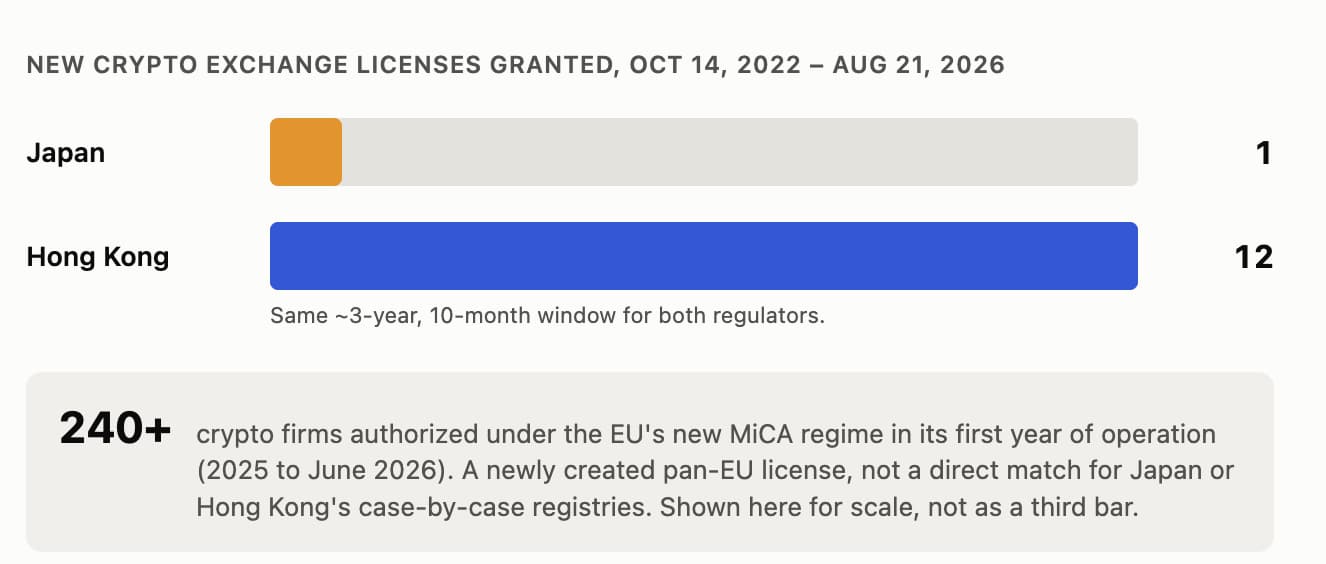
- It is Japan’s first new registration in that category since Binance Japan’s, on October 14, 2022, a gap of three years and ten months.
- The approval comes roughly six months after Nomura disclosed about $65 million in crypto-trading losses tied to Laser Digital and tightened the unit’s risk controls.
Laser Digital Japan, the local arm of Nomura’s digital-asset subsidiary, registered with Japan’s Kanto Local Finance Bureau on August 21 as a crypto asset exchange service provider under the Payment Services Act. It is the first company to win that status in Japan since Binance Japan did in October 2022.
That comeback is real, but it follows a setback of its own. Nomura disclosed roughly $65 million in crypto-trading losses tied to Laser Digital only six months ago and tightened the unit’s risk limits in response, a detail that puts today’s talk of Laser Digital as trusted institutional infrastructure in sharper context.
Most coverage of the approval is calling the regulatory gap since Binance Japan four years. It is closer to three years and ten months, based on Japan’s own registry of every crypto exchange operator approved since 2017, shown below.
The registration itself is narrower than the word “exchange” suggests. Laser Digital Japan said it will start by supplying liquidity to Japan’s existing licensed virtual-asset providers, then later add trading services for institutional investors once launch details are set.
“Completing the rigorous regulatory review process marks an important milestone in our roadmap,” said Hideaki Kudo, the unit’s representative director and head of Laser Digital Japan.
Laser Digital co-founder and chief executive Jez Mohideen said Japan’s digital-asset market is “entering a new phase of maturity” that calls for “trusted counterparties and infrastructure” built for institutional investors.
Six months after a $65 million loss
Nomura’s earnings for the quarter ended December 2025, released in early February, showed group profit down about 9.7 percent, a drop the bank partly attributed to crypto losses at Laser Digital tied to October’s market-wide crash. Nomura put the regional loss at roughly $65 million and said it had tightened position limits at the unit afterward.
Laser Digital Japan’s application predates that disclosure, so the losses did not cause the delay or the approval. But the timing means the same unit being credentialed today as institutional-grade infrastructure is also the one Nomura pulled back from months ago, and the business it is actually launching in Japan, fee-based liquidity provision rather than proprietary trading, reads as a deliberate lower-risk starting point given that history.
Daiwa and SMBC Nikko are circling the same door
The approval lands as Japan loosens crypto rules more broadly. Parliament passed amendments in July reclassifying crypto assets as financial instruments rather than payment instruments, a change that takes effect within a year and is meant to clear the way for crypto ETFs and new tax treatment. Daiwa Securities and SMBC Nikko are also said to be weighing their own entry into crypto exchange licensing, betting on the same regulatory opening.
Laser Digital has been building toward this kind of multi-jurisdiction footprint for a while. It holds a virtual-asset license in Dubai, and in June it won conditional approval from the US Office of the Comptroller of the Currency to charter a national trust bank for digital-asset custody. “We’ve spent three years building across the UAE, Japan and the US,” executive chairman Steve Ashley said of the strategy.
What Laser Digital Japan has not yet said is when its institutional trading service actually opens or how large it plans to run. That, more than the registration itself, is what will show whether Nomura is ready to lean back into crypto risk or is content to collect fees at the edge of it for now.
Disclaimer: Cryip's content is strictly for educational and informational purposes and does not constitute financial, legal, or investment advice. Cryptocurrency involves significant risk, and readers assume full responsibility for their own financial decisions. Asset references are never endorsements.
To make complex crypto topics accessible to readers at all experience levels, our team uses AI tools strictly to refine language, correct grammar, and simplify terminology. AI is never used to draft facts, source information, or form conclusions. Every article is fact-checked and approved by a human editor before publication. Read our full AI Use & Content Policy.