



- Uniswap burned 150,000 UNI, about $590,000, on Aug. 21, its largest confirmed daily burn since the fee switch went live, passing the previous mark of 134,000 UNI set June 5.
- UNI has underperformed Bitcoin by 21.5% in the 30 days after the fee switch was announced and fell to a cycle low even as burns accelerated.
- An on-chain study of Uniswap’s fee switch found no statistically significant drop in liquidity provision in the eight weeks after it activated in December.
Uniswap burned 150,000 UNI, worth about $590,000, on Aug. 21. It is the protocol’s largest confirmed daily burn since the fee switch went live in December, passing the previous record of 134,000 UNI set on June 5.
Record UNI Burn Tests the Fee-Switch Thesis
The burn itself is real. Uniswap’s “UNIfication” upgrade routes a share of protocol trading fees into buying and burning UNI on the open market, and governance approved it with 99% support in December. What the record burn hasn’t done is settle either argument people have made about it. UNI has not rallied on the back of accelerating burns, and liquidity providers have not pulled capital out of Uniswap pools in response to losing a share of their fees. Six weeks of data show a mechanism working as designed while sitting mostly outside the story either side expected it to tell.
UNI Price Performance Tells a Different Story
UNI was changing hands at $4.08, up 3.84% over the prior 24 hours, with the fee switch and the Aug. 21 burn cited as a possible tailwind for sentiment. Research firm Tokenomist found UNI underperformed Bitcoin by 21.5% in the 30 days after the fee switch was announced, and priced the token at 88.8 times price-to-sales and 127 times fully diluted value to revenue, calling the program “real but fragile.”
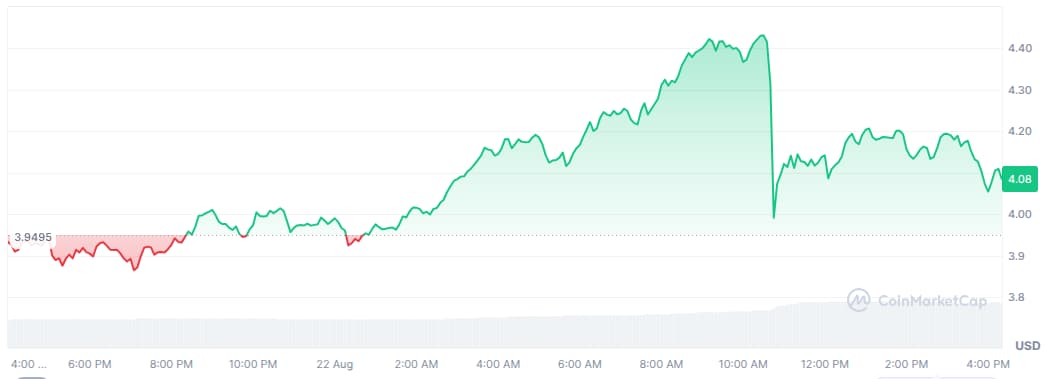
UNI also fell to a cycle low, a roughly 14% decline, in the same period the fee switch expanded and daily protocol revenue rose from about $114,000 in July to roughly $325,000 after the mechanism extended to Uniswap v4 pools.
On-Chain Data Finds No Major Liquidity Exodus
When Uniswap proposed taking a cut of LP fees to fund the burn, the concern was that liquidity providers would simply move capital to pools or exchanges that didn’t skim their returns. A working paper published in July by researcher Wen-Ting Wang tested that directly, comparing hundreds of pools subject to the new fee against a matched control group around the Dec. 28 activation date.
The paper found no statistically significant change in active liquidity, trading depth, or how often liquidity providers entered or exited pools. Wang’s own caveat is that the result is “a non-detection at the design’s resolution rather than a precise zero,” meaning the study can rule out a large exodus but not a smaller, harder-to-see reallocation.
How Uniswap’s UNI Burn Mechanism Works
UNIfication redirects trading fees, starting with Ethereum mainnet v2 and select v3 pools and later extended to Uniswap v4 pools and, as of August, creator fees, into a mechanism that buys UNI on the open market and removes it from circulation. The mechanism operates separately from security incidents such as the Uniswap V4 Router04 exploit, which involved funds being drained through an on-chain attack.
The plan also included a one-time retroactive burn of 100 million UNI from Uniswap’s treasury when it passed, meant to represent what would have been burned had the fee switch existed since UNI’s 2020 launch.
That mechanism runs alongside a separate 2% annual UNI inflation rate that has applied since September 2024, which the protocol needs to outpace before its circulating supply actually starts shrinking.
What Could Prove the Burn Is Working
Two things would undercut this reading. If UNI starts outperforming Bitcoin in a stretch that lines up with rising burn volume, or if on-chain data outside Wang’s eight-week window shows liquidity quietly draining to other venues, including activity linked to Uniswap crypto phishing, the case that burns don’t matter yet gets harder to make.
For now, the record burn changes Uniswap’s supply schedule. It hasn’t changed how the market, or its own liquidity providers, are behaving.
Disclaimer: Cryip's content is strictly for educational and informational purposes and does not constitute financial, legal, or investment advice. Cryptocurrency involves significant risk, and readers assume full responsibility for their own financial decisions. Asset references are never endorsements.
To make complex crypto topics accessible to readers at all experience levels, our team uses AI tools strictly to refine language, correct grammar, and simplify terminology. AI is never used to draft facts, source information, or form conclusions. Every article is fact-checked and approved by a human editor before publication. Read our full AI Use & Content Policy.