




Ask “how much does an Ethereum transaction cost?” and you’ll usually get one number: the current gas price, multiplied by 21,000, the cost of the simplest possible transaction, a plain ETH transfer. That number is real, but it’s a narrow answer. It says nothing about what it actually costs to swap tokens on a DEX, move USDT, or trigger a smart contract, which is what most Ethereum activity actually is. Two transactions can sit in the same block, seconds apart, and cost wildly different amounts. One needed far more computation; the other simply had a sender who chose to pay more.
To find out what people really pay, we didn’t rely on a single gas-price snapshot. We pulled 96 real, independently verifiable transactions straight off Ethereum, spread across nine different blocks over five weeks, and measured exactly what each one cost, in ETH and in the dollar value of ETH on the day it happened.
To be clear on what this is: we analyzed 96 transactions already recorded on Ethereum’s public ledger. We didn’t send any of them ourselves, and nothing here required a wallet, an exchange account, or a payment of any kind. Every transaction below can be looked up by anyone, on any Ethereum block explorer, using the links in this article.
How we did this
We picked nine blocks spread across five weeks (July 24 to August 28, 2026), at different times of day, so the sample wouldn’t be skewed toward one moment of network activity. A quiet Tuesday night and a busy weekday afternoon can have very different fees. From each block, we pulled transactions in the order they were listed, before we knew what any of their fees were, so we couldn’t cherry-pick cheap or expensive ones. One block happened to contain a long run of near-identical automated token transfers from a single bot, so we capped that at three examples so one bot’s activity couldn’t dominate the numbers.
That left a working sample of 96 transactions. Every fee was pulled directly from Ethereum’s transaction data and double-checked with simple arithmetic (gas used × gas price), and every one matched exactly. Historical ETH prices came from Coinbase’s public pricing data, matched to the actual day each transaction happened, never today’s price.
We sorted the transactions into five groups based on hard evidence: the exact function each transaction called, the tokens it moved, and the events it triggered, never just a guess based on which address it was sent to. Full detail on sampling, sourcing, and data checks is in the Methodology & sources section at the end, along with the raw dataset.
The results
| Transaction type | Sample | Median gas | Median fee (ETH) | Median fee (USD) |
| ETH transfer | 7 | 21,000 | 0.0000445 | $0.083 |
| ERC-20 transfer | 9 | 53,966 | 0.0000679 | $0.130 |
| Stablecoin transfer (USDT/USDC) | 19 | 58,409 | 0.0001310 | $0.303 |
| DEX swap | 16 | 189,103 | 0.0002095 | $0.522 |
| Other contract interaction | 45 | 156,787 | 0.0000989 | $0.186 |
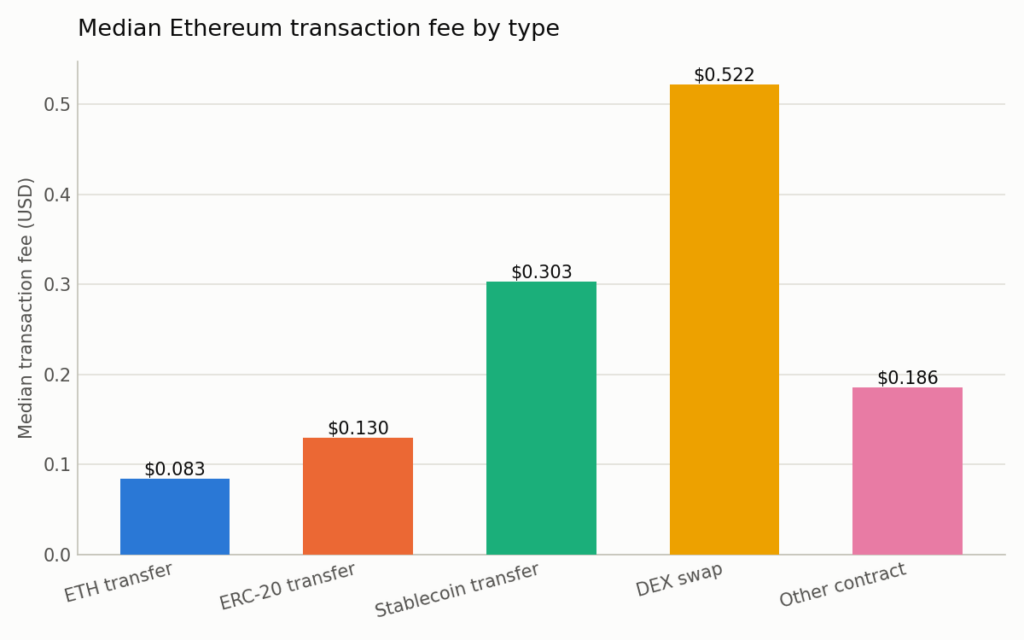
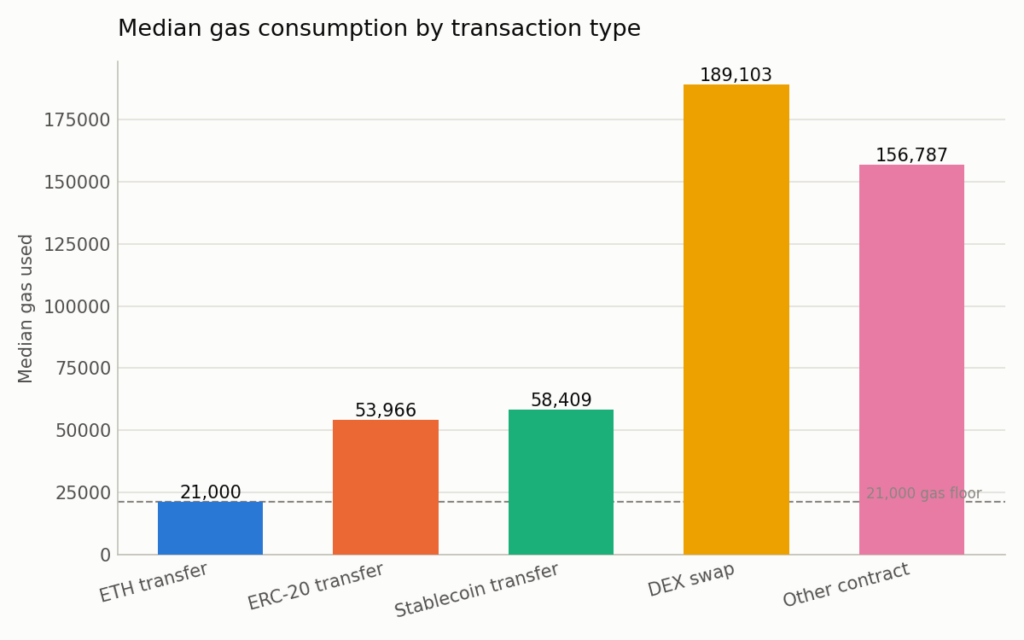
The pattern holds up: the more a transaction actually has to compute, the more it costs, in that order, every time. We use the median (the middle value) rather than the average throughout this piece, because a few very expensive transactions can drag an average up in a way that misrepresents what a typical transaction costs.
How much does a simple ETH transfer cost?
The seven plain ETH transfers in our sample all used exactly 21,000 gas, Ethereum’s fixed price for moving value from one wallet to another with no contract involved. Their fees ranged from $0.079 to $0.201, with a median of $0.083. Since the gas amount never changed, every cent of that difference came down to one thing: how much the sender chose to pay per unit of gas at that moment.
ERC-20 transfers vs ETH transfers
The nine plain token transfers we found (small-cap tokens like AGIX, JasmyCoin, and OrbsToken) used a median of 53,966 gas, about 2.6x a plain ETH transfer. That’s because moving a token means running a smart contract’s transfer function, which updates an internal ledger inside the contract and logs an event, instead of just adjusting a balance at the protocol level. Their median fee was $0.130, about 1.6x an ETH transfer.
Stablecoins specifically (USDT and USDC, 19 transactions in our sample) used a similar amount of gas but cost more overall, $0.303 at the median. That’s not because moving USDT needs more computation than moving any other standard token. It’s mostly because several of the USDT transfers in our sample happened to be sent with noticeably higher tips than average.
Why DEX swaps cost more
Swaps were the most expensive category we found, at a median of $0.522, about 6.3x a plain ETH transfer, with median gas usage of 189,103, roughly 9x a transfer’s fixed cost. That gap makes sense once you look at what a swap actually does: check an approval, pull tokens in, update a liquidity pool’s internal numbers, work out the exchange rate, and push tokens back out, often through more than one pool to find the best price.
One real example makes this concrete. A trader sent $2.35 through Tokenlon, a DEX aggregator, to swap 4,900 UNI for USDT. On-chain, that one transaction moved tokens twice, once in and once out, through a market-maker settlement contract, which is why it cost 28x what a plain ETH transfer cost that same week. Worth noting: two of the 16 swaps in our sample actually failed (reverted) after already spending real gas, a reminder that a failed swap still costs money.
The most expensive transactions we found
The single costliest transaction in our sample cost $13.40, and it’s a good lesson in why “expensive” doesn’t always mean “the network was busy. “That transaction used a completely ordinary 184,470 gas for a single token swap. What made it expensive was the price: its sender set a flat rate of 30 gwei per unit of gas, about 15 times the sample’s typical rate of roughly 2 gwei, while the network’s own baseline price that moment was less than a fifth of a gwei.
Seven of our ten most expensive transactions followed the same pattern: ordinary computation, paired with a price far above what everyone else was paying at that moment. Only one of the ten, a large 1,335,252-gas contract call priced at a modest rate, was expensive mainly because of what it computed, rather than what its sender chose to pay.
The cheapest transactions we found
The ten cheapest transactions cost between $0.0026 and $0.0219, a fraction of a cent to a couple of pennies, two to three orders of magnitude below the sample’s typical fee. Every one of them landed during a quiet stretch on the network and paired that with a minimal or zero tip. The cheapest of all was a small housekeeping call to a contract called PrioUpdateRegistry, costing just $0.0026. Close behind it, at $0.0028 each, were two nearly identical payouts from the same Gnosis Safe multisig wallet, a shared wallet used by teams and DAOs. We’re showing these as real, checkable data points, not as what Ethereum transactions typically cost.
Gas price vs. gas used
This is the distinction that gets lost whenever someone says “gas fees are expensive.” Two different things decide what you pay:
- Gas used: how much computational work a transaction actually requires. Fixed at 21,000 for a transfer, and rising with every extra step a smart contract has to do.
- Gas price: how much you choose to pay per unit of that work. Part of it (the base fee) is set by the network itself and is the same for everyone in a given block; the rest (the priority fee, or tip) is entirely up to you, and buys faster inclusion.
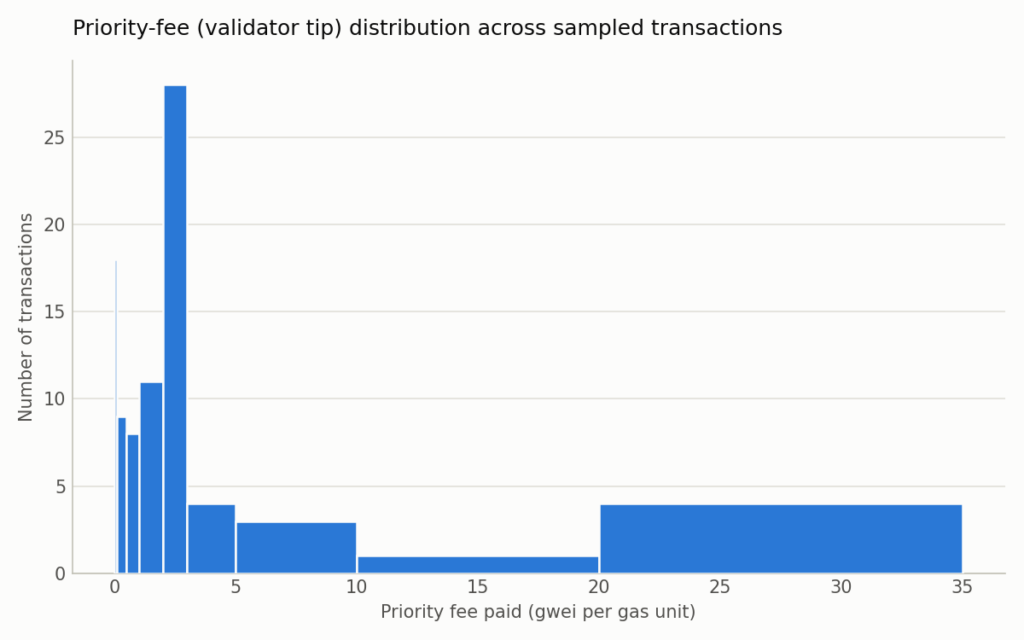
Our data lays out all four combinations side by side. The single highest-gas transaction we found, a big multi-step swap using 1,358,311 gas, cost relatively little, because its sender priced it at a very low rate. The single most expensive transaction we found used an ordinary amount of gas, priced extremely high. Across the whole sample, the price people chose to pay varied by a factor of 710 (from 0.04 gwei to 30 gwei), while the actual computation required varied by a factor of only 65. In this sample, what people were willing to pay moved far more than what their transactions actually needed, and it explains almost every one of the truly expensive outliers.
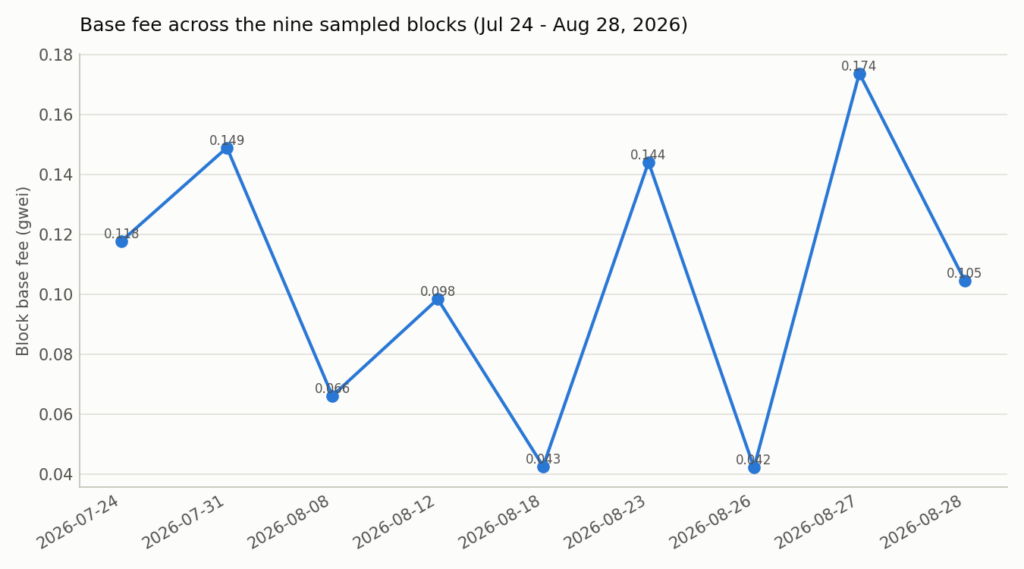
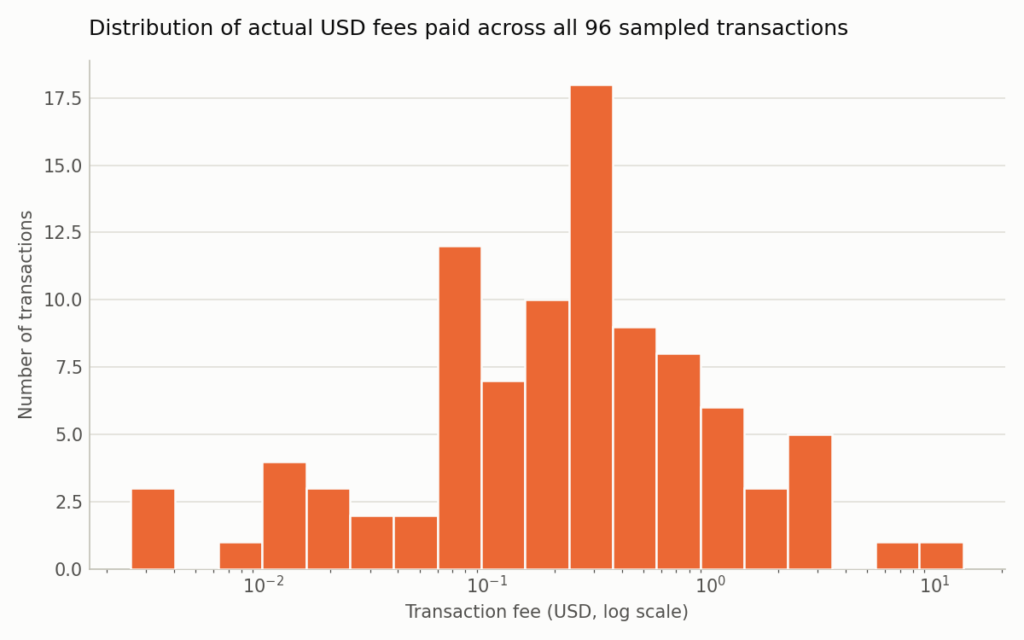
The base-fee line above barely moves. The fee-distribution chart next to it tells the real story: most transactions cluster in a narrow band, but the tail stretches out to the $13.40 outlier discussed earlier, entirely because of pricing choices, not network conditions.
Where your Ethereum fee actually goes
Since Ethereum’s 2021 fee-market upgrade (known as EIP-1559), every standard transaction fee splits into two pieces that go to two very different places:
- The base fee is set automatically by the network, based on how full the last block was. It’s burned: destroyed permanently, paid to no one.
- The priority fee is a tip you choose to add, paid directly to whoever assembled the block you’re in.
We recalculated both halves for every transaction in our sample directly from the raw numbers, and they added up correctly every single time. The result: 93.6% of the fees in our sample went to the priority fee, and only 6.4% was burned. In the five weeks we looked at, the part of the fee that’s supposed to reflect real network congestion was a small slice of what people actually paid. The rest was tipping.
Five transactions, tracked start to finish
We picked five transactions to walk through in full: sender, contract, what was actually called, what tokens moved, what events fired, and what it cost. Each one shows a different reason fees vary.
- A private market-maker swap. This transaction sent 4,900 UNI into Tokenlon, a DEX aggregator that fills trades through registered market makers instead of an open liquidity pool. On-chain, the UNI went in, a market maker’s USDT came in on the other side, and the contract paid out 22,326.67 USDT to the trader, about 49 USDT less than the raw exchange rate, which is the market maker’s spread. Gas used: 308,233. Cost: $2.35.
- A “smart wallet” bundling several actions into one transaction.This transaction called the ERC-4337 EntryPoint contract, the standard contract behind “account abstraction,” which lets a smart-contract wallet bundle several pre-approved actions into a single transaction. Inside this one transaction: a gas-sponsorship withdrawal, a token approval, and a full swap routed through a Uniswap pool. Gas used: 1,099,226, about 52x a plain transfer, because it’s really doing the work of several transactions at once. Despite that huge amount of computation, it was priced cheaply, so it cost only $1.79, less than several far-smaller transactions elsewhere in our sample that were priced more aggressively. This is the clearest case in our data of gas usage and total cost not moving together.
- A next-generation wallet executing a trade directly. This transaction is one of Ethereum’s newest transaction types (EIP-7702), which lets a normal wallet temporarily attach smart-contract code to itself. Here, the wallet used that upgrade to wrap 0.0195 ETH and swap it directly for a token through a Uniswap pool, all from what looks like an ordinary wallet address, with no separate “smart contract” account involved. Gas used: 189,095. Cost: $0.52. We flagged this one as a swap based on the tokens that actually moved on-chain, not the function name, which wasn’t publicly decodable on its own.
- A privacy-pool withdrawal. This transaction is a withdrawal from Tornado Cash, a privacy protocol that uses zero-knowledge proofs to let users withdraw funds without linking them back to the original deposit. Verifying that kind of cryptographic proof on-chain takes real computational work, 409,455 gas, well above an ordinary transfer, even though the gas price paid was unremarkable. Cost: $0.81, almost entirely because of the computation involved, not the price paid for it.
- The most expensive transaction in our entire sample. This transaction swapped a small token for ETH through a trading-bot contract, using a perfectly normal amount of gas (184,470). What made it the priciest transaction we found wasn’t the swap itself. It was the flat 30-gwei price the sender set, about 15 times the sample’s typical rate. Cost: $13.40, almost all of it a voluntary premium.
What our data shows
Across the 96 transactions we analyzed: DEX swaps cost roughly 6.3x more than plain ETH transfers at the median, and that gap is almost entirely explained by how much computation a swap requires, not by a higher price per unit of gas. Any kind of contract interaction cost about 3.3x more than a plain transfer at the median. The large majority of every fee, 93.6%, went to validators as a voluntary tip rather than being burned by the network. How full the network was barely moved the typical fee in our sample, but individual pricing choices moved the extremes by more than 5x. And the single biggest factor separating an expensive transaction from a cheap one, in this data, was the price its sender chose to pay per unit of gas, not what the transaction actually did.
One more honest note: no NFT transactions turned up anywhere in our sample, despite pulling from nine blocks across five weeks. We’re reporting that as what we found, not filling in a category that isn’t backed by real data.
Limitations
This is a 96-transaction sample: enough to compare categories meaningfully, not enough to make precise claims about every Ethereum transaction ever sent. We pulled transactions from the start of each sampled block’s list rather than a strict random draw across the whole block, which can skew slightly toward higher-tip transactions, since block builders tend to prioritize by tip. We used one ETH/USD price per day rather than a live, second-by-second price. And we weren’t able to cross-check every transaction against a second, separately run block explorer, since most require a registered account to query automatically. Every hash here is still independently checkable by anyone, on any explorer, at any time.
Conclusion
So, how much does an Ethereum transaction really cost? Among the transactions we looked at, a plain ETH transfer cost about eight cents, a stablecoin transfer about thirty cents, and a DEX swap about fifty-two cents, typically, with a handful of transactions costing more than ten dollars, not because the network was congested, but because their senders chose to pay a steep premium for speed. There isn’t one honest answer in a single gas-price number. There are two separate questions: how much computation did this actually need, and how much did the sender choose to pay for speed? In our data, the second question mattered more at the extremes than the first.
Disclaimer: Cryip's content is strictly for educational and informational purposes and does not constitute financial, legal, or investment advice. Cryptocurrency involves significant risk, and readers assume full responsibility for their own financial decisions. Asset references are never endorsements.
To make complex crypto topics accessible to readers at all experience levels, our team uses AI tools strictly to refine language, correct grammar, and simplify terminology. AI is never used to draft facts, source information, or form conclusions. Every article is fact-checked and approved by a human editor before publication. Read our full AI Use & Content Policy.