


Bitcoin traded above $71,000 on Wednesday, registering a gain of more than 6% over a 24-hour period. The move positioned Bitcoin as the leading performer among major digital assets during the session.
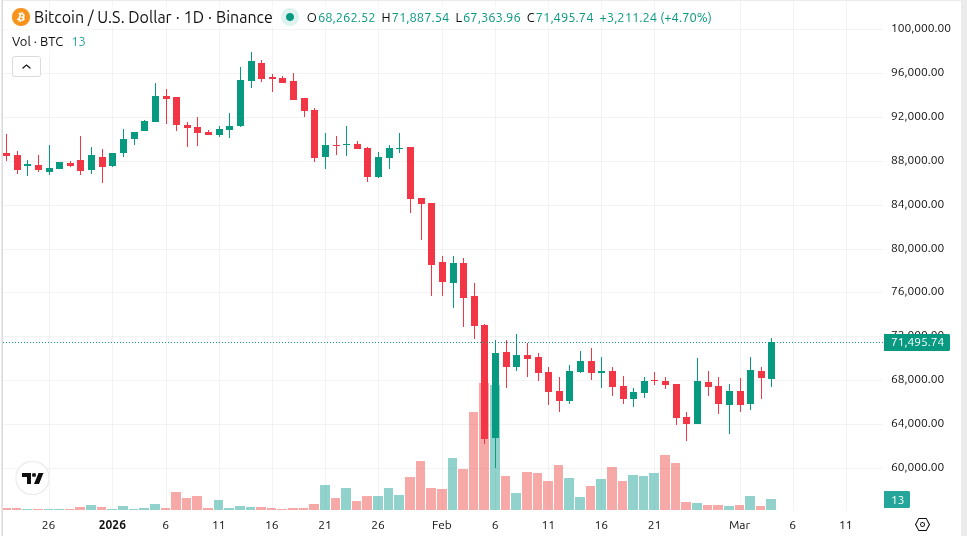
The price reached $71,495 (10:29 UTC) during European trading hours before continuing higher. At the time referenced in the data, Bitcoin (BTC) was trading at $71,803.81, marking a multi-week high.
24-Hour Market Performance
Bitcoin’s 24-hour increase exceeded 6%, leading broader advances across the cryptocurrency market. Other major digital assets recorded gains within a similar timeframe:
- Ether (ETH): up between 4% and 6%
- XRP (XRP): up between 4% and 6%
- Solana (SOL): up between 4% and 6%
The synchronized gains across large-capitalization cryptocurrencies indicate broad-based upward price movement within the digital asset market during the 24-hour window.
Price Support and Volatility Range
Since the escalation of geopolitical tensions involving Israel, the United States (recently moves BTC), and Iran, Bitcoin’s downside has been capped around $65,000. According to the data, the $65,000 level has acted as a support zone since the conflict began.
The current rally represents a move from that support range to levels above $71,000. The data highlights a recovery and extension toward multi-week highs within several trading sessions following the initial geopolitical shock.
Geopolitical Context and Energy Disruptions
The price movement occurred during heightened geopolitical tensions in the Middle East. The conflict intensified after Iran blocked oil supplies through the Strait of Hormuz. The disruption raised concerns about global energy costs and potential inflationary pressures.
The Strait of Hormuz is a critical transit route for global oil shipments. Disruptions in this corridor can influence commodity pricing and broader financial markets.
Despite these developments, Bitcoin maintained price stability above the $65,000 threshold and subsequently advanced to multi-week highs.
Comparison With Gold and Equity Markets
Gold, traditionally regarded as a safe-haven asset during periods of geopolitical stress, followed a different trajectory during the same timeframe. The metal peaked above $5,400 per ounce on Monday before declining to $5,160.
This pullback occurred as Bitcoin moved higher. The divergence highlights contrasting short-term price movements between the two assets during the period covered by the data.
Equity markets in Asia recorded declines. South Korea’s Kospi index led regional losses, with energy import cost increases cited as a contributing factor. Rising oil prices can affect economies that rely heavily on energy imports, contributing to equity market weakness.
Market Breadth and Index Performance
Major cryptocurrencies such as Ether, XRP, and Solana posted gains within a 4% to 6% range over the same 24-hour period. This indicates that upward momentum extended across multiple large-capitalization tokens rather than being confined to a single asset.
Observable Market Metrics
Based on the data figures:
- Bitcoin price exceeded $71,000 during European hours.
- 24-hour gain surpassed 6%.
- Support level observed around $65,000 since conflict escalation.
- Gold declined from above $5,400 per ounce to $5,160.
- Major altcoins recorded gains between 4% and 6%.
These metrics collectively reflect short-term strength in digital asset markets during a period of geopolitical tension and commodity price volatility.
Price Action
Bitcoin’s advance above $71,000 marks a continuation of upward price momentum following stabilization around $65,000. The move coincided with:
- Escalating Middle East tensions
- Oil supply disruptions through the Strait of Hormuz
- Gold retreating from recent highs
- Declines in Asian equity markets
All reported figures are based on the market data and reflect observed price levels and percentage changes during the referenced trading period.
Disclaimer: Cryip's content is strictly for educational and informational purposes and does not constitute financial, legal, or investment advice. Cryptocurrency involves significant risk, and readers assume full responsibility for their own financial decisions. Asset references are never endorsements.
To make complex crypto topics accessible to readers at all experience levels, our team uses AI tools strictly to refine language, correct grammar, and simplify terminology. AI is never used to draft facts, source information, or form conclusions. Every article is fact-checked and approved by a human editor before publication. Read our full AI Use & Content Policy.