




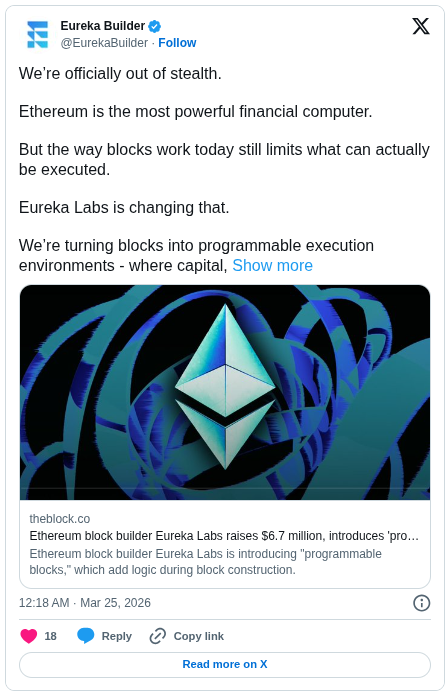
Eureka Labs, an Ethereum block builder, raised $6.7 million in a seed funding round. Spark Capital and Collider Ventures co-led the round. The amount raised totaled $6.7 million, structured as a SAFE with token warrants.
Eureka Labs develops programmable blocks for Ethereum. These blocks function as active execution environments that incorporate capital, computation, and execution logic during block construction.
Funding Overview
Eureka Labs completed the seed round in two tranches. The first tranche raised $4.7 million in April 2025. Spark Capital provided an additional $2 million in June 2025. Eureka Labs disclosed the round upon emerging from stealth mode. The startup declined to reveal its valuation.
- Round type: Seed, structured as SAFE with token warrants.
- Total amount: $6.7 million.
In parallel with broader market activity, Enlivex Secures $21M, reflecting continued capital inflows across biotech and Web3-linked treasury strategies. Avishay Ovadia, founding partner at Collider Ventures, joined Eureka Labs’ board as part of the investment.
About the Company
Eureka Labs founded in December 2024 and is based in Tel Aviv, Israel. The company employs a team of 12 people. Eureka Labs recently opened a research and development site in Poland.
Eureka Labs ranks as the fourth-largest Ethereum block builder by number of blocks built, per Rated Network data. Its market share stands at around 1.5%. Titan Builder, BuilderNet, and Quasar Builder hold nearly 96% of the market.
Eureka Labs operates within Ethereum’s Proposer-Builder Separation (PBS) architecture. In this system, specialized builders like Eureka Labs handle block construction instead of validators. The company generates revenue by collecting fees from transactions included in its blocks.
Eureka Labs introduces “programmable blocks.” These shift Ethereum blocks from passive transaction containers to active execution environments. Block builders add logic during construction.
Key features include:
- Intra-block credit: Users access temporary loans within a single block without collateral, repaid before finalization.
- State-aware pre-computation: Complex calculations run at construction time using the block’s exact state, reducing gas costs and improving reliability.
- Execution-time external data access: Transactions incorporate real-time off-chain data during construction.
- Deterministic transaction placement: Specific transactions execute in guaranteed order within the block.
Nir Magenheim, co-founder and CEO of Eureka Labs, stated that these features enable developers to rely on block-level guarantees beyond smart contracts. Applications include advanced trading strategies, efficient DeFi, and complex onchain computations.
Investors
Spark Capital and Collider Ventures co-led the seed round in Eureka Labs. Additional venture firms participated as follows:
- Varrock Ventures
- Node Capital
- Reverie
- Very Early Ventures
- Atka Capital
- Synergis Capital
- Masterkey
Angel investors included CoinList president Scott Keto, who invested in Eureka Labs.
Market Context
Ethereum blocks currently package and order transactions. Eureka Labs’ programmable blocks add construction-time logic, such as temporary capital provision, computations, and transaction ordering control.
Magenheim described block builders as potentially evolving into a new execution layer for Ethereum. This mirrors how smart contracts expanded Ethereum’s capabilities. Eureka Labs positions its technology as an early step in making blocks programmable. Rated Network data confirms the competitive landscape. The top three builders dominate, leaving limited share for others like Eureka Labs.
Disclaimer: Cryip's content is strictly for educational and informational purposes and does not constitute financial, legal, or investment advice. Cryptocurrency involves significant risk, and readers assume full responsibility for their own financial decisions. Asset references are never endorsements.
To make complex crypto topics accessible to readers at all experience levels, our team uses AI tools strictly to refine language, correct grammar, and simplify terminology. AI is never used to draft facts, source information, or form conclusions. Every article is fact-checked and approved by a human editor before publication. Read our full AI Use & Content Policy.