




The closure of Over Protocol underscores a broader shift underway in the cryptocurrency sector, where tightening liquidity and waning investor appetite are accelerating the failure rate of smaller projects.
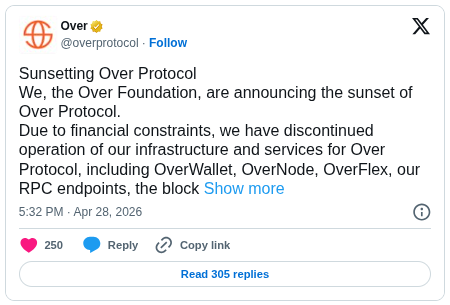
In a statement released on April 28, the team behind Over Protocol confirmed it would sunset operations, citing financial constraints and an inability to sustain core infrastructure. Services including its wallet, node operations, APIs, and block explorer have all been discontinued, effectively halting activity on the network.
The shutdown reflects mounting pressure across the industry, particularly among mid-tier and emerging blockchain platforms that lack strong user bases or consistent revenue streams.
A vision that struggled to scale
Over Protocol was positioned as a user-friendly Layer 1 blockchain, aiming to lower participation barriers by allowing individuals to run nodes on standard personal computers. This approach was designed to broaden decentralization by reducing reliance on specialized hardware.
Layer 1 networks form the base layer of blockchain ecosystems, responsible for validating transactions and maintaining network security independently. Established examples such as Bitcoin and Ethereum have demonstrated the importance of network effects, something newer entrants like Over Protocol have struggled to replicate, even as SimpleChain Closes $15M L1 highlights continued funding for emerging networks.
Despite building an ecosystem that included OverWallet and OverNode, OverFlex, the project failed to attract sufficient adoption. Without a critical mass of developers, users, or liquidity, even technically differentiated platforms face steep challenges in competing with dominant chains.
Warning signs preceded the shutdown
The project’s closure did not come abruptly. Delays in key milestones, including its token generation event and airdrop, had already raised concerns about execution and coordination.
At the same time, its native token experienced a dramatic collapse, losing more than 98% of its peak value. Such declines are often indicative of weak market demand and limited trading activity, both of which can erode a project’s ability to fund ongoing operations.
As capital inflows slowed across the broader crypto market, maintaining infrastructure became increasingly difficult. Although the network was designed to be decentralized, the reliance on foundation-led support meant that operational continuity was still tied to funding availability.
The team acknowledged this reality, noting that while the protocol existed in theory, it was unlikely to remain functional in practice without active support.
Industry-wide shakeout intensifies
Over Protocol is not an isolated case. Since the beginning of 2026, more than 20 crypto projects, including wallets, exchanges, NFT platforms, and decentralized finance tools, have ceased operations.
This trend marks a departure from earlier market cycles, when abundant capital allowed projects to survive despite limited traction. In the current environment, investors are placing greater emphasis on fundamentals such as revenue generation, product-market fit, and user retention.
The result is a consolidation of activity into a smaller number of dominant platforms, leaving less room for experimental or underfunded ventures.
From hype to sustainability
Narratives alone, such as promises of decentralization or technical innovation, are no longer sufficient to attract sustained investment, even as quantum-safe blockchain efforts continue to emerge across the sector.
Instead, projects are increasingly judged on measurable outcomes such as active users, developer ecosystems, and real economic activity. This transition suggests the industry is moving toward a more mature phase, where survival depends on execution rather than speculation.
While this shakeout may reduce short-term diversity, it could strengthen the sector over time by filtering out unsustainable models and redirecting resources toward viable platforms.
Disclaimer: Cryip's content is strictly for educational and informational purposes and does not constitute financial, legal, or investment advice. Cryptocurrency involves significant risk, and readers assume full responsibility for their own financial decisions. Asset references are never endorsements.
To make complex crypto topics accessible to readers at all experience levels, our team uses AI tools strictly to refine language, correct grammar, and simplify terminology. AI is never used to draft facts, source information, or form conclusions. Every article is fact-checked and approved by a human editor before publication. Read our full AI Use & Content Policy.