



- Quantum-resistant signatures to be introduced at mainnet launch
- Future-proof wallets designed to withstand quantum attacks
- Institutional focus with privacy and secure financial data protection
- USDC used as gas token during testnet phase
- Sub-second finality reduces potential attack window
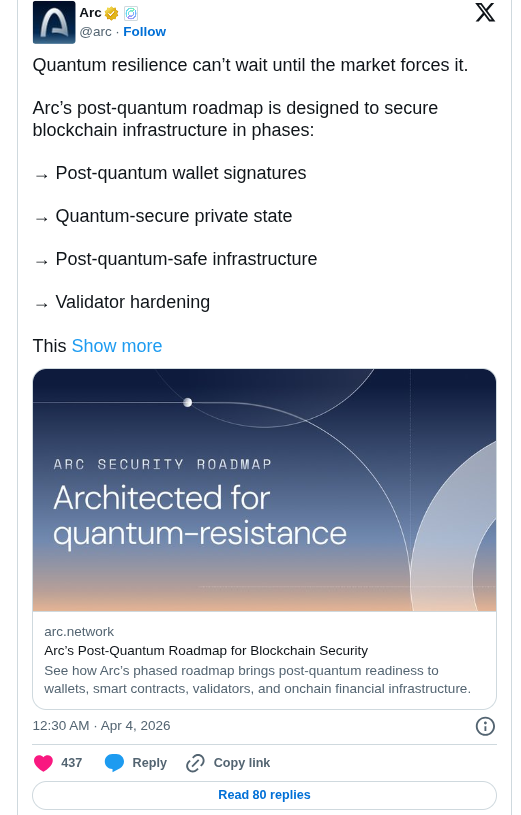
Circle’s Layer-1 blockchain Arc is being developed with quantum-resistant features built directly into its foundation. At mainnet, Arc will introduce a post-quantum signature scheme, allowing users to create wallets designed to remain secure against future quantum computing threats.
This approach differs from legacy blockchains, which may implement such protections later as upgrades. Arc enables users to select a signing method that is designed to remain secure even as computational capabilities evolve. Blockchain wallets rely on digital signatures to verify ownership and authorize transactions. While current systems are considered secure against today’s computing power, Arc’s design addresses the possibility that future quantum systems could compromise existing cryptographic methods.
Institutional Focus and Privacy Protection: Arc is positioned for stablecoin finance and institutional use. The network began its testnet phase in October, using USDC as the native currency for gas fees. The roadmap includes protections beyond wallet security. Near-term plans focus on safeguarding private balances, confidential payments, and recipient data using quantum-resistant cryptography. Mid-term development will address potential vulnerabilities across infrastructure layers, including cloud servers used by validators, hardware security modules storing keys, and encrypted communication between nodes.
Validator Security and Network Performance
In the long term, Arc will focus on strengthening the validator layer. Validators, operated by trusted institutions, are responsible for confirming transactions and maintaining the blockchain.
The network currently finalizes blocks in under a second, limiting the time available for potential attacks. While this reduces risk, Arc’s roadmap includes further validator signature hardening after performance testing and tooling support are complete. The development comes amid increasing discussion around quantum risks to existing blockchain systems, prompting ongoing efforts across the industry to explore protective solutions.
Disclaimer: Cryip's content is strictly for educational and informational purposes and does not constitute financial, legal, or investment advice. Cryptocurrency involves significant risk, and readers assume full responsibility for their own financial decisions. Asset references are never endorsements.
To make complex crypto topics accessible to readers at all experience levels, our team uses AI tools strictly to refine language, correct grammar, and simplify terminology. AI is never used to draft facts, source information, or form conclusions. Every article is fact-checked and approved by a human editor before publication. Read our full AI Use & Content Policy.