



Q1 2026 web traffic data for centralized cryptocurrency exchanges (CEXs) reveals a highly stratified yet globally interconnected market structure, where a small group of exchanges command the majority of user attention while a long tail of platforms compete through regional specialization. Binance maintains its position as the dominant global exchange by a significant margin, while MEXC, OKX, and Coinbase form a strong second tier with distinct geographic strategies. This broader trend was already visible in crypto exchange traffic January 2026, which highlighted early signs of global diversification and emerging market expansion. At the same time, exchanges such as Upbit, Bithumb, CoinDCX, and Bitvavo demonstrate extreme country-level concentration, highlighting the continued importance of local regulatory environments, fiat access, and cultural trust in shaping user behavior.
The quarter also reinforces a broader structural trend: globally diversified exchanges are becoming more resilient, while regionally concentrated platforms face increasing exposure to regulatory shifts and localized demand cycles. This dynamic reflects the ongoing maturation of the crypto exchange ecosystem, where growth is no longer uniform but instead driven by targeted regional expansion and differentiated product offerings.
Top exchanges by quarterly web traffic
The Q1 2026 leaderboard reflects cumulative traffic across 23 centralized exchanges, providing a clearer picture of sustained user engagement beyond short-term fluctuations.
Top 10 by Q1 2026 visits
- Binance recorded approximately 133.5M visits, maintaining a commanding lead with a globally diversified user base spanning South Korea (7.46%), India (6.96%), Turkey (6.06%), Brazil (5.97%), and Ukraine (4.95%), with no single market dominating its traffic profile.
- MEXC followed with around 89.97M visits, establishing itself as a major challenger, driven primarily by Algeria (47.27%) and Morocco (6.71%), alongside additional contributions from South Korea, India, and Japan.
- Coinbase generated roughly 78.78M visits, heavily concentrated in the United States (68.87%), with smaller shares from the United Kingdom (5.06%), Germany (2.41%), Canada (2.33%), and France (2.16%), reinforcing its position as the leading regulated US exchange.
- OKX recorded about 71.13M visits, demonstrating strong global diversification with traffic from the United States (11.15%), Brazil (8.87%), Japan (8.60%), Vietnam (5.39%), and Turkey (4.92%).
- KuCoin logged approximately 53.24M visits, supported by a geographically distributed audience across the United States (9.55%), India (7.84%), Vietnam (6.06%), Singapore (4.60%), and Azerbaijan (3.39%).
- Bitget attracted around 51.73M visits, with notable contributions from the United States (8.58%), India (7.23%), South Korea (5.01%), Germany (3.54%), and Russia (3.49%).
- Gate generated roughly 46.16M visits, with traffic spread across the United States (10.73%), South Korea (5.02%), Russia (4.45%), Singapore (3.61%), and China (3.37%).
- Bybit recorded about 40.86M visits, showing significant dependence on Russia (32.61%), followed by South Korea (9.46%), Ukraine (6.77%), Japan (3.34%), and Turkey (3.00%).
- BitMart reached approximately 38.12M visits, with a mix of users from the United States (16.16%), China (5.72%), the Philippines (4.64%), Taiwan (4.11%), and Turkey (3.74%).
- LBank followed closely with 37.96M visits, drawing traffic from Azerbaijan (7.52%), the Philippines (7.47%), China (4.47%), Singapore (4.36%), and the United States (3.97%).
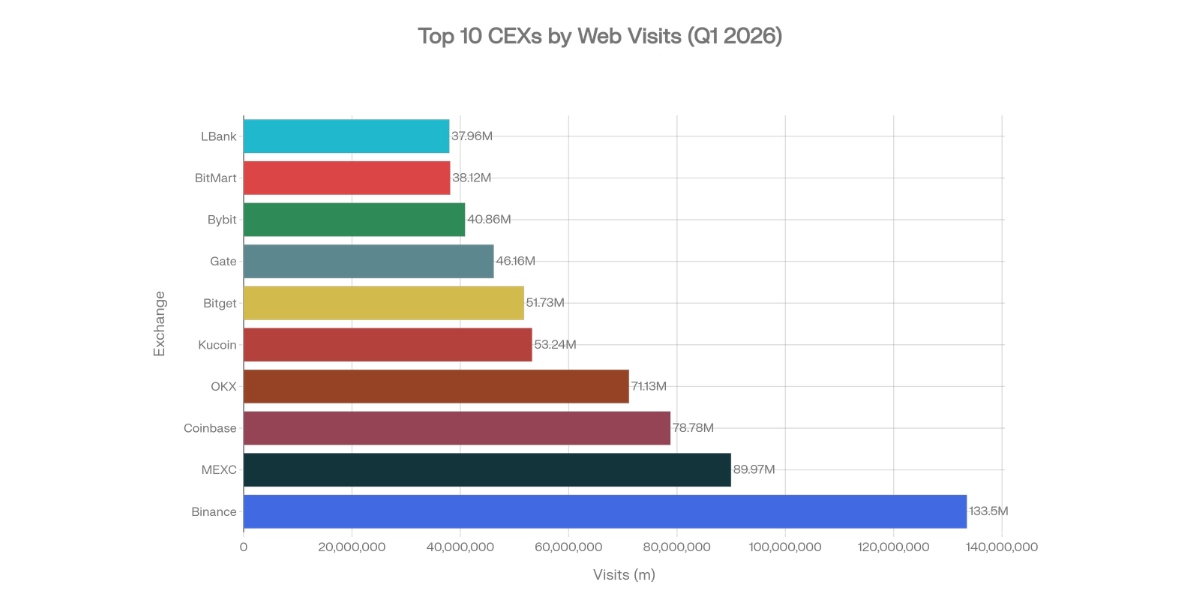
Binance’s sustained lead reflects both scale and diversification, while MEXC’s rise underscores the growing influence of emerging markets. Coinbase and OKX illustrate contrasting models, with Coinbase relying heavily on regulated Western markets and OKX pursuing broader global penetration.
Momentum across mid-tier and emerging exchanges
During the quarter, shifts observed in CEX Web Traffic in February 2026 indicated growing engagement across mid-tier platforms, particularly in emerging regions.
Beyond the top tier, several exchanges demonstrate meaningful scale and strategic positioning.
- BingX recorded 34.47M visits, with strong representation from Brazil (9.17%), Argentina (9.06%), Ukraine (8.68%), Vietnam (8.01%), and Australia (6.76%), highlighting a balanced emerging-market footprint.
- Phemex reached 31.51M visits, heavily influenced by Russia (20.28%), South Korea (9.38%), Germany (6.18%), the United Kingdom (5.59%), and Turkey (5.27%).
- Kraken generated 21.98M visits, with a strong Western user base led by the United States (35.30%), followed by the UK, Canada, France, and Germany.
- Upbit recorded 22.37M visits, with an overwhelming 97.98% of traffic from South Korea, emphasizing its role as a domestic leader.
- Bithumb showed similar patterns with 16.27M visits, including 98.33% Korean traffic, confirming extreme localization.
- Crypto.com (12.65M), Gemini (8.16M), and HTX (7.62M) maintain moderate traffic levels with varying degrees of regional concentration.
- CoinDCX recorded 4.76M visits, with 78.21% from India, while Bitstamp (2.03M), Bitfinex (1.85M), and Bullish (273K) represent smaller but globally distributed or niche platforms.
Regional patterns and country-level concentration
Q1 2026 reveals four dominant structural archetypes that define exchange traffic distribution. Late-quarter dynamics, consistent with CEX Web Traffic in March 2026, further emphasized the gap between globally diversified platforms and regionally concentrated exchanges.
Korea-centric exchanges
Upbit and Bithumb remain the clearest examples of hyper-localized platforms, with nearly all traffic originating from South Korea. Their dominance reflects strong regulatory alignment and brand trust within a single market, but also indicates limited global expansion.
US-anchored, regulated venues
Coinbase, Kraken, Gemini, and Crypto.com demonstrate strong reliance on the United States and Western markets. Coinbase leads this category, with nearly 70% of its traffic from the US, while Kraken and Gemini show slightly more diversification across Europe. These platforms benefit from regulatory clarity and institutional trust but show slower expansion into emerging markets.
Emerging-market specialists
MEXC, Bybit, HTX, and Phemex highlight the importance of emerging economies in driving crypto adoption. MEXC’s dominance in Algeria, Bybit’s reliance on Russia, and CoinDCX’s concentration in India illustrate how exchanges can achieve scale through targeted regional strategies. However, such concentration also introduces exposure to geopolitical and regulatory risks.
Globally diversified platforms
Binance, OKX, KuCoin, Gate, and Bitget exhibit the most balanced geographic distribution. These exchanges draw users from multiple continents without overdependence on any single country, making them more resilient to localized disruptions. Their success reflects a combination of broad product offerings, flexible onboarding, and global accessibility.
Key insights from Q1 2026
The data highlights several important structural trends shaping the crypto exchange ecosystem:
- Market leadership is increasingly tied to geographic diversification and global accessibility
- Emerging markets such as India, Brazil, Vietnam, Turkey, and Algeria are driving significant portions of traffic
- Exchanges with high country concentration face greater regulatory and demand-cycle risks
- The United States remains a dominant but mature and slower-growing market
- Multi-exchange usage is likely increasing, particularly among active traders operating across regions
Conclusion
Q1 2026 confirms that the centralized exchange market is evolving into a hybrid global-regional system, where a few platforms dominate globally while others maintain strong regional control. Binance continues to set the benchmark for scale and diversification, while challengers like MEXC and Bitget are leveraging emerging markets to expand rapidly. At the same time, insights from the Crypto Exchange Token Listings Report 2025 further support how exchange competitiveness is increasingly shaped not just by traffic, but also by listing strategies and asset diversity. Regionally dominant exchanges such as Upbit, Bithumb, and CoinDCX retain strong local positions but face structural limitations in global growth.
References: A downloadable dataset for Web Traffic of Cryptocurrency Exchanges Report Q1 2026 is available on GitHub.
Disclaimer: Cryip's content is strictly for educational and informational purposes and does not constitute financial, legal, or investment advice. Cryptocurrency involves significant risk, and readers assume full responsibility for their own financial decisions. Asset references are never endorsements.
To make complex crypto topics accessible to readers at all experience levels, our team uses AI tools strictly to refine language, correct grammar, and simplify terminology. AI is never used to draft facts, source information, or form conclusions. Every article is fact-checked and approved by a human editor before publication. Read our full AI Use & Content Policy.