
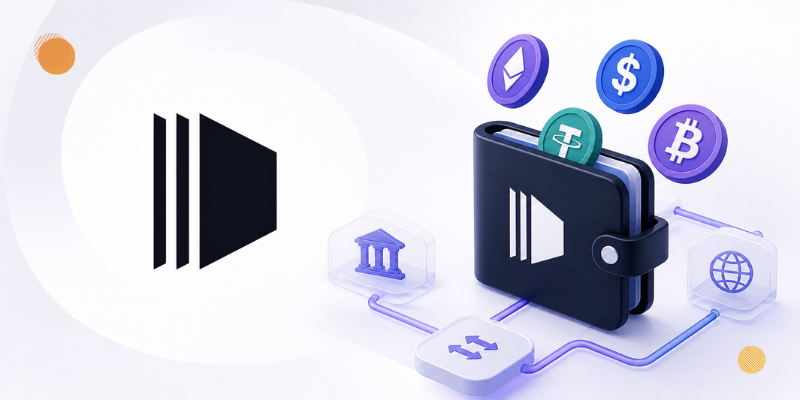


Startup Fun has secured $72 million in Series A funding to scale its technology that enables seamless movement between cryptocurrencies and traditional currencies, underscoring rising investor interest in payment infrastructure bridging digital assets and fiat systems.
The round was co-led by Multicoin Capital and SignalFire, with participation from Infinity Ventures, Pharsalus Capital, and Justin Mateen. The financing closed in January 2026, following an earlier $3.9 million seed round raised in 2022.

Building the rails between crypto and cash
Founded in 2022 by CEO Alex Fine, Fun focuses on a technical but increasingly critical layer of financial infrastructure: enabling users to deposit and withdraw funds across platforms that support both crypto assets and fiat currencies like the U.S. dollar.
Rather than acting as an exchange, Fun provides backend systems that integrate directly into client platforms. These systems allow users to move funds without relying on external exchanges or traditional banking workflows. As Fun secure $72 million in Series A, the company is accelerating efforts to strengthen this infrastructure and support a growing number of institutional and enterprise clients across global markets. The company works closely with engineering teams to tailor payment flows, often customizing them based on user behavior patterns.
Fun says it processes more than $18 billion in annual payment volume and serves over 20 clients. Its infrastructure supports platforms such as Polymarket, Aave, and crypto derivatives platform Lighter. These integrations typically focus on improving conversion rates, ensuring users successfully complete deposits or withdrawals, and minimizing friction in onboarding.
Use of funds and expansion plans
The newly raised capital will be directed toward geographic expansion, product development, and hiring. A key priority is entering the Asia-Pacific region, with plans to open a Singapore office, reflecting growing demand for digital asset services in that market.
The company also indicated it may pursue acquisitions to strengthen its infrastructure stack, particularly in areas like compliance, payment routing, and currency conversion. With a current workforce of fewer than 30 employees, Fun plans to expand its engineering and operations teams.
Fine has positioned the company around a long-term thesis that financial systems are gradually transitioning from traditional databases to blockchain-based infrastructure. While that shift remains uneven globally, the company is building tools designed to support hybrid systems where both fiat and crypto coexist.
Investors bet on infrastructure layer
Investors backing Fun are effectively wagering that the next phase of crypto adoption will depend less on speculative trading and more on practical infrastructure. Spencer Applebaum, a general partner at Multicoin Capital, noted that as fintech firms and neobanks increasingly adopt stablecoins and tokenized assets, demand for reliable payment rails is likely to grow. The deal also adds to a growing list of web3 fundraising updates, highlighting continued venture appetite for infrastructure providers building the connective layer between digital assets and traditional finance.
This aligns with a broader trend. Infrastructure providers, rather than consumer-facing crypto apps, have attracted sustained venture funding over the past two years. These companies typically generate revenue through transaction fees or enterprise contracts, offering more predictable business models than trading platforms.
Market context: shifting regulatory and industry dynamics
Fun’s funding comes amid a changing regulatory and industry environment. Several large technology firms, including Meta, Stripe, and Shopify, have recently expanded support for crypto payments or stablecoins. This marks a shift from earlier caution, as regulatory clarity in some jurisdictions has improved.
In the United States, policy adjustments under the administration of Donald Trump have contributed to a more favorable environment for crypto-related financial services, particularly around stablecoins and payment processing. However, regulatory fragmentation remains a challenge globally, with varying compliance requirements across regions.
At the same time, competition in the crypto payments space is intensifying. Companies like Stripe and PayPal have expanded their crypto capabilities, while specialized firms continue to build infrastructure for institutional and enterprise clients. Fun differentiates itself by focusing on deeply customized integrations rather than standardized APIs.
Outlook
The long-term viability of Fun’s model will depend on whether demand for hybrid crypto-fiat systems continues to grow. While blockchain adoption in traditional finance is still evolving, the need for seamless value transfer across systems is widely recognized.
If more mainstream platforms integrate digital assets, particularly stablecoins for payments, companies providing backend infrastructure could play a central role. Fun’s latest funding round suggests investors see that layer as a critical piece of the financial system’s next phase.
Disclaimer: Cryip's content is strictly for educational and informational purposes and does not constitute financial, legal, or investment advice. Cryptocurrency involves significant risk, and readers assume full responsibility for their own financial decisions. Asset references are never endorsements.
To make complex crypto topics accessible to readers at all experience levels, our team uses AI tools strictly to refine language, correct grammar, and simplify terminology. AI is never used to draft facts, source information, or form conclusions. Every article is fact-checked and approved by a human editor before publication. Read our full AI Use & Content Policy.