

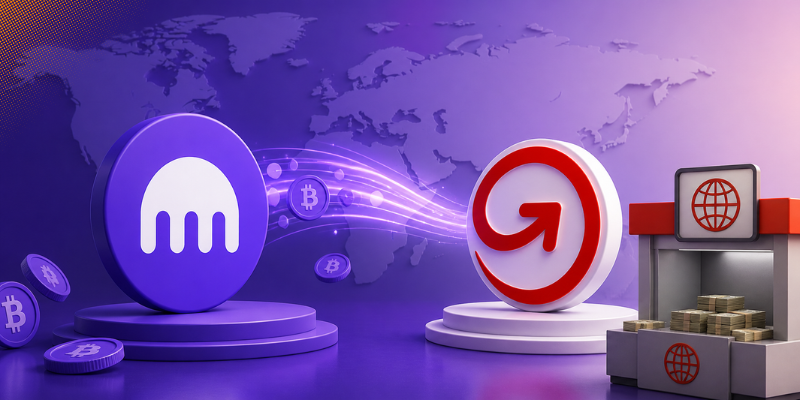


Cryptocurrency exchange Kraken has launched a new partnership with MoneyGram that will allow users to convert cryptocurrency holdings into local cash through MoneyGram’s transfer network, underscoring a broader push by crypto companies toward real-world payment infrastructure.
The rollout begins at a time when large exchanges are facing pressure to diversify beyond trading revenue, which remains heavily tied to market volatility and speculative activity. Industry executives and investors have increasingly shifted focus toward services tied to payments, remittances, and cross-border money movement as regulators demand more practical financial use cases for digital assets.
Kraken said the service will be introduced gradually across multiple regions, including North America, Europe, Latin America, Africa, and parts of Asia-Pacific. Eligible users will be able to withdraw funds in local currency through participating MoneyGram locations.
The partnership gives Kraken access to a global cash distribution system without requiring the exchange to build local banking relationships in every market where it operates.
Internet money ➡️ real-world access.@KrakenFX 🤝 @MoneyGram
You can now convert crypto into cash through MoneyGram’s global network. pic.twitter.com/1QpSolPNVz
— Kraken (@krakenfx) May 5, 2026
Crypto Industry Pushes Beyond Trading
During the previous crypto market cycle, exchanges focused heavily on expanding trading products, derivatives, and token listings. Kraken, in particular, continued Kraken listing new crypto assets for traders as part of its effort to attract global users and deepen market liquidity across its platform. But following tighter regulatory scrutiny in the United States and Europe, several major firms have started repositioning themselves as broader financial technology platforms.
Payments infrastructure has become a major area of investment. Crypto exchanges have expanded into stablecoin settlements, merchant payments, and international transfers in recent years. Analysts say firms increasingly view cross-border payments as one of the few large-scale commercial applications where blockchain systems may offer operational advantages over traditional financial networks.
The Kraken-MoneyGram arrangement focuses primarily on crypto “off-ramp” services, systems that allow users to move funds from digital assets into local fiat currency. That remains a significant challenge in several developing markets where crypto adoption has increased faster than banking infrastructure.
MoneyGram Builds Position in Digital Asset Infrastructure
For MoneyGram, the partnership continues a gradual expansion into blockchain-related financial services.
The remittance company has spent recent years developing APIs and settlement infrastructure designed for fintech and crypto firms seeking access to regulated payout systems. Rather than operating a cryptocurrency exchange directly, MoneyGram has focused on positioning itself as a backend infrastructure provider capable of handling licensed money transmission and local cash distribution.
That strategy allows the company to participate in the growth of crypto-linked financial services while avoiding some of the market risks associated with holding or trading digital assets directly.
The company’s retail footprint may also provide a competitive advantage in regions where cash transactions remain common and banking penetration remains relatively low.
According to World Bank estimates, remittance inflows remain a critical source of household income across parts of Africa, Latin America, and South Asia. Traditional remittance providers, however, continue facing criticism over transaction costs and settlement delays.
Crypto companies have argued for years that blockchain-based settlement systems could lower transfer expenses and improve transaction speeds. Adoption has remained uneven because of compliance concerns, fluctuating token values, and limited consumer trust following multiple industry failures between 2022 and 2024.
Regulatory Pressure Shapes Industry Expansion
Analysts say partnerships with regulated financial infrastructure providers could become increasingly important for exchanges attempting to expand payment-related services while navigating local regulatory frameworks. Recent strategic moves, including Kraken acquires Magna token management platform, highlight how the exchange is building capabilities beyond trading and moving deeper into token infrastructure, compliance, and institutional digital asset services.
Kraken has faced scrutiny in several jurisdictions over licensing, compliance standards, and For MoneyGram, the partnership continues a gradual expansion into blockchain-related financial servicesproduct offerings, similar to many large trading platforms operating internationally. Analysts say partnerships with regulated financial infrastructure providers could become increasingly important for exchanges attempting to expand payment-related services while navigating local regulatory frameworks.
Under the arrangement, Kraken will oversee customer verification and account compliance procedures, while MoneyGram will manage the regulated cash payout component.
Industry observers say the success of crypto payment services will depend less on blockchain technology itself and more on whether companies can integrate digital assets into existing financial systems without adding complexity for users.
For now, the partnership signals that large crypto firms continue looking beyond trading markets in search of more durable revenue streams tied to global payments and money transfers.
Disclaimer: Cryip's content is strictly for educational and informational purposes and does not constitute financial, legal, or investment advice. Cryptocurrency involves significant risk, and readers assume full responsibility for their own financial decisions. Asset references are never endorsements.
To make complex crypto topics accessible to readers at all experience levels, our team uses AI tools strictly to refine language, correct grammar, and simplify terminology. AI is never used to draft facts, source information, or form conclusions. Every article is fact-checked and approved by a human editor before publication. Read our full AI Use & Content Policy.