



On May 4, 2026, Pavel Durov posted a short but powerful update that sent ripples across the crypto market. He announced that transaction fees on The Open Network (TON) had dropped sixfold to nearly zero. More importantly, Telegram is now stepping in as the main driving force behind TON, replacing the TON Foundation and becoming its largest validator. New developer tools, a refreshed ton.org, and performance upgrades are expected within 2 to 3 weeks.
This move marks a bold return to the project Durov originally envisioned. To truly appreciate its weight, we need to revisit the rocky history that forced Telegram to step back years ago.
Fees in TON have dropped 6× — to nearly zero.
Next step — Telegram replaces the TON Foundation as the driving force behind TON and becomes its largest validator.
The focus shifts to tech superiority.
New https://t.co/Me0w683UiK, new dev tools, new performance upgrades.…
— Pavel Durov (@durov) May 4, 2026
The SEC Chapter: What Went Wrong in 2019-2020
Back in 2018, Telegram raised an impressive 1.7 billion dollars through private sales of “Gram” tokens to fund the Telegram Open Network (TON). The idea was revolutionary – a fast, scalable blockchain deeply integrated into Telegram’s messaging app for seamless mass adoption.
But the U.S. Securities and Exchange Commission (SEC) saw it differently. In October 2019, the SEC filed an emergency action, arguing that the Gram token sale was an unregistered securities offering. A federal court sided with the SEC. In March 2020, it issued a preliminary injunction blocking distribution. Facing continued uncertainty, Pavel Durov made the tough call in May 2020 to abandon the official TON project under Telegram’s direct control.
In June 2020, Telegram settled with the SEC. The company agreed to:
- Pay an 18.5 million dollar civil penalty
- Return approximately 1.22 billion dollars to investors
The project’s code was open-sourced, and the TON Foundation took over. Durov stepped back due to regulatory pressure, not lack of belief in the technology.
The Comeback: Why This 2026 Shift Matters Deeply
Fast forward to today. TON has grown with real usage in mini-apps, payments, and games. But Durov clearly believes it’s time for the next level. By taking over as the driving force and largest validator, Telegram is injecting founder-level vision and resources back into the network.
Key implications:
- Stronger focus on “tech superiority,” better dev tools, and performance upgrades.
- Near-zero fees for truly frictionless in-app experiences.
- Deeper integration with Telegram’s nearly one billion users.
- Clear leadership and network stability through Telegram’s staking power.
Immediate Market Impact: Strong Bullish Reaction
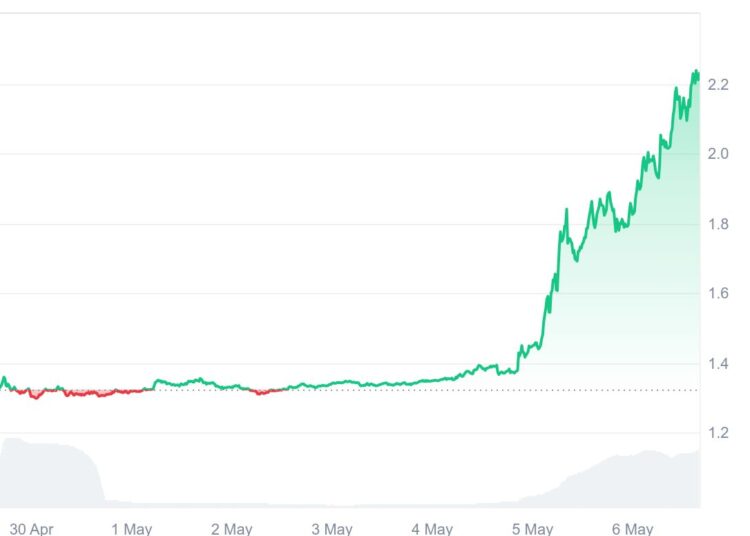
The market reacted very positively to Pavel Durov’s announcement. Within the first 24 hours, Toncoin (TON) surged between 30% and 36%, reaching a four-month high of $1.80 – $1.88.
Trading volume increased sharply – rising between 300% and 650%, with 24-hour volume crossing $600 million to $1 billion at peak. TON’s market capitalization rose from around $4.4 billion to over $5.9 billion, bringing it back into the top 20 cryptocurrencies.
As of May 6, TON is trading around $2.21, reflecting an overall gain of more than 60% from pre-announcement levels. The TON ecosystem also saw strong gains. Popular tokens like DOGS and Notcoin (NOT) delivered double-digit and even triple-digit increases, showing renewed excitement across the network. This strong price action clearly shows that the market was waiting for direct leadership from Durov. His return has positioned TON as a true Telegram-native blockchain with strong growth potential.
Balanced View: Opportunities and Realistic Risks
This development is clearly bullish for usability and adoption, especially in emerging markets where low fees and easy in-app access matter most. For developers, improved tools and Telegram’s engineering support could drive innovation. For users, blockchain features inside messaging feel more natural than ever.
However, regulatory challenges continue. Russia has recently initiated a criminal case against Pavel Durov, accusing him of facilitating terrorist activity, while throttling Telegram traffic nationwide to 55 percent. These ongoing global pressures highlight the complex environment Durov and Telegram operate in.
What This Means for Different Players
For everyday users: TON features inside Telegram just became more attractive and cheaper. It’s a good time to explore wallets, mini-apps, and payments.
For developers: Better tools and committed platform support could open new opportunities.
For investors and holders: Founder re-engagement often signals important shifts. The combination of technical improvements, low fees, and massive distribution potential is compelling – but remember crypto volatility and manage risk properly.
FAQS
1. What is the relationship between Telegram and TON now?
Telegram has officially taken direct control of TON. It is no longer just a partner but the main driving force behind the blockchain with deeper integration planned.
2. What happened with Telegram and the SEC in the past?
In 2018 Telegram raised $1.7 billion. The SEC sued them for selling unregistered securities. In 2020, Telegram paid $18.5 million fine and returned $1.22 billion to investors, then stepped away from the project.
3. What regulatory problems does Pavel Durov face now?
Russia has recently filed a criminal case against Durov and throttled Telegram’s speed to 55% in the country, showing continued global regulatory pressure.
4. What can normal users expect from this TON update?
Users can expect cheaper transactions, smoother mini-apps, easier wallet usage, and faster new features directly inside the Telegram app.
Disclaimer: Cryip's content is strictly for educational and informational purposes and does not constitute financial, legal, or investment advice. Cryptocurrency involves significant risk, and readers assume full responsibility for their own financial decisions. Asset references are never endorsements.
To make complex crypto topics accessible to readers at all experience levels, our team uses AI tools strictly to refine language, correct grammar, and simplify terminology. AI is never used to draft facts, source information, or form conclusions. Every article is fact-checked and approved by a human editor before publication. Read our full AI Use & Content Policy.