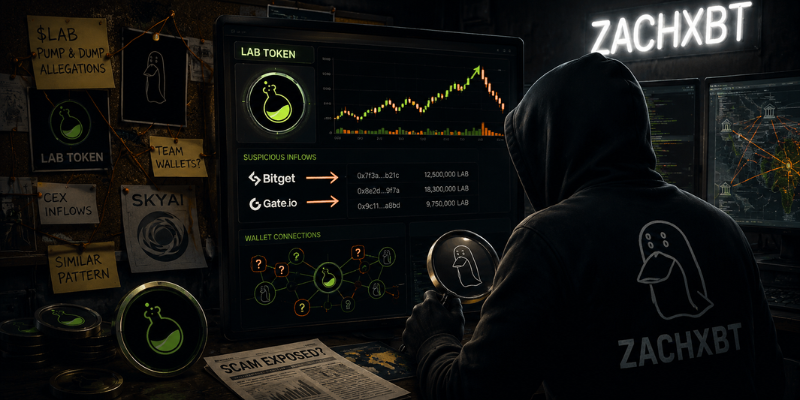


The cryptocurrency market is once again facing scrutiny over alleged coordinated market manipulation, this time involving $LAB, the native token of LABtrade, a multi-chain trading platform. Prominent blockchain sleuths ZachXBT and SpecterAnalyst have spotlighted suspicious patterns of large token movements to centralized exchanges ahead of price surges, raising fresh concerns about supply control and insider driven volatility.
LABtrade markets itself as an advanced trading terminal that supports spot, futures, and perpetual contracts across multiple blockchains including Solana, Ethereum, and BNB Chain. The platform emphasizes AI-powered tools, sub-second execution, low fees, and transparent revenue-sharing mechanics through its $LAB token. The project, linked to founder Vova Sadkov, has positioned itself at the intersection of decentralized trading infrastructure and niche narratives like DeSci (decentralized science) and biotech themes.
Despite these ambitions, $LAB has experienced dramatic price swings. In recent weeks, the token saw sharp gains in early May followed by corrections, with significant futures liquidations reported across major platforms. Critics now question whether these moves were organic or engineered.
Price manipulation now happens almost every week, with $LAB by @LABtrade_ becoming the latest pump-and-dump token while Bitget continues playing the usual CEX role.
The LAB team, @vsadkovv, appears to control a significant portion of the supply. Wallets linked to the team still… pic.twitter.com/O7MnoQBkgL
— Specter (@SpecterAnalyst) May 7, 2026
The Core Allegations
According to detailed on-chain analysis shared publicly, wallets believed to be linked to the LAB team appear to hold a substantial portion of the token supply. Investigators have pointed to large deposits to exchanges such as Bitget and Gate.io in the lead-up to price action. The timing of these deposits is highly suspicious. On May 2, $LAB witnessed a massive price pump, surging from around $0.33 to nearly $4.00 within days, a gain of over 1,000%. This explosive move was accompanied by extremely high trading volume, peaking at $147.86 million in 24 hours.
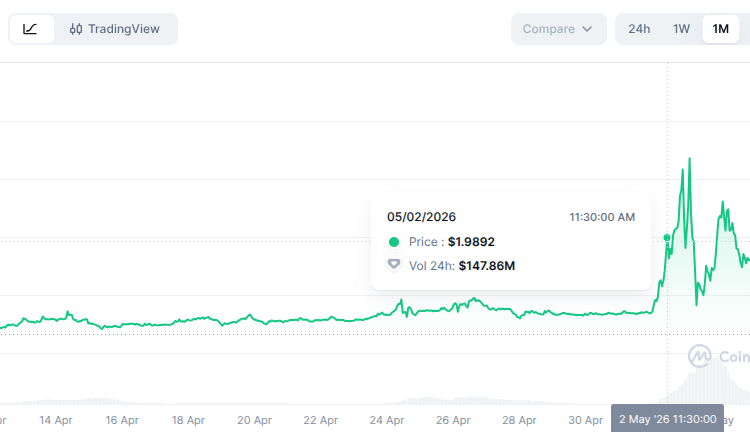
Key observations include:
- Significant token transfers to Bitget in April and late April, shortly before a notable pump starting around May 1.
- Coordinated preparation signals, including gas fee distributions on BNB Chain ahead of activity.
- One address linked to aggressive on-chain buying of $LAB before depositing to exchanges, with similar patterns observed in other volatile tokens.
ZachXBT amplified these concerns, noting the apparent lack of transparency from the project and claiming the founder has been deleting older posts while ignoring direct messages. He drew comparisons to previous cases involving tokens like $SIREN and $RAVE, where similar tactics of supply concentration and timed CEX inflows were alleged.
SpecterAnalyst described $LAB as the “latest pump-and-dump token,” criticizing Bitget’s role in facilitating such activity. The investigator highlighted that weeks after Bitget CEO Gracy Chen promised probes into earlier incidents (such as $RAVE), the community is still awaiting meaningful public updates.
Connections to $SkyAI Raise Additional Red Flags
SpecterAnalyst has explicitly linked the $LAB activity to a similar pattern observed in $SkyAI. The same wallet involved in aggressive on-chain buying of $LAB before routing to exchanges was previously connected to $SkyAI, a token that reportedly surged over 1000% in a short period.
According to the on-chain claims, in April 2025, a large allocation of 800 million $SKYAI was transferred to an “airdrop distribution” wallet. However, the majority of recipient wallets were freshly created addresses allegedly controlled by the same entities. In March 2026, funds from many of these wallets were consolidated into several main addresses before being deposited to Gate.io and Bitget. This alleged cycle of controlled distribution followed by coordinated exchange inflows and price pumping has strengthened suspicions that the same group may be executing a repeatable playbook across multiple tokens.
Why This Matters: Low Float, High Impact
Reports suggest $LAB’s circulating supply remains relatively low compared to its total maximum supply of around 1 billion tokens. This low float naturally amplifies volatility, but when combined with heavy insider-controlled allocations, strategic exchange deposits, and cross-token similarities with $SkyAI, it creates conditions ripe for engineered price movements. Retail traders chasing momentum often bear the brunt through liquidations on both the way up and down.
As an experienced crypto analyst, these recurring patterns are deeply concerning. While many low-cap tokens exhibit wild swings due to thin liquidity, the combination of concentrated supply, pre-pump inflows, limited team transparency, and alleged repeated tactics across $LAB and $SkyAI crosses into serious red-flag territory. Projects that genuinely aim for long-term utility must move beyond marketing narratives and provide verifiable proof of fair token distribution, locked vesting, and clear treasury management.
Platform Responsibility and Industry Implications
Centralized exchanges play a critical gatekeeping role. They benefit immensely from trading volume and fees generated during volatile pumps. However, repeated facilitation of alleged manipulation without swift, transparent investigations damages overall market confidence. Bitget, in particular, has come under repeated fire in recent months for its handling of high-volatility listings.
The broader crypto industry continues to grapple with trust issues. On-chain investigators like ZachXBT and SpecterAnalyst serve as vital watchdogs, often offering rewards for credible information. Yet real change requires exchanges to invest in better pre-listing due diligence, real-time monitoring of suspicious flows, and decisive action when manipulation is evident. The growing number of crypto scams across different ecosystems, including a recent TON address poisoning incident involving 116K TON, also highlights how attackers continue using sophisticated on-chain tactics to exploit traders and manipulate market behavior.
For LABtrade, the allegations risk overshadowing genuine platform developments, such as its buyback portal that displays revenue spent on token repurchases. The project’s leadership now faces a pivotal moment: addressing these claims head-on with clear data, wallet verifications, or third-party audits could help restore credibility. Continued silence or evasion, however, will only fuel further skepticism.
Advice for Traders
Retail participants should treat this as another reminder of core crypto principles:
- DYOR must include on-chain scrutiny, not just project websites.
- Be wary of tokens with extremely low circulating supply and heavy promotion around niche narratives.
- Monitor large exchange inflows and wallet concentration metrics before FOMOing into pumps.
- Remember that high-reward opportunities in crypto almost always carry equally high risks.
This story is developing rapidly. As of May 7, 2026, the allegations remain based on on-chain observations and have not been independently verified by this outlet or proven in any formal proceeding. LABtrade has not issued a detailed public rebuttal at the time of writing.
The crypto space desperately needs higher standards of transparency and accountability. Until projects and platforms prioritize integrity over short-term volume, stories like this will continue to surface, eroding confidence and harming the industry’s long-term growth.
Disclaimer: Cryip's content is strictly for educational and informational purposes and does not constitute financial, legal, or investment advice. Cryptocurrency involves significant risk, and readers assume full responsibility for their own financial decisions. Asset references are never endorsements.
To make complex crypto topics accessible to readers at all experience levels, our team uses AI tools strictly to refine language, correct grammar, and simplify terminology. AI is never used to draft facts, source information, or form conclusions. Every article is fact-checked and approved by a human editor before publication. Read our full AI Use & Content Policy.