



StablR’s EURR and USDR stablecoins lost their pegs today after an attacker exploited a 1-of-3 multisig wallet tied to the project’s minting contract. The intruder minted roughly 8.35 million unbacked USDR and 4.5 million EURR – tokens with a combined face value near $13.5 million – then dumped them across decentralized exchanges for approximately 1,115 ETH, realizing around $2.8 million in profit amid heavy slippage.
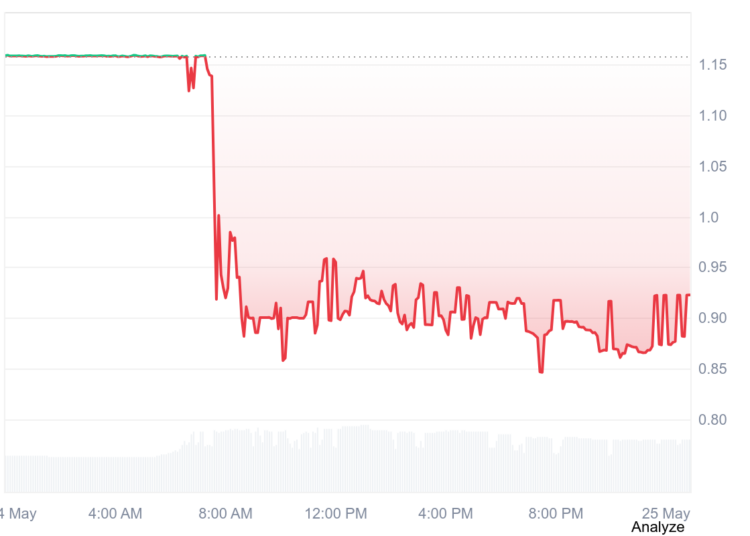
The depeg hit fast. EURR, designed to track the euro at 1:1, traded as low as €0.85–0.90 in the hours following the mint. USDR, pegged to the dollar, fell even harder, dipping below $0.70 at points and hovering in the $0.40–$0.80 range depending on the pool and timing. Liquidity thinned out quickly as traders rushed to exit, amplifying the price action on Ethereum where the affected contracts sit. The price of EURR, USDR plummeted following the exploit.
The Attack Vector: Not a Smart Contract Bug, But a Governance Failure
On-chain investigator ZachXBT was the first to flag the unusual minting activity.
The root cause was straightforward and painful: an attacker gained control of one private key belonging to a multisig signer. With just 1-of-3 approval required for the minting admin role, that single key was enough to remove the legitimate owners, add their own wallet, and authorize unlimited issuance with zero collateral behind it.
This wasn’t a vulnerability in the token contracts themselves. Audits had previously confirmed the 1:1 fiat reserves held by StablR. The problem sat entirely in the operational layer – key custody and multisig configuration for the most sensitive function any stablecoin issuer controls: the ability to create new supply.
StablR operates as a Malta-licensed Electronic Money Institution (EMI) and positions itself as fully MiCA-compliant. The project has attracted backing and investment from Tether, and it emphasizes proof-of-reserve attestations while bridging traditional finance rails to DeFi on Ethereum (and reportedly Solana). Yet the minting authority relied on what many now see as an outdated and dangerously thin security setup.
The Attacker’s Wallet and Timeline
The attacker operated from Ethereum address 0xea480c23d7b29a515856aafe0dc86f7519965a04. On-chain activity suggests the exploit unfolded overnight in European time zones, when monitoring may have been lighter. By the time the first alerts surfaced, the attacker had already swapped the freshly printed tokens and withdrawn the ETH proceeds. Some six-figure amounts were later frozen by security teams, but the bulk of the realized gain had already left the ecosystem.
StablR Team’s Official Response
Security update: We have identified an exploit affecting StablR and are actively working to contain it and minimize impact.
Protecting our users and your funds is our top priority.
We’ll share verified details and next steps as soon as possible.
— StablR (@StablREuro) May 24, 2026
That post arrived roughly eight hours after the last suspicious transactions. No immediate freeze of the entire supply or detailed recovery roadmap was included in the initial update. Trading in both EURR and USDR remains volatile as this article publishes, with thin order books reflecting the sudden loss of confidence.
What Makes This Different — And Why Reserves Still Matter
Unlike algorithmic failures such as Terra’s UST collapse, StablR’s underlying fiat reserves appear untouched. Previous attestations showed full backing, and nothing in today’s incident suggests the attacker drained the actual cash or treasury accounts. The depeg stems purely from an artificial oversupply hitting the secondary market – a classic symptom of minting authority being hijacked rather than a solvency crisis.
That distinction matters for holders. In theory, once StablR regains control of the minting contract, burns or redeems the excess supply, and restores proper governance, the peg has a clear path back to parity. But the window between exploit and full resolution is exactly where trust evaporates. Traders are pricing in the operational risk right now, not the fundamental backing.
Broader Lessons for MiCA-Era Stablecoins
This event lands at a sensitive moment for European stablecoin regulation. MiCA was meant to bring credibility and consumer protection to issuers like StablR through licensing, reserve requirements, and transparency mandates. Yet it does not – and realistically cannot – micromanage every multisig threshold or key-storage practice.
The gap is now obvious: compliance covers the vault, but the printing press still depends on human-controlled admin keys. A 1-of-3 setup for a project handling tens of millions in stablecoin supply was always going to be a single point of failure once one key was compromised, whether through phishing, insider access, or targeted social engineering.
StablR is not the first project to learn this the hard way, but it may be the highest-profile regulated European issuer to face it publicly. The incident will likely accelerate conversations around mandatory time-locks, hardware security modules, distributed key management, and real-time monitoring requirements for minting authorities under future MiCA guidance or national implementations.
For the wider market, the message is blunt. Even “institutional-grade,” Tether-backed, MiCA-licensed stablecoins carry governance risk that cannot be fully outsourced to regulators. Proof-of-reserve is necessary but not sufficient when the issuance mechanism itself can be hijacked in minutes.
StablR has built a solid reputation over the past year as a compliant bridge between TradFi and on-chain liquidity. Today’s exploit tests whether that reputation can survive a real-world stress event. The next 24–48 hours will be critical: clear communication on exactly how much excess supply exists, how it will be clawed back or burned, and what upgraded multisig or custody measures will prevent recurrence.
Until then, the depeg serves as a live reminder that stable doesn’t always mean bulletproof – especially when the weakest link is still a private key.
Stay tuned for updates as StablR provides verified on-chain details and a full post-mortem. This coverage draws directly from blockchain data, ZachXBT’s investigation, and the issuer’s own statements.
Disclaimer: Cryip's content is strictly for educational and informational purposes and does not constitute financial, legal, or investment advice. Cryptocurrency involves significant risk, and readers assume full responsibility for their own financial decisions. Asset references are never endorsements.
To make complex crypto topics accessible to readers at all experience levels, our team uses AI tools strictly to refine language, correct grammar, and simplify terminology. AI is never used to draft facts, source information, or form conclusions. Every article is fact-checked and approved by a human editor before publication. Read our full AI Use & Content Policy.