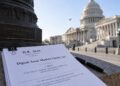

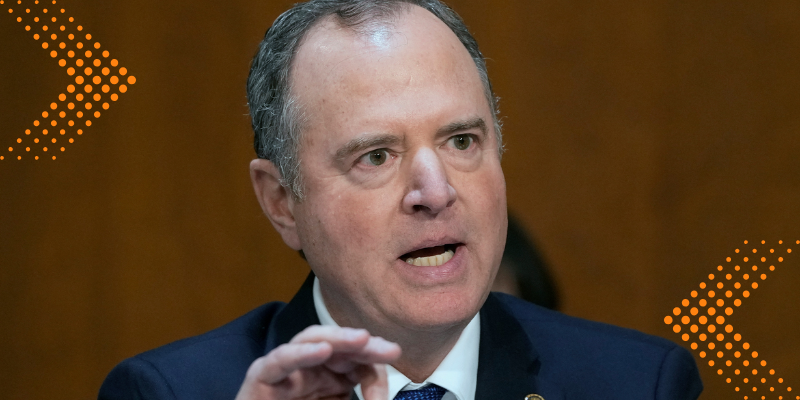


U.S. lawmakers have introduced new legislation aimed at banning prediction market bets that involve war, terrorism, assassination, or death. The proposed bill seeks to prevent platforms regulated by the Commodity Futures Trading Commission (CFTC) from offering contracts linked to violent or unlawful events.
Schiff Shares Bill and Statement on X
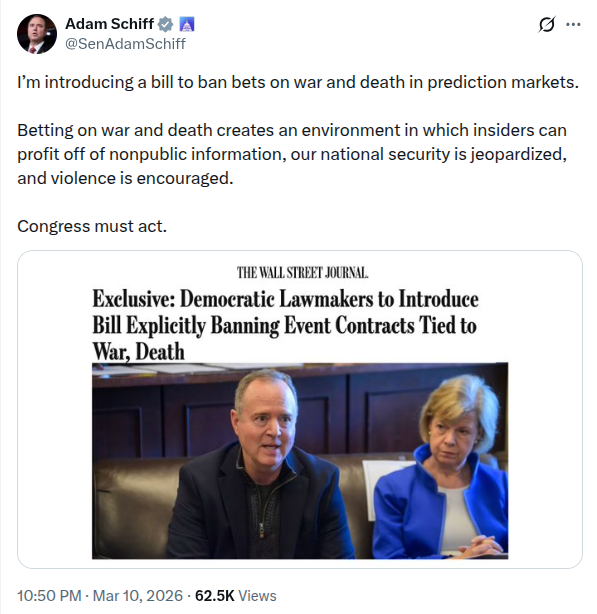
U.S. Senator Adam Schiff announced the proposal on X, stating that he is introducing legislation to ban betting on war and death in prediction markets. “Betting on war and death creates an environment in which insiders can profit off nonpublic information, our national security is jeopardized, and violence is encouraged,” Schiff wrote while sharing the bill text.
The legislation, detailed in the official bill document released by Schiff’s office, would prohibit any entity regulated by the Commodity Futures Trading Commission from listing contracts that involve, relate to, or reference terrorism, assassination, war, or an individual’s death.
Schiff and Levin Lead Bicameral Legislative Effort
The legislation was introduced in the Senate by Adam Schiff, a Democrat from California, with companion legislation introduced in the House of Representatives by Mike Levin. The proposal would explicitly prohibit any CFTC-regulated entity from listing contracts that “involve, relate to, or reference” terrorism, assassination, war, or death.
Supporters of the bill argue that allowing such markets could create serious ethical and security concerns. According to Schiff, betting on violent events could enable individuals with nonpublic information to profit while potentially encouraging harmful behavior.
Federal law already gives the CFTC authority to block event contracts tied to war, terrorism, assassination, or activities that violate federal or state laws or conflict with the public interest. However, Schiff’s legislation seeks to make the prohibition explicit to prevent such contracts from appearing on regulated platforms.
Prediction Market Platforms
The proposal comes as prediction markets have expanded in recent years. Platforms like Kalshi and Polymarket allow users to trade contracts based on the outcomes of real-world events, including political and economic developments.
Earlier this month, prediction markets that allowed bets on whether Iran’s Supreme Leader Ali Khamenei would remain in power drew scrutiny after reports of his killing, raising questions about whether sensitive geopolitical events should be traded in such markets.
In February, Michael Selig argued that prediction markets could harness the “wisdom of crowds” to generate useful information and provide signals outside traditional media and institutional gatekeepers.
Disclaimer: Cryip's content is strictly for educational and informational purposes and does not constitute financial, legal, or investment advice. Cryptocurrency involves significant risk, and readers assume full responsibility for their own financial decisions. Asset references are never endorsements.
To make complex crypto topics accessible to readers at all experience levels, our team uses AI tools strictly to refine language, correct grammar, and simplify terminology. AI is never used to draft facts, source information, or form conclusions. Every article is fact-checked and approved by a human editor before publication. Read our full AI Use & Content Policy.