




David Hoffman, co-founder of the popular crypto media platform Bankless and one of Ethereum’s most prominent advocates, has sold his entire ETH holdings after nearly nine years. In a detailed essay published on May 26, 2026, Hoffman explained that the long-standing “ETH is Money” investment thesis has effectively played out and reached its realistic limit.
“The ETH is Money thesis didn’t fail… it played out. Ethereum got the ETH price it deserves, and I don’t see ETH being rerated as an asset, higher or lower.”
I spent the weekend putting my thoughts about $ETH and Ethereum into this article
I built my career, community, and business on Ethereum, so the decision to sell deserves a deeper explanation
I hope this is sufficient
Thank you, all https://t.co/cPCbMcz8EY
— David Hoffman (@TrustlessState) May 26, 2026
Despite selling his ETH, Hoffman remains strongly bullish on Ethereum as a network and ecosystem. He expects Ethereum to continue thriving as the leading infrastructure layer for decentralized finance, stablecoins, tokenized assets, and institutional blockchain applications.
“p.s. I am massively bullish Ethereum. I expect Ethereum as a network to do exceptionally well from here on out. I think only a marginal amount of that success will be reflected in ETH.”
Ethereum the Network vs ETH the Asset
Hoffman emphasized a clear distinction between the success of the Ethereum network and the performance of ETH as an asset. While Ethereum has technologically succeeded in becoming the dominant smart contract platform, he argues that this success has not translated into outsized value capture for the native ETH token.He described Ethereum as “a giver, not a taker” – an open-source protocol that provides blockspace at cost and prioritizes ecosystem growth over aggressive value extraction for ETH holders. According to Hoffman, future value growth will likely flow more toward Layer-2 networks, applications, stablecoins, and tokenized assets rather than directly benefiting ETH itself. This perspective aligns with Ethereum’s evolving scaling roadmap, where Layer-2 expansion and interoperability have become central to the network’s long-term growth strategy.
The Collapse of the ‘Fat Protocol’ Thesis
A central point in Hoffman’s analysis is the decline of the “Fat Protocol Thesis,” which assumed base-layer blockchains would capture the majority of economic value. Ethereum’s rollup-centric roadmap has instead redistributed revenue and activity to Layer-2 solutions and applications.He highlighted how competing Layer-1 chains such as Solana, NEAR, and others have shown stronger correlations between on-chain revenue and native token performance in recent cycles, while Ethereum increasingly functions as neutral settlement infrastructure.


Stablecoins: Ethereum’s Biggest Success and ETH’s Challenge
Hoffman noted that Ethereum’s dominance in the stablecoin market – currently hosting over $163 billion in tokenized dollars – has strengthened the network’s utility and institutional relevance. However, this success has primarily benefited dollar-backed assets rather than accruing significant value back to ETH, further limiting its monetary premium.
Market Reaction and Community Response
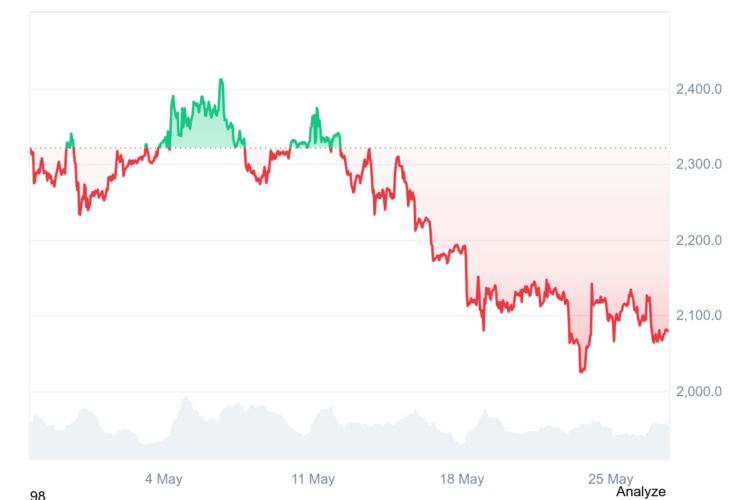
As of May 27, 2026, ETH is trading around $2,070–$2,100, showing only modest downward pressure following the announcement. The market reaction has been relatively muted, with no major sell-off observed.The post quickly crossed over one million views and triggered intense debate across crypto Twitter, Reddit, and forums. Reactions were divided: Some praised Hoffman’s transparency and long-term thinking, Ethereum loyalists saw it as damaging to sentiment, while others viewed it as a potential market bottom signal. The discussion also comes at a time when institutional interest in Ethereum remains strong, with several companies continuing to expand their ETH holdings despite ongoing debates over the token’s long-term value capture potential.
A Maturing Narrative in Crypto
Hoffman’s decision reflects a broader shift in 2026 crypto markets: investors are increasingly separating the technological and adoption success of a blockchain from the price performance of its native token.While Ethereum continues to lead in developer activity, DeFi TVL, stablecoins, and institutional experimentation, the market is becoming more selective about which assets actually capture long-term economic value.
David Hoffman’s exit is not a rejection of Ethereum, but rather a capital reallocation based on a reassessment of ETH’s risk-reward profile. His message is clear: Ethereum the ecosystem has a bright future, but expecting massive upside in the ETH token itself may no longer be realistic.