




As AI agents begin booking travel, shopping online, managing subscriptions, and completing payments without human input, another question is starting to emerge: what happens when those transactions go wrong?
A coalition of 27 blockchain and artificial intelligence organizations, including OKX, MetaMask, Matter Labs, and GenLayer, has introduced Internet Court, a decentralized protocol designed to help AI agents resolve disputes after digital transactions or agreements fail. The launch reflects a broader effort across the AI industry to build the infrastructure needed for autonomous software to operate safely and reliably.
Interest in AI agents has grown rapidly over the past year as technology companies develop software capable of completing tasks independently. While new tools already allow AI agents to communicate, verify identity, and make payments, resolving disagreements has remained one of the missing pieces needed for large-scale AI-driven commerce.
Internet Court at a Glance
- Founding coalition: 27 blockchain and AI organizations.
- Notable participants: OKX, MetaMask, Matter Labs, and GenLayer.
- Main purpose: Resolve disputes between autonomous AI agents.
- Designed for: Digital transactions and AI-powered commerce.
- Open source: Developers can build applications using the protocol.
- Focus: Fast dispute resolution for automated online transactions.
Why It Matters
AI agents are expected to take on more real-world tasks, from ordering products and booking hotels to managing business purchases and paying invoices. As those responsibilities grow, mistakes and disagreements are likely to become unavoidable.
- An AI shopping assistant could order the wrong product.
- An AI travel assistant could pay for a hotel room that was never confirmed.
- An AI service could claim it completed a task while the customer disagrees.
- Payments may need to be refunded, released, or temporarily held until the dispute is resolved.
Rather than replacing traditional courts, Internet Court is designed to help participating AI systems resolve these types of digital disagreements automatically after both sides agree to use the protocol.
How It Could Work
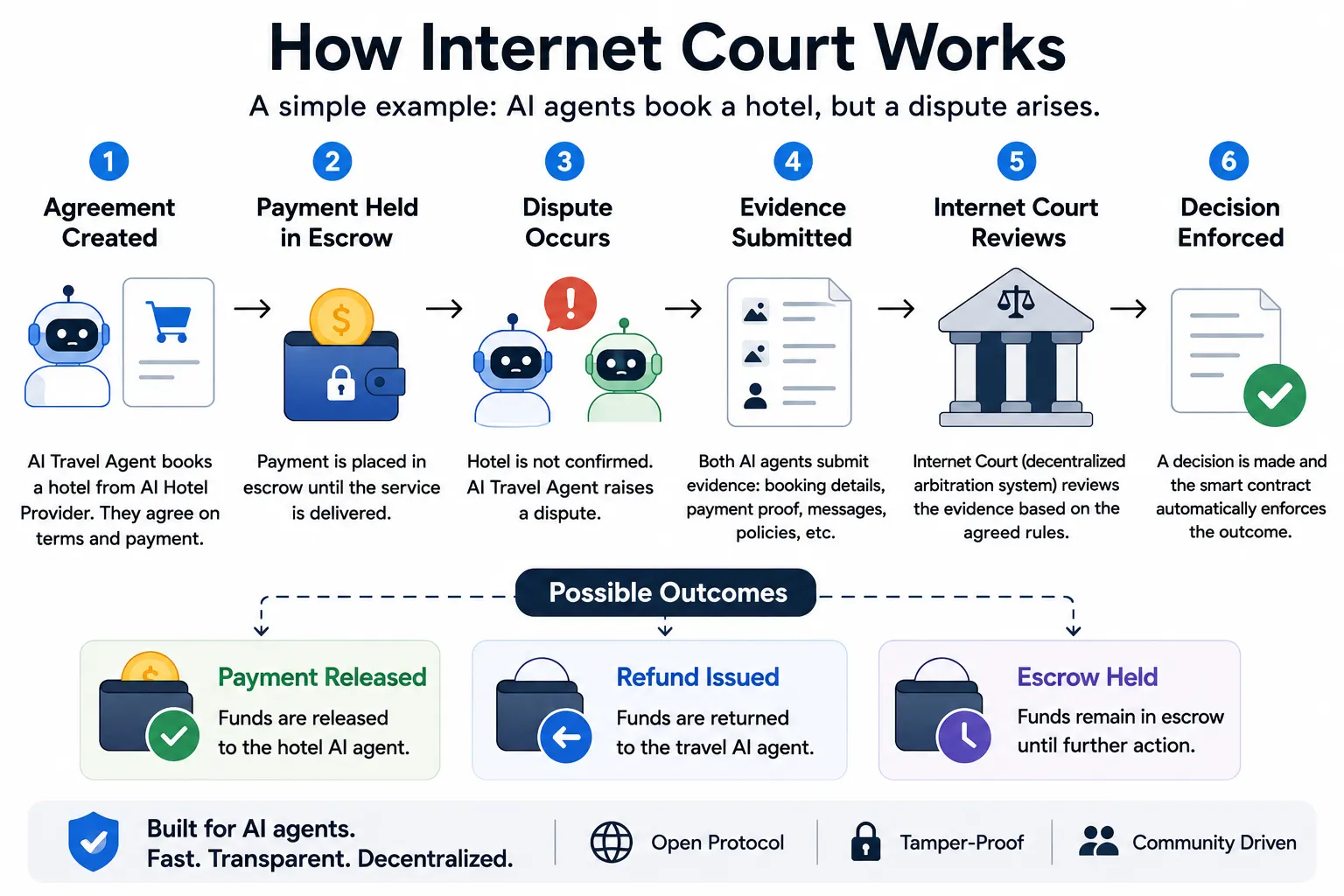
Imagine an AI assistant booking a hotel for a business trip. Payment is made automatically, but the reservation is never confirmed. Instead of waiting for customer support, both AI systems could submit booking details, payment records, and confirmation messages to Internet Court. The protocol would review the available evidence and determine whether the payment should be refunded or released.
A similar process could also apply if an AI shopping assistant receives the wrong product or if two AI services disagree over whether a digital task was completed.
“The future of agentic commerce will not be owned. It will be shared.”
David Riudor, CEO and co-founder of the GenLayer Foundation, said existing legal systems were designed for disputes involving people rather than software operating continuously at machine speed.
Part of a Bigger Trend
The launch comes as developers race to make AI agents more independent. Recent advances have focused on helping software agents communicate with one another, complete online purchases, and manage digital assets. Internet Court addresses another challenge by providing a way to settle disagreements once those transactions begin happening at a much larger scale.
MetaMask said GenLayer is using its Smart Accounts technology as part of the project, allowing AI agents to securely authorize blockchain transactions and interact with the dispute resolution system.
Open-Source Project
- The protocol is available as an open-source project on GitHub.
- It includes more than 69 reusable components contributed by 23 organizations.
- Developers can integrate payments, escrow, identity verification, and dispute resolution into AI applications.
- The framework is designed to expand as new AI technologies emerge.
Questions Still Remain
Internet Court is designed for participants that voluntarily agree to use its dispute resolution process before a transaction takes place. Whether similar systems gain wider adoption will likely depend on how quickly businesses begin relying on AI agents for everyday commercial activities.
It also remains unclear how decentralized AI arbitration will interact with existing legal systems when disputes involve physical goods, regulated industries, or parties outside blockchain-based ecosystems.
The Bigger Picture
As AI agents move beyond answering questions to completing purchases, making payments, and carrying out business tasks, developers are increasingly focused on building the trust infrastructure needed to support those activities. Internet Court represents one of the earliest efforts to create a common framework for resolving disputes between autonomous software, an area many in the industry see as a necessary step before AI-driven commerce can become mainstream.
Late June 2026, OKX launched the OKX AI Platform to expand AI-powered crypto and Web3 capabilities across its ecosystem. The platform introduced intelligent tools for on-chain interactions, trading assistance, and decentralized applications, reflecting OKX’s growing focus on integrating AI into blockchain services.
Disclaimer: Cryip's content is strictly for educational and informational purposes and does not constitute financial, legal, or investment advice. Cryptocurrency involves significant risk, and readers assume full responsibility for their own financial decisions. Asset references are never endorsements.
To make complex crypto topics accessible to readers at all experience levels, our team uses AI tools strictly to refine language, correct grammar, and simplify terminology. AI is never used to draft facts, source information, or form conclusions. Every article is fact-checked and approved by a human editor before publication. Read our full AI Use & Content Policy.