



- Binance delists ICX, SCRT and STORJ spot pairs on Sept. 3 at 03:00 UTC, citing only a routine “periodic review” of listed assets.
- Secret Network’s own Cosmos chain loses official development support two days earlier, on Sept. 1, after a $4.67 million bridge exploit in June.
- Storj’s parent company filed for Chapter 11 bankruptcy in a West Virginia court on July 27; ICON’s blockchain is set to stop producing blocks entirely on Dec. 31.
Binance is treating ICX, SCRT and STORJ as one routine delisting, but the three tokens don’t share a reason for leaving. They share only a coincidence of timing, and each token’s real ending has almost nothing to do with Binance.
Binance will Delist ICX, SCRT, STORJ on 2026-09-03
👉 https://t.co/DvbaTMYbdH pic.twitter.com/pOAiHgoGI3
— Binance (@binance) August 20, 2026
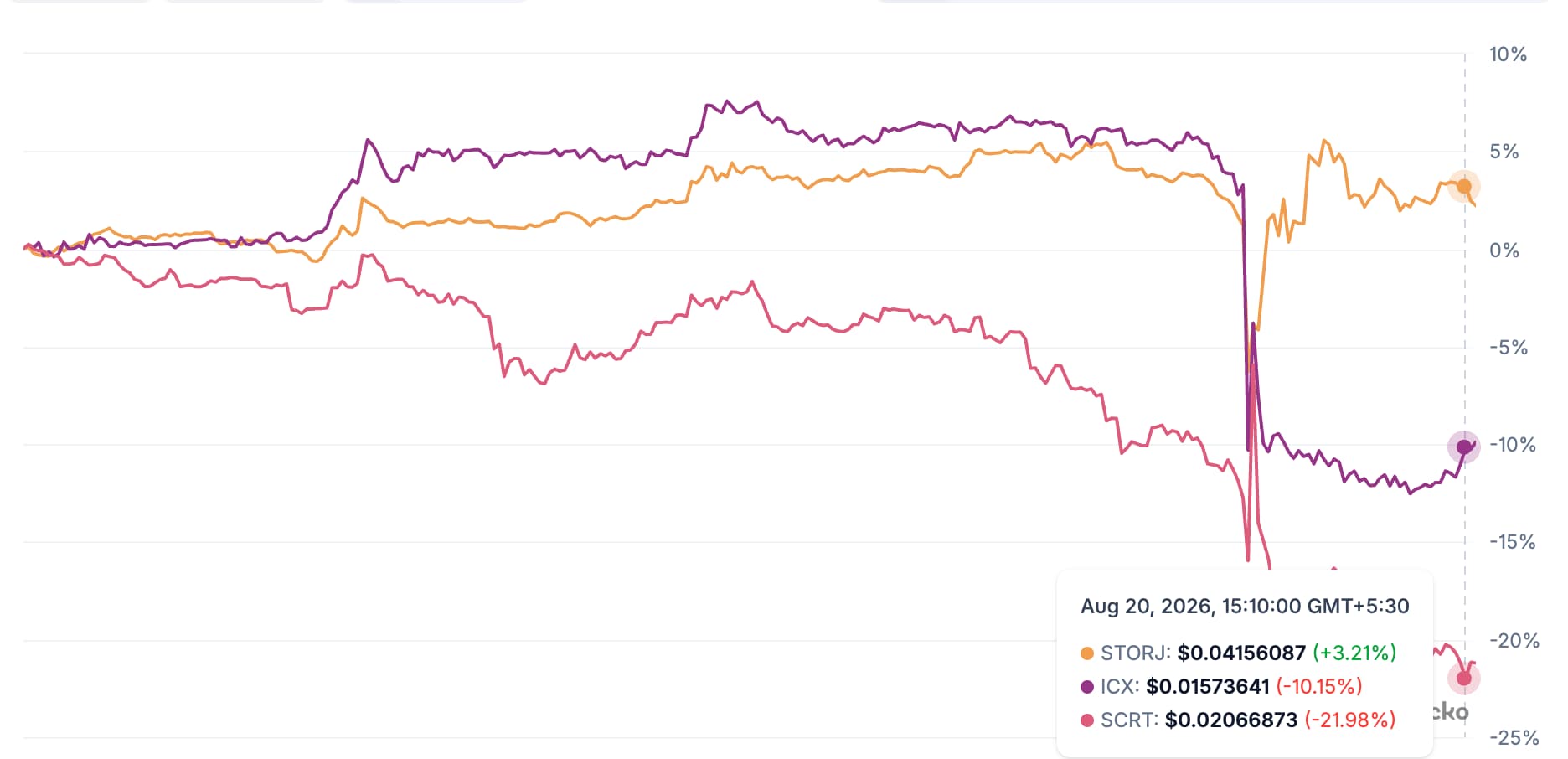
Binance’s own announcement gives no token-specific reason. It cites “periodic review” criteria, team commitment, development activity, liquidity, network security, community sentiment, that could describe almost any small-cap token. All three coins trade more than 98% below their all-time highs, and ICX touched a fresh record low, $0.01529, on the same day the delisting news spread. But the timing of Binance’s Sept. 3 cutoff doesn’t match what’s actually happening to these tokens at the protocol level, and in two of three cases, it doesn’t even come first. The delisting comes as Binance takes other measures affecting crypto platforms, including moves to halt transactions with selected services.
Secret Network is not being killed by Binance. Its own community proposed moving SCRT off its native Cosmos-based chain onto an ERC-20 token on Arbitrum, after a June exploit of the Axelar-Secret bridge drained $4.67 million. The team’s proposal argues that older chains are getting easier to break because “AI can help attackers read contracts, trace assumptions and identify forgotten edge cases,” and that “for SCRT to endure, it needs a new stable home.”
A one-time snapshot of balances is scheduled for Sept. 1, two days before Binance’s own delisting takes effect. After that, Cosmos-based SCRT stops receiving official development support. The migration still needs a governance vote; the team has been explicit that “this is a proposal, not a decision.”
ICON’s chain has a longer runway than Binance’s countdown suggests. ICX is being consolidated 1:1 into a new token, SODA, as the project winds down its own Layer 1 in favor of a DeFi platform called Soda Xchange, built on the Sonic network. ICON’s own governance forum frames this as a cost-saving pivot, not a failure. Running an independent blockchain, the team wrote, comes with “high direct and indirect costs” it would rather “reinvest… toward builders.” Two-way swapping between ICX and SODA closes Sept. 30; the ICON chain itself won’t stop producing blocks until Dec. 31, three months after Binance has already dropped the pair.
Storj is the odd one out: its problem isn’t the chain, it’s the company behind it. Storj Labs filed for Chapter 11 bankruptcy on July 27 in the U.S. Bankruptcy Court for the Northern District of West Virginia, citing what its own blog calls “legacy obligations from an earlier chapter.” The company says the network keeps running with no interruption in service, and that STORJ holders may be offered equity in the reorganized business, an arrangement token holders in a bankruptcy proceeding don’t usually get. STORJ fell sharply the day the filing became public and remains down roughly 98% from its high, though the token has ticked up slightly this week on delisting-driven trading volume.
None of these three unwindings needed Binance to happen. The latest delisting also comes amid Binance’s broader removal of other monitored assets, including ACX, HFT, PIVX, PYR, VANRY and VIC. The exchange’s delisting looks less like a cause and more like a formality catching up to what each project had already set in motion. The deadline that actually matters to anyone still holding ICX, SCRT or STORJ isn’t Sept. 3. It’s whichever of the three separate deadlines applies to the token they’re holding, and none of those run on Binance’s clock.
AI Disclosure: Cryip uses AI-assisted tools to help refine language — correcting spelling and grammar and simplifying complex terms for readability.
We do this to make crypto topics easier to understand for readers at all experience levels. AI does not draft facts, sources, or conclusions. Every article is reviewed and approved by a human editor before publication. Read our full AI Use & Content Policy.