




- Ethereum Foundation introduces a clarified mandate focusing on decentralization, privacy, and security.
- Vitalik Buterin describes Ethereum as a “sanctuary technology” designed to protect technological self-sovereignty.
- Strong emphasis on CROPS principles – censorship resistance, capture resistance, open source, privacy, and security.
- Foundation positions itself as a steward, not the sole authority over the Ethereum ecosystem.
Ethereum Foundation Clarifies Its New Strategic Mandate
The Ethereum Foundation has released a new mandate outlining its strategic direction and responsibilities within the Ethereum ecosystem. The clarification emphasizes the foundation’s role as a steward of the network while reaffirming core principles such as decentralization, privacy, and open-source development.
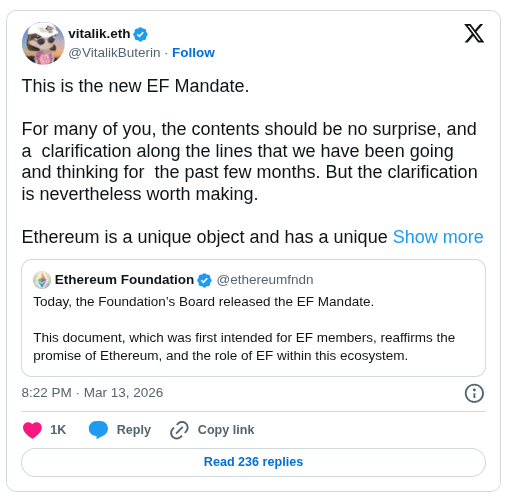
According to Vitalik Buterin, Ethereum serves a unique role in the digital landscape as a “sanctuary technology.” He described the blockchain as a platform designed to preserve technological self-sovereignty and enable cooperation without coercion or centralized control. Ethereum Foundation President Aya Miyaguchi shared the new EF mandate on X. Recently, Vitalik Buterin also discussed his $500 million SHIB donation to the Future of Life Institute
The mandate explains that Ethereum’s mission includes ensuring that no single organization, ideology, or individual can dominate cyberspace. The Ethereum Foundation stated that its responsibility is to protect and expand the properties that make Ethereum resistant to censorship and centralized capture.
Focus on CROPS Principles
The foundation said its work will prioritize what it calls CROPS principles, which include:
- Censorship and capture resistance
- Open-source development
- Privacy protections
- Security
These principles apply both to Ethereum’s protocol layer and to the user-facing tools and applications built within the ecosystem. At the protocol level, the foundation plans to focus on improving decentralization, network security, and privacy while maintaining strong guarantees around inclusion and network liveness.
Protocol Development Priorities
The Ethereum Foundation also highlighted several technical areas where it intends to focus its efforts. These include improving the scalability and capabilities of the Ethereum base layer while preserving decentralization.
Areas mentioned include:
- Layer-1 scaling improvements
- Account abstraction
- In-protocol aggregation techniques
The organization stated that these improvements are intended to reduce reliance on intermediaries and allow Ethereum’s core properties to extend across the broader technology stack.
Emphasis on User Sovereignty
Beyond protocol development, the foundation also stressed the importance of building user tools that prioritize privacy and security while preserving user autonomy.
The mandate describes a goal of creating high-quality “zero option” user experiences systems designed to protect users without requiring centralized intermediaries. At the same time, the Ethereum Foundation acknowledged that many ecosystem projects that integrate existing financial or technological systems will likely be developed outside the foundation itself. The organization said it intends to support such efforts across the broader ecosystem.
A Broader Role in the “Sanctuary Tech” Community
The mandate also reflects a broader shift in how the foundation views its role globally. The organization noted that Ethereum should be seen not only as a blockchain network but also as part of a wider movement focused on technologies that protect digital freedom and self-sovereignty.
While reaffirming its commitment to Ethereum, the foundation emphasized that it is one steward among many in the ecosystem rather than its sole authority. The clarification comes as Ethereum continues to evolve and as discussions around decentralization, privacy, and governance remain central to the future of blockchain infrastructure.
Disclaimer: Cryip's content is strictly for educational and informational purposes and does not constitute financial, legal, or investment advice. Cryptocurrency involves significant risk, and readers assume full responsibility for their own financial decisions. Asset references are never endorsements.
To make complex crypto topics accessible to readers at all experience levels, our team uses AI tools strictly to refine language, correct grammar, and simplify terminology. AI is never used to draft facts, source information, or form conclusions. Every article is fact-checked and approved by a human editor before publication. Read our full AI Use & Content Policy.