




- Total holdings: 28,355 BTC worth approximately $2.2 billion
- Customer assets: 19,357 BTC valued at approximately $1.5 billion
- Corporate treasury: 8,997 BTC worth approximately $692.3 million
- Snapshot date: As of March 2026
- Verification: Enabled via onchain cryptographic signatures
- Ranking: 14th-largest corporate Bitcoin holder
Bitcoin Holdings Disclosure
Block Inc., the fintech company led by Jack Dorsey and operator of Square and Cash App, disclosed total Bitcoin holdings of 28,355 BTC in its first-quarter proof-of-reserves report published Monday. The holdings are valued at approximately $2.2 billion as of March 2026. The report shows that 19,357 BTC, worth approximately $1.5 billion, are held on behalf of customers, while 8,997 BTC, valued at approximately $692.3 million, are part of the company’s corporate treasury. The figures were confirmed by third-party auditors. It held 8,883 BTC at the end of last year.
proof of reserves https://t.co/XuFpXxfjzU
— jack (@jack) April 27, 2026
Block stated that users can independently verify its Bitcoin holdings through onchain cryptographic signatures. The company added that its reserves are “actively controlled, not just historically observed,” allowing public confirmation without requiring access to private keys.
Top Corporate Bitcoin Holders
Among corporate Bitcoin holders, MicroStrategy ranks first with over 800,000 BTC, followed by Marathon Digital Holdings with more than 40,000 BTC and Riot Platforms with over 15,000 BTC. Tesla holds approximately 10,000 BTC, while Block Inc. ranks fifth with 8,997 BTC in its corporate treasury. The distribution highlights a significant concentration of Bitcoin among a small number of major corporate holders.
Corporate Bitcoin Strategy Comparison: Block’s Bitcoin exposure is driven by its user ecosystem, where customer holdings form a large portion of total BTC under management. This contrasts with companies like MicroStrategy, which accumulate Bitcoin as a primary treasury reserve asset. While Block integrates Bitcoin into its payments platform, other firms primarily treat Bitcoin as a long-term balance sheet asset.
Proof-of-Reserves Snapshot and Verification
The disclosure represents a point-in-time snapshot of balances as of March 2026 and does not constitute a full audit of solvency. The proof-of-reserves model is designed to provide transparency into asset holdings, while not offering a complete view of liabilities.
Block emphasized that users should be able to verify holdings independently rather than rely solely on trust. The system enables confirmation of asset ownership directly on the blockchain using publicly shared wallet addresses and signed messages. The company’s corporate Bitcoin holdings rank 14th globally among corporate treasuries.
Q1 2026 Bitcoin Market Overview
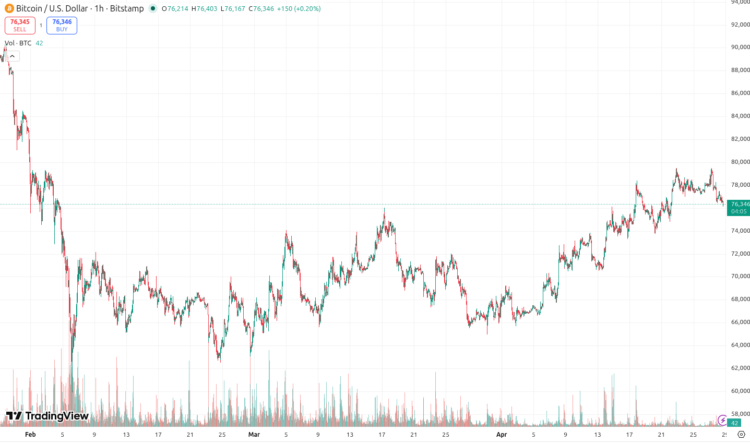
Bitcoin traded within a range of approximately $60,000 to $80,000 during the first quarter of 2026. The market experienced early weakness followed by a steady recovery toward the end of March. Total market capitalization fluctuated between roughly $1.25 trillion and $1.55 trillion. Price action reflected a phase of consolidation after prior volatility in late 2025. By the end of Q1, Bitcoin stabilized near the upper range, maintaining a market cap above $1.5 trillion. This price range reflects broader market consolidation and sustained institutional participation during the quarter.
Block Bitcoin Holdings Trend: Block’s corporate Bitcoin holdings increased from 8,883 BTC at the end of 2025 to 8,997 BTC in Q1 2026, indicating a gradual accumulation strategy. The modest increase reflects a gradual accumulation strategy compared to previous periods.
Potential Impact on Earnings: Block’s Bitcoin exposure is closely tied to its financial performance, particularly through transaction activity on Cash App. With Bitcoin trading in the $60,000 to $80,000 range during Q1 2026, transaction volumes may influence revenue generated from crypto-related services. The company is expected to report its Q1 earnings on May 7, where Bitcoin-related activity could be a contributing factor to overall financial results.
Industry Context and Debate
Proof-of-reserves reporting gained wider adoption following the collapse of FTX in November 2022, as crypto firms implemented transparency measures to rebuild trust after major industry failures. However, the approach remains debated. In May 2025, Michael Saylor, executive chairman of Strategy, criticized current proof-of-reserves practices, stating that publishing wallet addresses may expose transaction histories and create potential security risks.
“It actually dilutes the security of the issuer, the custodians, the exchanges and the investors. It’s not a good idea. It’s a bad idea,” Saylor said at the time, adding that, “It’s a proof of assets that is insecure, and it is not a proof of liabilities.”
The disclosure comes ahead of Block’s first-quarter earnings report scheduled for May 7. The company previously reported net income of $115.7 million for Q4 2025, compared to $1.9 billion in the same period of 2024.
Market Perspective
Market participants continue to evaluate proof-of-reserves frameworks as transparency tools. While some view them as a step toward verifiable disclosures, others highlight limitations related to the absence of liability reporting. The ongoing debate reflects differing views on how crypto firms should balance transparency, security, and financial disclosure standards. Corporate Bitcoin adoption continues to expand as companies integrate digital assets into treasury and operational strategies.
FAQ
1. How much Bitcoin does Block hold in 2026?
Block holds a total of 28,355 BTC as of March 2026, including both corporate treasury and customer-held Bitcoin.
2. What is Block’s corporate Bitcoin holding in 2026?
As of March 2026 (UTC), Block holds 8,997 BTC in its corporate treasury, valued at approximately $692.3 million.
3. What is proof of reserves in crypto?
Proof of reserves is a method used by crypto companies to show that they hold sufficient assets, allowing users to verify balances using blockchain data.
4. Is proof of reserves a full financial audit?
No, proof of reserves confirms asset holdings only and does not include liabilities or provide a complete audit of financial health.
Disclaimer: Cryip's content is strictly for educational and informational purposes and does not constitute financial, legal, or investment advice. Cryptocurrency involves significant risk, and readers assume full responsibility for their own financial decisions. Asset references are never endorsements.
To make complex crypto topics accessible to readers at all experience levels, our team uses AI tools strictly to refine language, correct grammar, and simplify terminology. AI is never used to draft facts, source information, or form conclusions. Every article is fact-checked and approved by a human editor before publication. Read our full AI Use & Content Policy.