



Monad Foundation offered a group of its early investors a chance to sell locked MON tokens back to the foundation this year, at a discount, before the tokens’ four-year lock-up even starts to lift. Almost nobody took it.
The foundation disclosed the result on its official X account this week, saying the liquidity program has concluded and was capped at $60 million in total purchases. “Nearly all holders approached declined to participate,” the foundation said, adding that any MON it did buy remains subject to the same lock-up as before.
Monad Foundation recently completed a liquidity program under which the Foundation offered to buy locked MON from certain early investors in Monad at a discount reflecting the applicable four-year lock-up.
Any MON purchased by the Foundation through the liquidity program remains…
— Monad (@monad) August 17, 2026
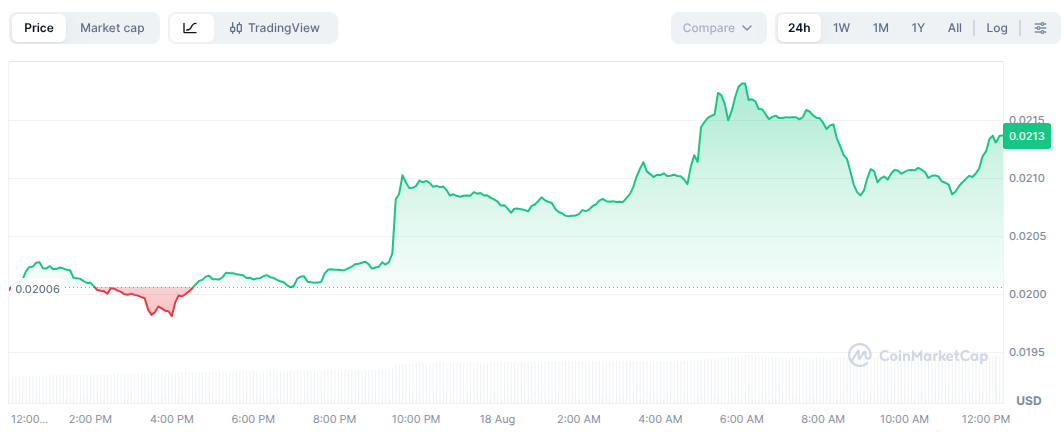
As of 6:46 a.m. UTC, MON was trading at around $0.02125, roughly 15% below the $0.025 price paid by public investors in Monad’s Coinbase token sale last November. Its market cap sits near $251 million on about 11.8 billion circulating tokens, a fraction of the roughly $2.1 billion the full 100.7 billion token supply would be worth once everything unlocks. Investors already sitting on a token worth less than they, paid for it were offered a discounted exit anyway, and turned it down.
The math behind the $60 million cap
Monad’s own tokenomics, published in November 2025, allocated 19.7% of MON’s total supply, about 19.6 billion tokens, to early investors. At current prices, that position is worth roughly $415 million. A $60 million buyback, even bought at a discount, could only ever have absorbed a small share of it: under 15% of investor holdings at full price, and somewhat more at a discount, but nowhere near half. The size of that locked supply also matters as Monad faces growing activity and security challenges, including the recent Monad DeFi hack
Monad’s statement also specified the offer went to “certain early investors,” not the full investor base. Combined with the size of the cap, that suggests a targeted program aimed at holders who wanted out, not a test of how the entire 19.6 billion locked investor position might trade once it’s free to move.
What Monad has and hasn’t said
The foundation was direct about one thing it says it hasn’t done. In the same statement, it said it “has not sold, offered to sell, or sought to sell any MON via OTC or otherwise” and is not currently running any such process.
The buyback, in other words, was framed as a bounded, now-closed program, not an ongoing search for buyers of locked supply. Monad has not said how many investors it approached, what discount it offered, or how much of the $60 million it actually spent.
Monad’s Investors Stay Put
Buybacks aimed at insiders don’t always land the same way. OpenAI closed a $7 billion tender offer this month, buying back employee shares at an $852 billion valuation, a size that points to plenty of employees wanting to cash out. World Liberty Financial had the opposite experience earlier this year.
A plan to unlock 62.3 billion tokens surfaced alongside a $75 million loan tied to insiders posting locked tokens as collateral, and WLFI’s price fell around 12% the day the loan became public. Monad’s result sits between those two. Nobody has accused the foundation of doing something insiders needed to hide, the way WLFI’s critics did, but unlike OpenAI’s tender offer, the people Monad approached mostly stayed put.
An unlock schedule that doesn’t add up
When Monad’s investor tokens actually become liquid matters more here than the buyback itself. The November 2025 tokenomics document said unlocks would begin in the second half of 2026 and increase quarterly through the end of 2029. The schedule described this week, though, puts it differently: monthly releases starting around November 24, 2026, the one-year anniversary of mainnet launch.
That gap matters because it’s the same lock-up Monad cited as the reason for offering a discount in the first place. Investors who turned down $60 million are betting on how, and when, close to 20 billion locked tokens eventually reach the market, and the exact shape of that release is still not settled.
Growth continues, regardless
Deposits across Monad’s DeFi apps grew from about $360 million on July 2 to roughly $895 million by mid-August, an increase of about 150% in six weeks. Aave’s Monad market crossed $100 million in deposits within two days of launching in early July, with $75 million of that arriving in the first 24 hours. Monad Foundation backed the launch with $15 million in incentives over its first year and agreed to hold at least 10 million GHO for six months.
Monad is climbing while the token that secures and prices that usage trades below what both its earliest backers and its public buyers paid for it, and the Monad Foundation’s acquisition of Ponder adds another layer to its broader ecosystem expansion, while most investors who could have taken a discounted exit chose to keep waiting instead. Whether that reflects confidence in where MON goes once the disputed unlock schedule actually arrives is something only the next several months will show.
Disclaimer: Cryip's content is strictly for educational and informational purposes and does not constitute financial, legal, or investment advice. Cryptocurrency involves significant risk, and readers assume full responsibility for their own financial decisions. Asset references are never endorsements.
To make complex crypto topics accessible to readers at all experience levels, our team uses AI tools strictly to refine language, correct grammar, and simplify terminology. AI is never used to draft facts, source information, or form conclusions. Every article is fact-checked and approved by a human editor before publication. Read our full AI Use & Content Policy.