


The Securities and Exchange Commission is developing a rulemaking framework for crypto token offerings under authority it already holds. Congress, through the Digital Asset Market Clarity Act, is trying to write a statute that would settle the same jurisdictional questions on a more permanent basis.
Neither effort has produced a final answer, and the dollar thresholds each would set are far enough apart that the choice between them will matter to which one crypto issuers end up relying on if both eventually take effect.
A scheduled August 14 open meeting on a framework the agency calls “Regulation Crypto” was canceled a day earlier, with no replacement date announced, according to the SEC’s. It is the clearest recent evidence of a pattern: an agency-level effort that keeps advancing in outline but keeps slipping in execution, running alongside a legislative effort that keeps losing ground in the Senate.
The broader institutional interest in crypto ETFs is also visible in Canada. National Bank of Canada recently disclosed holdings in XRP and Bitcoin ETFs, adding to the growing footprint of traditional financial institutions in regulated crypto investment products.
The SEC’s framework, and the meeting that did not happen
The SEC’s effort traces to remarks SEC Chair Paul Atkins gave on March 17, 2026, in which he described, in his own words, illustrative figures. A startup exemption would let early-stage projects raise “up to a defined amount (say $5 million)” over as long as four years, with notice-based filings rather than full registration.
A separate, larger fundraising exemption would let issuers raise “up to a defined amount (say $75 million) during any 12-month period,” with audited financials and semiannual reporting loosely modeled on existing Regulation A+ offerings. A third piece would let a token exit securities treatment once its issuer has completed or permanently ceased the “essential managerial efforts” it promised buyers at launch, after which transfer restrictions and exchange-registration requirements would fall away, though anti-fraud rules would still apply.
The SEC’s own Sunshine Act notice and meeting agenda for August 14 described the item narrowly: the Commission was to “consider whether to issue a release proposing new rules to create a tailored offering regime for certain investment contracts involving crypto assets.”
🚨Scooplet: The @SECGov’s tokenization innovation exemption has been “further delayed,” with details expected to remain under wraps for the time being, per a source familiar with the matter.
Part of the reason, I’m told, could be that the tokenization section of the Clarity Act…
— Eleanor Terrett (@EleanorTerrett) August 13, 2026
The delay extends beyond Regulation Crypto. On Aug. 13, Eleanor Terrett reported that the SEC’s tokenization innovation exemption was further delayed, possibly due to negotiations over Section 10505 of the CLARITY Act.
The $5 million and $75 million figures, they are numbers Atkins floated in a speech, attached to a rulemaking step that has not happened. A formal SEC rule carries legal weight once adopted, but it arrives through a slower and more reversible process than a statute.
It requires notice-and-comment rulemaking, it can be challenged in court, and a future Commission can revise or unwind it without needing Congress. Atkins has acknowledged this limitation himself, calling his own framework “merely a head start on legislation” and saying that “only Congress can ensure that regulation in this area is future-proofed.”
Congress’s harder path
The CLARITY Act is the vehicle meant to provide a more durable answer, and it currently sits below the threshold it needs to advance. Senate Majority Leader John Thune filed a cloture motion on August 8, and the chamber has set September 15 as the date for its first procedural vote when lawmakers return from recess. That vote requires 60 yes votes to proceed, a bar that generally means Republicans need roughly ten Democratic votes on top of their own conference. Passage would still require resolving disagreements over illicit-finance protections, stablecoin provisions, and an ethics dispute tied to senior officials’ personal crypto holdings.

Galaxy Research, the research arm of Galaxy Digital, has cut its estimate for 2026 passage twice this summer: from a high near 75% after an earlier bipartisan Senate Banking Committee vote, down to 50%, and then to 30% in a July 24. Galaxy’s Alex Thorn attributed the latest cut to a shrinking legislative calendar, writing that “the calendar is no longer merely an obstacle.
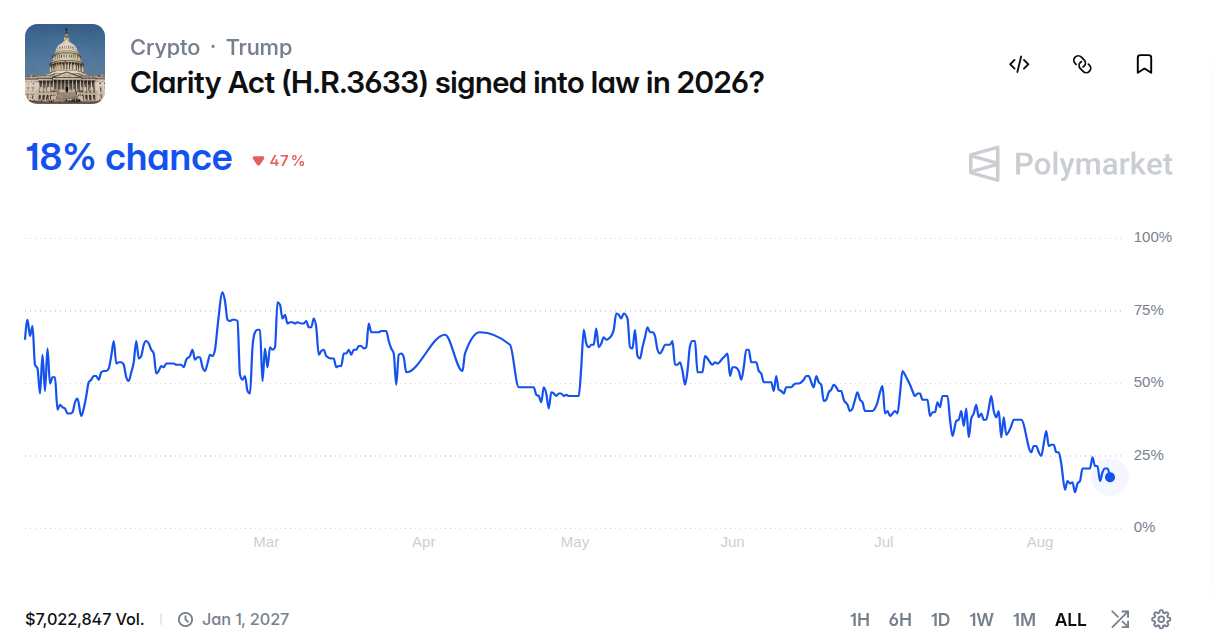
Polymarket traders put the odds of the CLARITY Act becoming law in 2026 at 18% on Aug. 14. ” On Polymarket, where traders bet directly on whether the bill will be signed into law in 2026, the contract was priced at 21% as of August 14, down from a peak near 82% in February and down from a 16% reading a week earlier on August 7.
Where the two tracks diverge
Set next to each other, the SEC’s illustrative figures and CLARITY’s statutory figures show how differently the two paths would treat the same crypto issuer.
| SEC’s Regulation Crypto (illustrative, unadopted) | CLARITY Act (as introduced) | |
|---|---|---|
| Smaller, early-stage raise | Approximately $5 million, over up to four years | $50 million per year, for up to four years, or 10% of outstanding ancillary-asset value, whichever is greater |
| Larger raise | Approximately $75 million, in any 12-month period | $200 million aggregate lifetime cap |
| Legal form | Chairman’s outline, no adopted rule text | Statutory text, pending Senate passage |
The SEC’s approach is more conservative in scale but can move, in theory, without a legislative supermajority. Congress’s approach is more generous in scale but has to survive a 60-vote threshold currently working against it.
- Feb. 2026: Polymarket’s CLARITY Act contract peaks near 82%.
- Mar. 17, 2026: SEC Chair Paul Atkins outlines Regulation Crypto concepts, including the $5M and $75M figures.
- Jul. 24, 2026: Galaxy Research cuts CLARITY passage odds to 30% from 50%.
- Aug. 7, 2026: Polymarket’s CLARITY contract priced at 16%.
- Aug. 8, 2026: Senate Majority Leader John Thune files cloture motion on CLARITY Act.
- Aug. 11, 2026: SEC sets Aug. 14 open meeting to consider proposing Regulation Crypto.
- Aug. 13, 2026: SEC cancels the Aug. 14 meeting, cites scheduling issue.
- Aug. 14, 2026: Polymarket’s CLARITY contract priced at 21%.
- Aug. 20, 2026: CFTC’s first Innovation Advisory Committee meeting, agenda includes crypto asset regulation.
- Sept. 15, 2026: Scheduled Senate cloture vote on the CLARITY Act.
- Nov. 2026: Hester Peirce’s planned departure from the SEC.
A departure that adds its own clock
SEC Commissioner Hester Peirce, who has pushed for a crypto safe harbor since a first version of the idea in 2020, is set to leave the agency in November 2026 for a faculty position at Regent University’s law school.
One of the framework’s most consistent internal advocates could be gone from the Commission around the same period any rescheduled vote might occur, which adds uncertainty about who inside the agency carries the framework forward.
The CFTC is building its own track, too
The Commodity Futures Trading Commission holds the first meeting of its newly created Innovation Advisory Committee on August 20, with an agenda that explicitly includes crypto asset regulation alongside artificial intelligence and prediction markets.
The CFTC currently lacks the standing, day-to-day authority over crypto spot markets that CLARITY would grant it by statute, so convening an advisory body is one of the few tools it has in the meantime. It confirms that federal crypto policy is developing across more than one agency at the same time.
Why the distinction between rulemaking and legislation matters
Delays and stalls happen routinely and rarely warrant close attention on their own. What makes this moment worth tracking is the question underneath both: whether U.S. crypto regulation ends up built primarily through agency rulemaking, primarily through congressional statute, or through a combination where each fills gaps the other leaves. That distinction has consequences for the crypto industry.
A rule built by the SEC alone can change the next time the Commission’s composition changes, which makes it a weaker foundation for a company planning a multi-year token issuance. Companies deciding how to structure a raise right now are, in effect, choosing between a faster but less durable path and a slower, uncertain, but more permanent one, without knowing the final shape of either.
Congress has the CLARITY Act, has come closer than it has in years to a market-structure vote, and has the ability to draw a permanent line between the SEC’s and CFTC’s jurisdiction that no agency rule can guarantee, but that same bill sits below the 60 votes it needs, with two independent measures of its odds trending down.
Five markers will show which track actually moves first: whether the SEC announces a new date for its Regulation Crypto meeting; how the CFTC’s Innovation Advisory Committee frames crypto policy when it convenes on August 20; whether the Senate finds 60 votes on September 15; who inside the SEC carries the safe harbor argument forward after Hester Peirce leaves in November; and, longer term, whether Congress eventually passes a statute that supersedes, absorbs, or collides with whatever the SEC has built by then. None of those outcomes is fixed yet, and how they land will determine which set of rules the crypto industry has to live with.
Disclaimer: Cryip's content is strictly for educational and informational purposes and does not constitute financial, legal, or investment advice. Cryptocurrency involves significant risk, and readers assume full responsibility for their own financial decisions. Asset references are never endorsements.
To make complex crypto topics accessible to readers at all experience levels, our team uses AI tools strictly to refine language, correct grammar, and simplify terminology. AI is never used to draft facts, source information, or form conclusions. Every article is fact-checked and approved by a human editor before publication. Read our full AI Use & Content Policy.