




In a stark reminder of the risks inherent in decentralized finance (DeFi), an anonymous trader executed a massive swap on March 12, 2026, converting approximately $50 million in USDT into just a fraction of its intended value, roughly $36,000 worth of AAVE tokens, due to extreme price impact and slippage.
The incident unfolded through the official Aave interface, where the user attempted to purchase AAVE governance tokens using $50 million worth of USDT (deposited as collateral in the form of aEthUSDT on Aave V3). On-chain records indicate the trade was routed via CoW Protocol (an aggregator integrated with Aave), passing through Uniswap V3 for an intermediate swap to WETH, before landing in a low-liquidity SushiSwap pool. This path resulted in catastrophic price impact, estimated at over 99%, leaving the trader with only about 324–327 aEthAAVE tokens. At prevailing market prices around $111–$112 per AAVE, the received tokens were valued at approximately $36,000–$36,400, representing an effective loss of nearly $49.96 million from the original order size.
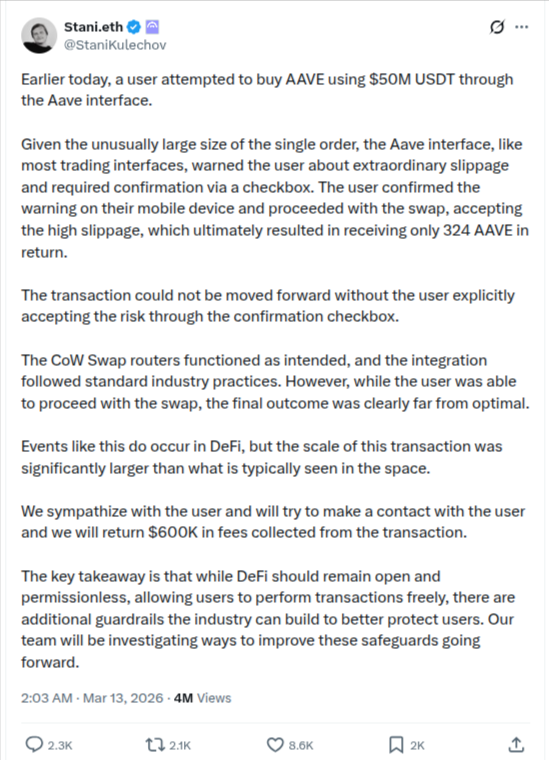
Aave’s Official Response
Aave founder and CEO Stani Kulechov addressed the matter directly on X (formerly Twitter) shortly after the transaction. In a detailed statement, he confirmed:
-
The order’s unusually large size triggered an explicit warning in the Aave interface about “extraordinary slippage.”
-
The platform required the user to manually check a confirmation box acknowledging the extreme risk.
-
The trader accepted the warning on a mobile device and proceeded with the swap.
-
CoW Protocol’s routing and integration operated as designed, following standard industry practices.
-
No protocol exploit or hack occurred; the outcome stemmed from the user’s explicit acceptance of the quoted terms.
Kulechov expressed sympathy for the trader, stating the Aave team would attempt to contact them and refund approximately $600,000 in fees collected from the transaction as a goodwill gesture. He emphasized that while DeFi must remain open and permissionless, the industry should explore additional safeguards to prevent such extreme user errors in the future.
Aave engineer Martin Grabina provided further technical clarification, noting that the core issue was not the slippage tolerance setting (which was around 1.21% as suggested), but the quoted price impact shown upfront, indicating the $50 million order would yield far fewer than 140 AAVE tokens before fees. The user reportedly received a small surplus via CoW’s auction mechanism, confirming the mechanics functioned correctly.
Broader Implications for DeFi
This event highlights persistent challenges in permissionless trading environments:
-
Liquidity Risks: Large orders in shallow pools can cause massive price shifts, amplified by automated market makers (AMMs) and aggregators.
-
User Interface Warnings: Multiple alerts and confirmations were present, yet the user proceeded. This raises questions about whether stronger behavioral nudges or hard limits could help.
-
MEV and Arbitrage: Reports suggest significant value flowed to arbitrage bots and block builders during execution, underscoring how MEV (Miner Extractable Value) can capture profits from such mispriced trades.
The wallet involved was reportedly funded from Binance about 20 days prior, though the trader’s identity remains unknown. No evidence suggests foul play on the protocol side.
As DeFi continues to mature, incidents like this serve as cautionary tales. Even sophisticated users can face devastating outcomes when bypassing warnings in high-volatility, low-liquidity scenarios. Aave has indicated it will review potential improvements to interface guardrails.
In a related development within the Aave ecosystem, ThomasG.eth sold 10,000 ETH worth $19.95 million to repay an Aave debt, highlighting how large Ethereum holders continue to manage significant DeFi positions.
Disclaimer: Cryip's content is strictly for educational and informational purposes and does not constitute financial, legal, or investment advice. Cryptocurrency involves significant risk, and readers assume full responsibility for their own financial decisions. Asset references are never endorsements.
To make complex crypto topics accessible to readers at all experience levels, our team uses AI tools strictly to refine language, correct grammar, and simplify terminology. AI is never used to draft facts, source information, or form conclusions. Every article is fact-checked and approved by a human editor before publication. Read our full AI Use & Content Policy.