



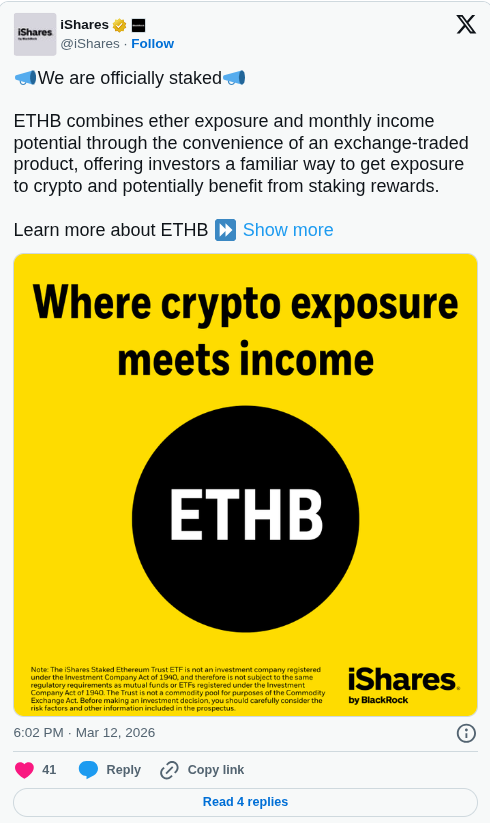
- BlackRock has launched the iShares Staked Ethereum Trust ETF (ETHB), its first crypto ETF incorporating Ethereum staking.
- The fund serves as a staking-enabled counterpart to the iShares Ethereum Trust ETF (ETHA), which holds about $6.6 billion in assets.
- ETHB launched with $107 million in assets, with around 80% currently staked.
- The ETF will convert staking rewards into cash and distribute them to investors monthly.
- Expense ratio will eventually match ETHA at 0.25%, with partial fee waivers initially.
BlackRock Introduces Staking-Enabled Ethereum ETF
BlackRock has launched its first cryptocurrency exchange-traded fund that incorporates staking, the iShares Staked Ethereum Trust ETF (ETHB). The fund debuted on Thursday and is designed as a staking-focused counterpart to the iShares Ethereum Trust ETF (ETHA).
ETHA, which launched in June 2024, currently manages approximately $6.6 billion in assets. ETHB will eventually carry the same 0.25% expense ratio as ETHA, although some fees will be temporarily waived during the early phase of the fund.
The new ETF launched with $107 million in assets, with roughly 80% of the ether held by the fund already staked.
How Staking Works in the ETF
The primary distinction between ETHA and ETHB is the inclusion of staking. Staking involves locking cryptocurrency to help validate transactions on a blockchain network. In return, participants receive rewards, allowing investors to earn yield while supporting the network’s operations. According to the fund’s prospectus, between 70% and 95% of ETHB’s ether holdings will be staked under normal market conditions.
Current Ethereum staking yields are just below 3%, though the exact return for investors depends on the percentage of assets staked and the fees associated with staking services. Under existing IRS guidance, staking rewards are typically taxed as ordinary income.
Distribution Model for Rewards
ETHB will distribute staking rewards as cash payments to investors on a monthly basis. The process involves converting staking rewards generated in ether into cash before distribution.
This structure mirrors the approach used by the Grayscale Ethereum Staking ETF (ETHE). ETHE manages approximately $1.8 billion in assets and charges a 2.5% expense ratio, distributing staking rewards to investors regularly.
Another fund, the Grayscale Ethereum Staking Mini ETF (ETH), takes a different approach. Instead of distributing rewards, the fund accumulates the ether generated from staking, increasing the amount of ETH backing each share. The Mini ETF also manages about $1.8 billion in assets and charges a 0.15% expense ratio.
Staking Levels and Fees
The percentage of assets currently staked varies among these funds:
- ETHB: ~80% of assets staked
- ETHE: ~66% staked
- ETH: ~62% staked
All three ETFs rely on Coinbase and third-party validators to manage the staking process. ETHB will take 18% of staking rewards as a service fee, compared with 23% for ETHE and about 6% for the Grayscale Mini ETF.
Why BlackRock Created a Separate Staking ETF
BlackRock’s decision to launch ETHB separately rather than integrating staking into ETHA may reflect different investor preferences. Some investors may prefer direct exposure to ether without the operational risks associated with staking. Validators responsible for securing the network can face penalties through a process known as slashing if they experience technical failures or behave improperly.
However, if staking operations are conducted reliably through institutional custodians and validators, staking-enabled ETFs could potentially generate higher returns than funds that simply hold ether. Over time, this feature may increase their appeal among investors seeking yield alongside crypto exposure.
Disclaimer: Cryip's content is strictly for educational and informational purposes and does not constitute financial, legal, or investment advice. Cryptocurrency involves significant risk, and readers assume full responsibility for their own financial decisions. Asset references are never endorsements.
To make complex crypto topics accessible to readers at all experience levels, our team uses AI tools strictly to refine language, correct grammar, and simplify terminology. AI is never used to draft facts, source information, or form conclusions. Every article is fact-checked and approved by a human editor before publication. Read our full AI Use & Content Policy.