



The infrastructure to launch a token has never been more accessible. Launchpads, liquidity bootstrapping pools, and no-code deployment tools have turned what once required months of engineering into a process measured in days. Yet the data tells a different story about what happens next.
A growing share of on-chain projects that successfully reach TGE lose operational momentum within their first 60 to 90 days. Community engagement drops. Brand messaging fragments across Discord, Twitter, and documentation. Founders find themselves managing a patchwork of analytics dashboards, communication tools, and operational workflows that were never designed to work together.
The problem, according to Aquads, is not that founders lack the ability to launch. It is that they lack the infrastructure to run a project after the launch.
From Launchpad to Distribution Layer
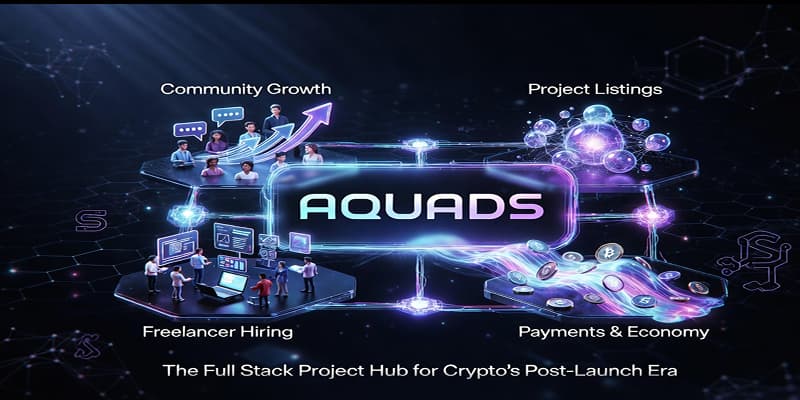
Aquads is positioning itself as a full-stack project hub built specifically for on-chain projects. Rather than competing with launchpads on token sale mechanics, the platform focuses on the post-TGE lifecycle: community retention, brand consistency, and operational coordination.
The approach treats project success as a continuous function rather than a single event. Features are structured around the idea that a token launch is the starting line, not the finish line, with tooling that supports community engagement, unified brand guidelines, and streamlined project operations under one architecture.
A Playbook for the Full Lifecycle
Earlier this month, Aquads published The Complete Playbook for Launching On-Chain Token Projects in 2026, a framework that maps the full arc from pre-launch preparation through post-launch scaling. The playbook has drawn attention for its emphasis on sustainability over speculation, a framing that stands out in a market still dominated by launch-day hype metrics.
The release signals Aquads’ broader thesis: that the next phase of on-chain project growth will be defined by operational maturity, not just token distribution.
Why Now
The timing aligns with a broader shift in the crypto market. As regulatory frameworks tighten and retail investors demand more transparency, projects that treat their operations with the same rigor as their smart contracts are increasingly separating themselves from the pack.
Aquads appears to be betting that this shift creates demand for infrastructure that treats post-launch project management as a first-class problem, not an afterthought.
“We didn’t build another launchpad because the market already has plenty of those. We built the distribution layer that keeps projects alive after the noise dies down,” said the founder of Aquads.
The platform is live at aquads.xyz. The 2026 playbook is available on the site.
Disclaimer: Cryip's content is strictly for educational and informational purposes and does not constitute financial, legal, or investment advice. Cryptocurrency involves significant risk, and readers assume full responsibility for their own financial decisions. Asset references are never endorsements.
To make complex crypto topics accessible to readers at all experience levels, our team uses AI tools strictly to refine language, correct grammar, and simplify terminology. AI is never used to draft facts, source information, or form conclusions. Every article is fact-checked and approved by a human editor before publication. Read our full AI Use & Content Policy.