



Harmony will replace the transaction history on two of its blockchain’s shards with a reviewed backup database, a fix the company says an outside security firm independently verified, it has issued since a forged-mint exploit hit the network on Aug. 11.
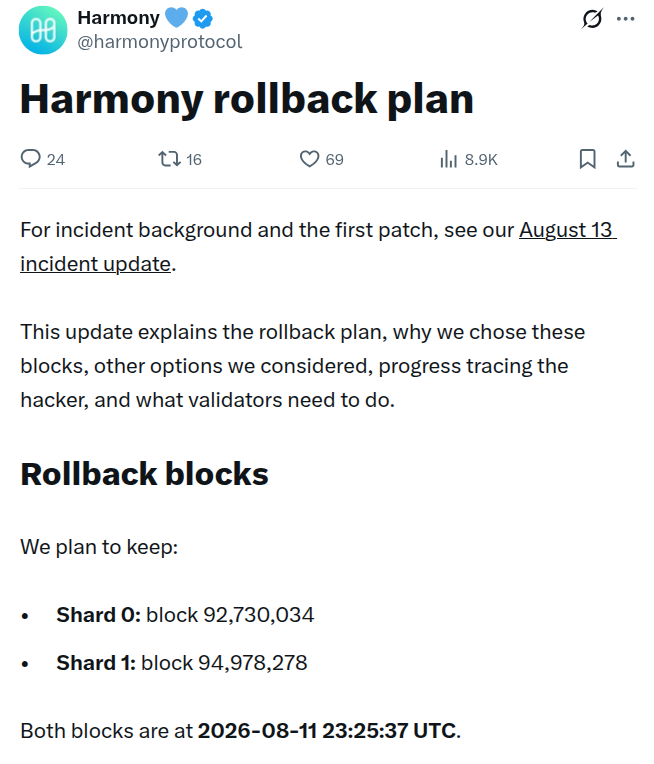
In a post published Aug. 17, Harmony said validators will keep shard 0 at block 92,730,034 and shard 1 at block 94,978,278, both timestamped 11:25:37 p.m. UTC on Aug. 11. Updated validator software rejects blocks after that point, and new blocks begin at heights 92,730,035 and 94,978,279.
Harmony chose that cutoff because the first confirmed forged mint entered shard 0 one block later, at 92,730,036, and the block in between carried no transactions, staking activity, or gas use at all, making it a clean line to hold.
An Irreversible Fix, Chosen After Ruling Out Five Others
Harmony said it considered and rejected five alternatives before settling on the replacement database: burning or repairing specific forged tokens, blacklisting wallets, replaying selected transactions, migrating to a new token, and a simple in-place chain revert.
It ruled out the targeted options because forged ONE had already moved through exchanges, pools, contracts and thousands of wallets by the time anyone caught it, and it ruled out a plain revert because Harmony’s own “revert” command mainly moves the chain head without clearing later receipts, indexes, or cross-shard state, which the company said could leave an attack path open or cause validators to disagree.
That reasoning also explains why almost none of the 109,126 regular transactions in the affected window survive the rollback, even the ones that look harmless on their face.
What Harmony’s Own Review Found
Harmony built a full archive of shard 0 covering 141,628 consecutive blocks, from the first block after its chosen cutoff through block 92,871,662, and sorted every regular transaction in that range into one of four groups:
- 22 transactions were simple transfers with no obvious link to another transaction, and Harmony still does not consider them safe to restore.
- 860 transactions raised balance, funding, nonce or later-spend questions.
- 80,630 transactions depended on contract or chain state that will have changed after the rollback.
- 27,614 transactions were failed, tied to the incident directly, or crossed an exchange, bridge or consolidation path.
- All 315 staking transactions in the window depend on chain and epoch state that no longer exists on the replacement database.
Of the transactions that will be discarded, 104,545, or 95.8 percent, were automated, and DEX bots alone accounted for 99,863 of them. Harmony’s point in publishing that split is that transaction count, but it cuts the other way too: a category that large and that automated is also the category regulators, exchanges and users have the least visibility into.
Two Different Counts of How Far the Forgery Spread
Its Aug. 17 report describes one forged-mint wallet that attempted 534 transfers of 5 billion ONE each in roughly two minutes, of which 477 went through, moving 2.385 trillion ONE in total. Five days earlier, Harmony’s own team had said it traced 10,288 transactions carrying forged tokens into 409 separate wallets.
| Reported | Figure | Scope | Source |
|---|---|---|---|
| Aug. 12, 2026 | 10,288 transactions across 409 wallets | Harmony’s early trace of forged tokens moving downstream | Harmony’s own team |
| Aug. 17, 2026 | 534 transfers attempted, 477 succeeded, 2.385 trillion ONE moved | A single forged-mint wallet’s outbound transfers | Harmony’s own rollback plan |
Harmony’s rollback post says “an independent third-party security firm separately reviewed the incident” and that its work “corroborated the forged mint and the main fund-flow findings.”
A search of Harmony’s own community forum, its X account, and coverage from more than a dozen outlets found no validator or community statement addressing this specific rollback plan as of Aug. 17.
Harmony’s validators went public with sustained complaints after the 2022 Horizon Bridge hack, including over a reimbursement plan that involved minting new tokens, so silence this time is not the network’s normal pattern and is worth tracking rather than reading as agreement.
Harmony’s Third Mint-Related Crisis Since 2022
After the June 2022 Horizon Bridge hack, which the FBI later attributed to hackers linked to North Korea, Harmony proposed minting 4.97 billion ONE to fully reimburse victims, or 2.48 billion for a 50 percent payout over three years.
The community response was overwhelmingly negative; one widely quoted comment called it “absolutely garbage” and demanded the team “go back to the drawing board.” In December 2023, a separate bug minted roughly 150 million ONE to 79 wallets, worth about $2.2 million, and the aftermath became its own dispute when Harmony staff accused a consultant of delaying a fix to profit from it, an accusation he denied.
How Chains Have Handled This Before
BNB Chain halted its network and executed a hard fork after an October 2022 cross-chain bridge exploit estimated near $100 million, a same-domain precedent for decisive chain-level intervention. Ethereum’s community, by contrast, debated and ultimately rejected a rollback after the February 2025 Bybit hack, on the grounds that unwinding a chain’s history undermines the premise the network is built on.
Harmony’s own post cites a wider list of precedents, including Bitcoin, Stellar, Zilliqa, Flow, Elastos, Nasdaq, OKX and the London Metal Exchange, as support for its choice, but the split outcomes at BNB Chain and Ethereum show that “similar incidents happened before” is not itself an argument for which path is right.
- Aug. 11, 2026, 11:25:37 p.m. UTC – The last clean block before the exploit is recorded on both shards; the forged mint enters shard 0 one block later, according to Harmony’s Aug. 17 account.
- Aug. 12, 2026 – Harmony confirms roughly 4 billion ONE were minted without authorization and asks exchanges to freeze funds tied to four wallet addresses. KuCoin suspends ONE deposits at 6:26 p.m. UTC the same day. Harmony’s team says it has traced 10,288 transactions into 409 wallets.
- Aug. 13, 2026 – Harmony posts an incident update alongside validator release v2026.1.1, which closes two receipt-verification flaws but leaves the excess supply already in circulation untouched.
- Aug. 17, 2026 – Harmony publishes its rollback plan, naming the checkpoint blocks, the 534-transfer figure, the 109,126-transaction review, and the unnamed third-party security review.
An on-record statement from even a handful of validators would show whether the network’s own operators are comfortable with a fix that discards 109,126 transactions on the strength of an internal review .
Disclaimer: Cryip's content is strictly for educational and informational purposes and does not constitute financial, legal, or investment advice. Cryptocurrency involves significant risk, and readers assume full responsibility for their own financial decisions. Asset references are never endorsements.
To make complex crypto topics accessible to readers at all experience levels, our team uses AI tools strictly to refine language, correct grammar, and simplify terminology. AI is never used to draft facts, source information, or form conclusions. Every article is fact-checked and approved by a human editor before publication. Read our full AI Use & Content Policy.