

- The Royal Government of Bhutan sent 300 BTC, worth about $19.28 million, to a newly created wallet on August 18, on-chain data shows.
- The receiving address carries no exchange label yet, the same signature Arkham Intelligence has tied to $162.6 million of Bhutan’s untagged 2026 outflows.
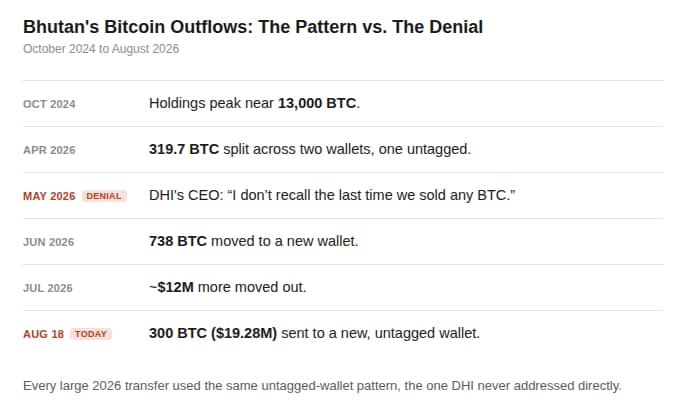
- In May, Druk Holding and Investments’ chief executive told reporters he was unaware of the government selling any bitcoin.
Bhutan’s sovereign Bitcoin wallet sent 300 BTC, worth roughly $19.28 million, to a freshly created address on August 18, according to Arkham Intelligence tracking data reviewed for this story. The destination wallet carries no exchange tag, meaning it isn’t yet linked to Binance, OKX, or any other trading venue. The transfer follows recent searches and reporting around Bhutan 250 BTC movements.

The Untagged-Wallet Signature
That untagged pattern matters because it isn’t new. Arkham Intelligence’s on-chain analysis found that $162.6 million of Bhutan’s 2026 outflows had passed through wallets “without clear ownership tags” before the funds moved on, including an April 9 transfer that split 319.7 BTC between a wallet previously used to route funds toward OKX and Galaxy Digital, and a second address with no prior activity. The pattern also includes the 519.7 BTC transfer on March 25, 2026, adding to the history of large Bhutan Bitcoin movements. Today’s transfer fits that same shape.
A CEO Who Says He Doesn’t Recall
It also lands three months after Bhutan’s government pushed back on the idea that it was selling bitcoin at all. In May, Ujjwal Deep Dahal, chief executive of Druk Holding and Investments, the state investment arm that runs Bhutan’s sovereign Bitcoin position, said, “I don’t recall the last time we sold any BTC.”
Numbers That Don’t Line Up
The dispute exists because the two sides of Bhutan’s Bitcoin story don’t line up. Arkham’s tracking showed Bhutan’s holdings falling from around 13,000 BTC in October 2024 to roughly 3,100 BTC by May 2026, with close to $1 billion moved to exchanges and trading firms over that stretch.
Bhutan’s holdings at 4,973 BTC as of today, a higher figure than Arkham’s mid-2026 estimates, likely a result of the two trackers clustering wallets differently rather than a sign Bhutan’s stack has grown.
Neither figure has been confirmed by DHI, which has also declined to say whether its hydropower-powered mining operation, running since 2019, is still active; Arkham noted the government’s wallets hadn’t recorded a mining inflow above $100,000 in more than a year.
The Case Against A Sale
The destination of today’s 300 BTC remains unclear. The same untagged-wallet pattern has, in past months, also been interpreted by at least one anonymous trading-firm source as evidence of custody or collateral arrangements rather than a direct sell-off. That interpretation becomes harder to sustain each time a new untagged transfer lands within weeks of a government denial and is not individually addressed by DHI.
What happens next is the actual test: every prior untagged Bhutan wallet this year has eventually fed into a labeled exchange deposit address within days to weeks. If this one does the same, it settles which reading was right. If it sits untouched, that’s the strongest evidence yet for DHI’s account.
Disclaimer: Cryip's content is strictly for educational and informational purposes and does not constitute financial, legal, or investment advice. Cryptocurrency involves significant risk, and readers assume full responsibility for their own financial decisions. Asset references are never endorsements.
To make complex crypto topics accessible to readers at all experience levels, our team uses AI tools strictly to refine language, correct grammar, and simplify terminology. AI is never used to draft facts, source information, or form conclusions. Every article is fact-checked and approved by a human editor before publication. Read our full AI Use & Content Policy.