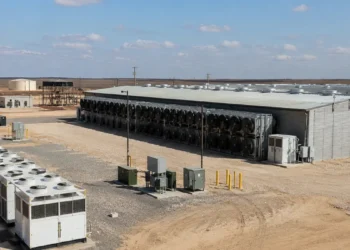


- Cypherpunk Mining launched August 18 with about 4.2 GSol/s of hashrate, roughly 18% of Zcash’s total network hashrate.
- The fleet came from Moria Mining, an affiliate of Winklevoss Treasury Investments, paid for entirely in stock warrants rather than cash.
- The deal pairs that hashrate with Cypherpunk’s separate goal of owning 5% of all ZEC in circulation, a combination Zcash’s mining sector.
Cypherpunk Technologies now controls roughly 18% of Zcash’s mining power, after paying $33.33 million in stock warrants for a fleet of machines bought from an affiliate of its own largest investor.
The Nasdaq-listed company announced Monday that its new mining subsidiary, Cypherpunk Mining, had acquired Z15 Pro machines and hosting agreements from Moria Mining LLC, a unit of Winklevoss Treasury Investments. Payment came as a pre-funded warrant for 43,290,042 shares at a $0.001 exercise price, working out to roughly $0.77 a share, rather than cash. Cameron and Tyler Winklevoss said in the announcement that “up until now, investors have had limited options for Zcash mining exposure.”
Missed the announcement this morning?
The TL;DR:
– Cypherpunk launched the largest Zcash mining fleet in the world, in the US
– ~18% of network hashrate
– Kevin Zhang, leading mining expert and veteran, joins as Head of MiningCypherpunk holds ZEC. Now Cypherpunk mines ZEC.
— Cypherpunk (@cypherpunk) August 18, 2026
Why the deal stands out
The deal does more than make Cypherpunk a big miner. It puts hashrate and token supply under the same roof. Cypherpunk already holds 323,394.38 ZEC, about 1.92% of everything in circulation, and has said it wants to reach 5%.
Now the same balance sheet also controls close to a fifth of the machines that produce new ZEC and validate the chain, following the Zcash Orchard vulnerability that exposed risks around the network’s shielded pool. No other entity holding a meaningful Zcash treasury has also built out mining infrastructure at this scale. That combination is what separates this deal from Zcash’s last brush with mining concentration.
How this differs from previous mining power shifts
In April, Foundry launched an institutional-grade Zcash mining pool that captured about 30% of network hashrate at launch, a bigger share than Cypherpunk holds today. Foundry runs it as a pooling service. Miners route their machines through Foundry’s pool, but Foundry doesn’t own the hashrate or accumulate ZEC itself. Zcash creator Zooko Wilcox welcomed the launch at the time, saying he was “happy that Foundry is bringing their institutional credibility and long-term commitment to Zcash.”
Cypherpunk’s arrangement is different in kind. It owns the machines and is building a ZEC treasury on top of that hashrate, meaning the same company benefits from block rewards, from any future ZEC price appreciation, and from influence over the network’s mining layer at once.
Inside the $33.3 million mining acquisition
Kevin Zhang joins Cypherpunk as head of mining. The company says he:
- Began mining Bitcoin in 2014 and Zcash in 2016.
- In 2019, he led the first conversion of a North American power plant into a Bitcoin mining site.
- He previously built a large Bitcoin mining pool at Foundry.
Cypherpunk’s chief investment officer, Will McEvoy, said the mining operation gives the company “financial and operational flexibility to fund future growth,” and that current Zcash mining economics generate about $450 per megawatt-hour in revenue, compared with about $223 for AI data-center colocation.
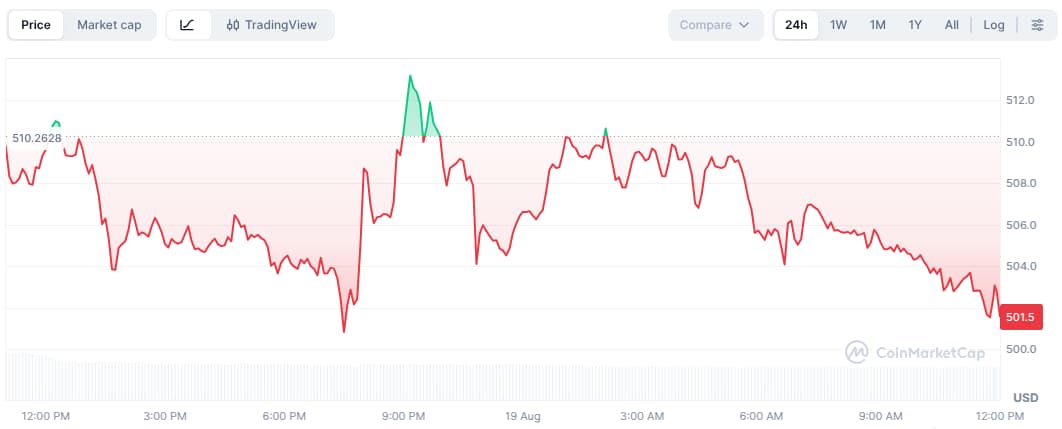
As of 06:23 UTC, Zcash (ZEC) is trading at $503.38, down 1.11% over the past 24 hours. Its market capitalization is around $8.47 billion, while 24-hour trading volume stands at $263.7 million. ZEC has a circulating supply of 16.82 million, with a maximum supply of 21 million ZEC.
Winklevoss Treasury Investments’ representatives, Khing Oei and Will McEvoy, already sit on Cypherpunk’s board, and the investment vehicle is said to hold about 19.9% of Cypherpunk’s shares, meaning the same group sits on both sides of Monday’s transaction.
- Expand Cypherpunk’s share count from around 108 million to roughly 151 million.
- Result in a dilution of almost 29%.
- Allow only about 5.37 million of those shares to be issued without a separate shareholder vote.
How Cypherpunk got here
Cypherpunk was, until November 2025, Leap Therapeutics, an oncology biotech developing cancer treatments. It rebranded after Winklevoss Capital led a $58.88 million private placement, and used $50 million of that to buy 203,775.27 ZEC at an average price of $245.37.
Zcash creator Zooko Wilcox joined as a strategic adviser the following month. In March, Cypherpunk put $5 million into the Zcash Open Development Lab alongside a16z, Winklevoss Capital, Coinbase, and Paradigm, and reported its first full-year profit, $4.8 million, on unrealized ZEC gains.
The company kept buying through the spring, adding 9,163.32 ZEC in April at $234.63 apiece. By mid-May its treasury had grown to 314,185.70 ZEC, about 1.88% of supply, even as a $77.2 million mark-to-market loss on that same treasury pushed its first-quarter results into the red.
In June, Zcash’s developers disclosed a critical Zcash minting bug in the network’s Orchard shielded pool that could have let someone create counterfeit ZEC. The flaw was patched before it was exploited, but ZEC fell more than 50% and Cypherpunk’s stock dropped about 40% in the panic that followed.
McEvoy told the market at the time that Cypherpunk remained “firmly committed to our 5% network accumulation target,” arguing Zcash had just demonstrated “the institutional-grade security culture that will survive the AI era.” Cypherpunk’s own account posted, “Please stop the FUD.”
What comes next for Cypherpunk and Zcash
Cypherpunk still has to grow from roughly 2% of ZEC supply to its stated 5% target, and it now controls close to a fifth of the hashrate that produces new coins along the way. With the Zcash Ironwood upgrade also part of the network’s ongoing development, whether that combination draws the kind of scrutiny ViaBTC’s 2023 concentration eventually did, or whether it simply becomes the template other treasury companies follow, is the open question the deal leaves behind.
Disclaimer: Cryip's content is strictly for educational and informational purposes and does not constitute financial, legal, or investment advice. Cryptocurrency involves significant risk, and readers assume full responsibility for their own financial decisions. Asset references are never endorsements.
To make complex crypto topics accessible to readers at all experience levels, our team uses AI tools strictly to refine language, correct grammar, and simplify terminology. AI is never used to draft facts, source information, or form conclusions. Every article is fact-checked and approved by a human editor before publication. Read our full AI Use & Content Policy.