



- Bitcoin broke $77,000 on August 21, up from a close near $72,600 the day before.
- A short squeeze on August 19-20 wiped out more than $3 billion in short positions in one continuous move, not two separate squeezes.
- Spot Bitcoin ETFs took in $517 million on August 19 and $606 million on August 20, according to Farside Investors.
Bitcoin broke $77,000 on August 21, up from a close near$72,600 the day before, extending a rally that began with a short squeeze on August 19.
The Squeeze Behind the Move
The rally’s mechanical starting point was a short squeeze on August 19. CoinGlass data show roughly $2.7 billion in crypto positions were liquidated that day, most of it shorts betting against a price rise. Bitcoin’s own shorts accounted for about $1.6 billion of that total.
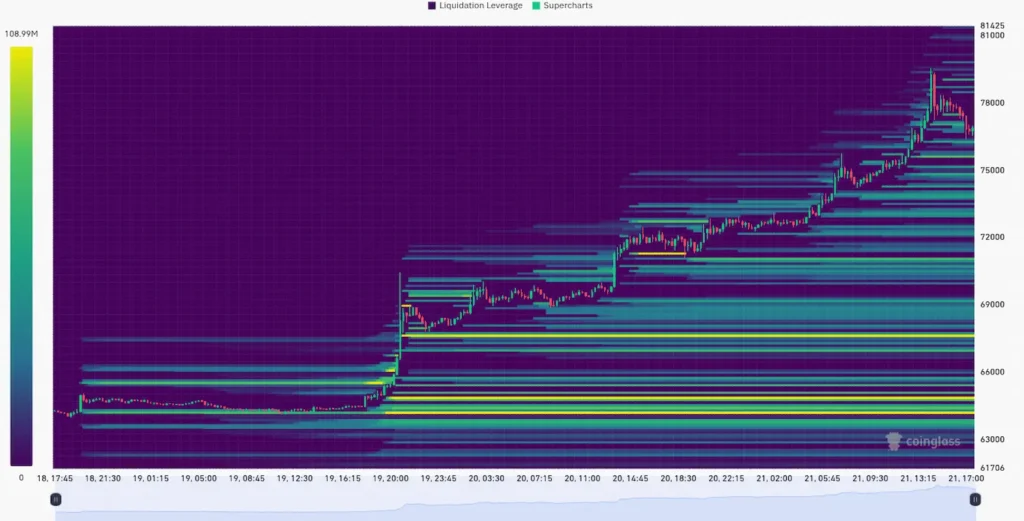
By the close of trading on August 20, the cumulative two-day short liquidation total had climbed past $3 billion, a single continuous unwind rather than two separate squeezes.
Two Washington Events, Same Day
The same day the squeeze began, two separate developments landed in Washington. The Treasury Department announced it would raise the maximum size of its long-end bond buyback operations, covering 10-to-30-year securities, from $2 billion to at least $4 billion per operation, effective September 9. Treasury Secretary Scott Bessent said the following day that the size “could be more than $4 billion per issue.”
Also on August 19, President Trump hosted crypto and prediction-market executives at the White House and called on Congress to pass “a fair version” of the Clarity Act, digital-asset legislation stalled in the Senate. CFTC Chairman Michael Selig said the agency “stands ready to implement” the bill once it’s signed into law, days after accusing Senate Democrats of holding up the same legislation.
The ETF Money Moved Separately
Spot Bitcoin ETFs took in $517 million on August 19 and $606 million on August 20, according to Farside Investors, with BlackRock’s IBIT fund leading the August 20 inflows at $503 million. Spot Ether ETFs added another $189 million on August 19.
| Date | IBIT (BlackRock) | All Other Spot BTC ETFs Combined | Total Net Inflow |
| Aug 19, 2026 | $284.7M | $232.5M | $517.2M |
| Aug 20, 2026 | $503.0M | $103.3M | $606.3M |
That money represents a different kind of buyer than the leveraged short-sellers being forced out in the squeeze: institutional and retail demand moving through regulated funds, not derivatives positions unwinding.
What Treasury Actually Said
Treasury, the CFTC, and the White House each described their own actions in terms that had nothing to do with Bitcoin. Treasury’s press release describes the buyback increase as a response to “strong sponsorship from market participants” in the market for long-dated government debt. It doesn’t mention cryptocurrency anywhere. Selig’s remarks were about implementing pending legislation, not about backing a price level. Trump’s comments concerned the Clarity Act’s passage, not the exchange rate.
The link between these events and Bitcoin’s move to $77,000 is a connection drawn in coverage of the story, not one Treasury, the CFTC, or the White House made themselves. The trading mechanism is simpler: a squeeze forced a wave of covering trades, and ETF demand kept the move going for two more days.
What Would Change This Read
Two things would undercut it. If Treasury or the White House states directly, in a future release or briefing, that the buyback timing or the executive meeting was meant to support crypto markets, the framing gap closes. And if derivatives data eventually shows the squeeze only accelerated after the buyback news broke, rather than running on its own momentum, that would tie the mechanism back to the policy events after all. Neither has happened yet.
Disclaimer: Cryip's content is strictly for educational and informational purposes and does not constitute financial, legal, or investment advice. Cryptocurrency involves significant risk, and readers assume full responsibility for their own financial decisions. Asset references are never endorsements.
To make complex crypto topics accessible to readers at all experience levels, our team uses AI tools strictly to refine language, correct grammar, and simplify terminology. AI is never used to draft facts, source information, or form conclusions. Every article is fact-checked and approved by a human editor before publication. Read our full AI Use & Content Policy.