


- Ripple is investing as a limited partner in a new RLUSD lending fund built with Clearpool and Cicada Partners, on the same terms as other backers and with no dollar amount disclosed.
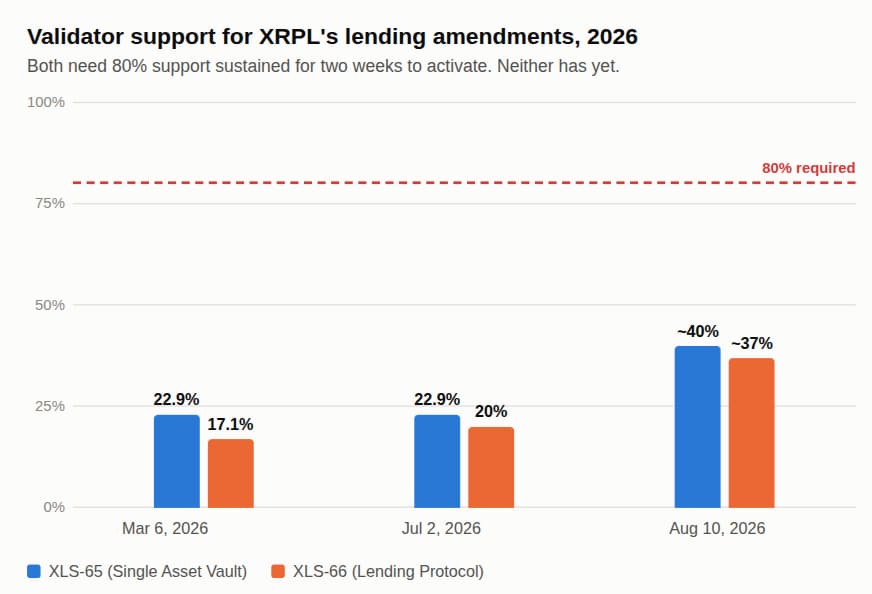
- The fund cannot lend a dollar on the XRP Ledger’s main network until two pending amendments clear an 80% validator supermajority; support sat near 37-40% as of August 10, up from roughly 17-23% in March.
- Halborn’s re-audit of the lending code closed out with zero critical or high-severity findings, one of several security steps completed before that vote.
The number that actually decides whether this fund does anything this year is a validator vote, and it is still short. Two amendments to the XRP Ledger, called XLS-65 and XLS-66, need 80% of network validators voting yes for two straight weeks before the ledger can natively issue, service and repay loans on its own rails. As of the most recent public tally on August 10, XLS-65 sat near 40% and XLS-66 near 37%. Both have roughly doubled since a March reading of 17% to 23%, but both remain about half of what mainnet activation requires.
What Clearpool and Cicada Actually Built
Ripple, Clearpool and Cicada Partners announced a joint lending initiative this week that would let fintechs, payment firms and crypto service companies borrow RLUSD for working capital and repay it in the same stablecoin. Clearpool, which says it has facilitated more than $950 million in institutional loans since 2021, is building the credit infrastructure.
Cicada Partners, which has underwritten more than $860 million in credit, acts as general partner, sourcing borrowers, setting loan covenants and monitoring their financial health. Ripple’s own role is narrower than the announcement’s tone suggests: one limited partner among several institutional co-investors, providing capital and settlement rails, not a backstop against losses.
The pitch, in Clearpool’s own words, is that this skips another circular DeFi yield loop. “An estimated 98% of yield in DeFi today comes from market mechanisms,” Clearpool wrote in its announcement. “The capital is mainly circular, not funding anything real.” RLUSD, in this design, flows to businesses with real payables and receivables instead of collateralizing more crypto trades.
Two Amendments Stand Between RLUSD and Mainnet
The catch is that none of it can run on mainnet yet. XLS-65 creates single-asset vaults, pools of one token managed under fixed rules; XLS-66 layers a lending protocol on top, handling loan terms, interest and repayment natively on the ledger instead of through a smart contract. Both are still confined to XRPL’s development network, where Clearpool and Cicada are testing the lender-borrower flow ahead of a technical demo.
Ripple has been building toward this for months, with the company also making a Ripple crypto adoption claim as part of its broader push for blockchain and digital asset use. The two amendments shipped for validator voting in late January, then went through nine rounds of review, by Ripple’s own account, including private audits from security firm Halborn, a $200,000 public bug bounty that surfaced 94 findings, and formal verification work. Halborn’s most recent re-audit closed with five outstanding issues, none rated critical or high, all since addressed, per Ripple. Ripple has called the underlying primitives “some of the most significant new financial capabilities added to the XRP Ledger since 2012.”
Ripple Is Both Referee and Backer Here
There is a structural wrinkle worth naming plainly. Ripple issues RLUSD, backs the ledger the fund would run on, and is now also an investor in a fund whose entire business is lending that same stablecoin at interest. The XRP ecosystem has also recently dealt with security concerns, including warnings over a fake XRP rewards scanner, highlighting the need for users to distinguish legitimate XRPL activity from fraudulent schemes. Clearpool and Cicada disclosed the arrangement themselves, and Ripple’s stake carries no guarantee against loss.
XRP was trading near $1.30 this week, up roughly 20% in 24 hours and about 30% over seven days, a run that coincided with both the fund announcement and separate news of an expanded U.S. Treasury bond buyback program. RLUSD’s own circulating supply has been climbing too, crossing 1.7 billion tokens in mid-August after a fresh $30 million mint, having passed $1.6 billion in market value back in May.
Every loan the fund eventually issues would also need XRP on hand to cover ledger fees and account reserves, which is the direct mechanism by which Ripple’s argument for XRP demand is supposed to work.
What Comes Next
Watch the validator numbers closely. If XLS-65 and XLS-66 hold 80% support for two consecutive weeks, the amendments activate and Clearpool’s devnet demo can move toward a mainnet launch. If support stalls in the 30s and 40s as it did through the spring, the fund Ripple just backed remains what it is today: a limited partnership and a plan, waiting on infrastructure that does not yet exist on the network it depends on. The move also comes as Ripple expands its regulated presence in Europe after securing a full MiCA license in Luxembourg, allowing it to provide regulated crypto-asset services across the European Economic Area.
Disclaimer: Cryip's content is strictly for educational and informational purposes and does not constitute financial, legal, or investment advice. Cryptocurrency involves significant risk, and readers assume full responsibility for their own financial decisions. Asset references are never endorsements.
To make complex crypto topics accessible to readers at all experience levels, our team uses AI tools strictly to refine language, correct grammar, and simplify terminology. AI is never used to draft facts, source information, or form conclusions. Every article is fact-checked and approved by a human editor before publication. Read our full AI Use & Content Policy.