




- Pakistan’s Virtual Assets Regulatory Authority opened its licensing portal on Aug. 22 and gave firms operating since March 5 until Sept. 5 to apply for a No-Objection Certificate or stop operating, under Section 70 of the Virtual Assets Act 2026.
- The regime spans 11 license categories, from exchanges and custody to stablecoin issuance, reached through a regulatory sandbox or a direct NOC application.
- PVARA Chairman Bilal Bin Saqib also runs the Pakistan Crypto Council, the body that has spent two years promoting the same industry he now licenses.
Every crypto firm that was operating in Pakistan on March 5 now has until Sept. 5 to file for a No-Objection Certificate or shut down. The Pakistan Virtual Assets Regulatory Authority opened its licensing portal on Aug. 22, completing a regulatory framework built in five months.
A historic shift for Pakistan’s financial system. 🇵🇰
In under 6 months of the Virtual Asset Act promulgation, Pakistan has now established a formal licensing regime for virtual asset service providers.
The licensing window is officially open, creating a clear pathway for… pic.twitter.com/q11GLXaRhE
— Pakistan Virtual Assets Regulatory Authority (@PakistanVARA) August 23, 2026
The man running that framework helped build the industry it now governs. PVARA Chairman Bilal Bin Saqib also serves as chief executive of the Pakistan Crypto Council, the government-linked body that has spent the past two years courting crypto exchanges and blockchain firms to set up in Pakistan.
Pakistan’s own civil service rules have already treated that kind of overlap as a problem once before. Saqib resigned as the prime minister’s special assistant on blockchain and crypto in December 2025, because the Rules of Business 1973 bar a special assistant from simultaneously chairing a statutory regulatory authority. The chairmanship and the council role were allowed to stand together.
What Existing Firms Must Do
The regulations create 11 categories of licensed activity: exchanges, custody, broker-dealing, advisory services, lending, derivatives, asset management, transfer and settlement, mining infrastructure, and two forms of stablecoin issuance. Firms can reach a full license through a regulatory sandbox, operating under supervision before graduating, or by securing an NOC first, incorporating locally, then completing the license application.
Either path requires Pakistani incorporation, minimum capital, background checks on directors and staff, and working anti-money-laundering and cybersecurity systems. Licensed firms must also keep customer assets segregated from their own and cannot lend or pledge customer holdings without written consent. In a national address posted by PVARA, Saqib said the segregation rule gives customer assets legal protection that did not exist before.
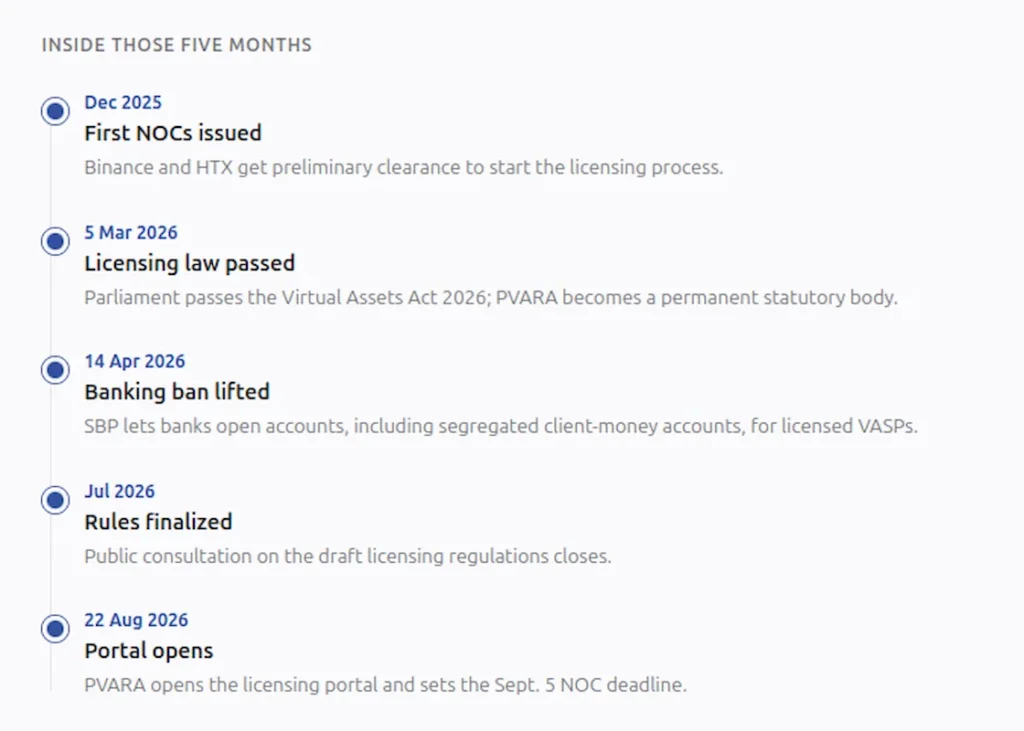
Banks were barred from touching virtual currencies for seven years, under a State Bank of Pakistan circular issued in 2018. That changed on April 14, when the central bank allowed banks to open accounts, including segregated client-money accounts, for PVARA-licensed firms.
How Fast This Moved
Pakistan spent seven years under a total banking ban on virtual currencies before any of this took shape. Almost everything below happened in the five months between March and August 2026.
Two Firms Already Inside
Binance and HTX are the only companies to have gone through any part of this process already. PVARA issued them preliminary NOCs in December 2025, months before the licensing portal existed.
“This is not our destination. This is the foundation of a building that you have to construct.”
Saqib used those words to describe the Binance and HTX approvals at the time, calling them the first step under what he called a risk-mitigated, phased, supervised entry framework rather than blanket permission to operate. Every other firm that was doing business in Pakistan on March 5, the day the Virtual Assets Act 2026 took effect, now has to reach that same starting point by Sept. 5, or stop.
PVARA has not said how it will enforce the Sept. 5 cutoff against firms that miss it, or whether companies with ties to the Crypto Council will face the same review as everyone else. Saqib’s council still lists building the industry as its mission. His authority now decides who gets to stay in it.
Disclaimer: Cryip's content is strictly for educational and informational purposes and does not constitute financial, legal, or investment advice. Cryptocurrency involves significant risk, and readers assume full responsibility for their own financial decisions. Asset references are never endorsements.
To make complex crypto topics accessible to readers at all experience levels, our team uses AI tools strictly to refine language, correct grammar, and simplify terminology. AI is never used to draft facts, source information, or form conclusions. Every article is fact-checked and approved by a human editor before publication. Read our full AI Use & Content Policy.