


The U.S. Treasury Department gave itself standing legal authority over Iran’s crypto sector on August 24. Digital assets joined technology, gold, aviation, and shipping as newly sanctionable sectors under Executive Order 13902, an authority Treasury has used since 2020 to name whole industries rather than individual violators.

Under that authority, anyone found operating in a named sector becomes exposed to sanctions directly, without Treasury first having to build a case against that specific company or person.
Treasury Secretary Scott Bessent framed the action in blunt political terms.
President Trump has taken action that his predecessors have long deferred. Under his leadership, America is no longer managing the Iranian threat. We are ending it.
Why it matters
The action arrived with a number attached that became the story on its own: more than $100 million in cryptocurrency payments tied to Iranian oil sales since 2023. In Treasury’s own release, that figure belongs to one person, shipping broker Ivan Obukhov, who is accused of using crypto to settle oil payments on behalf of the Revolutionary Guard’s Qods Force branch.
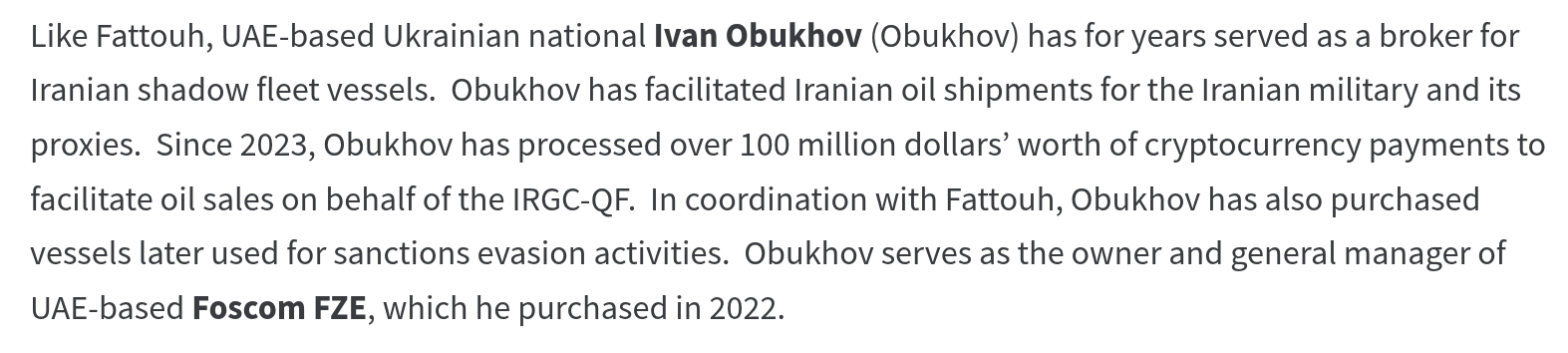
It is not a measure of what Iran’s crypto sector moved overall, and the sectoral designation itself does not blacklist Iranian crypto firms outright. It gives OFAC a standing basis to add targets later without a fresh determination each time.
This was not Treasury’s first Iran-crypto move this month. On August 7, it sanctioned the exchanges Shelbit and Aban Tether, along with operator Siavash Kayvanpour, for routing Revolutionary Guard funds through digital assets.
Seventeen days later, Treasury moved from designating specific exchanges to claiming authority over the sector itself. Two actions inside three weeks reads less like a single announcement than a campaign settling into a rhythm.
Five sectors, two with a target so far
The August 24 action reached well beyond crypto. Treasury named nearly 60 targets in total, including cyber operatives tied to intrusions against U.S. infrastructure and a shadow fleet of tankers moving Iranian crude and LPG, some bound for China.
But the five new sectors were not treated equally. Digital assets and shipping came with named targets attached immediately: Obukhov for crypto, a roster of tankers for shipping. Treasury’s own list of designees from this action does not include a named gold trader or airline, leaving those two sectors as legal authority without an enforcement target yet.
Whether that gap closes will say more than August 24 does on its own. A gold or aviation case following within weeks would confirm this is an active campaign working through its sectors in sequence. No follow-up would suggest those two additions were symbolic, in a way this month’s crypto authority, arriving on the heels of an actual case, was not.
Disclaimer: Cryip's content is strictly for educational and informational purposes and does not constitute financial, legal, or investment advice. Cryptocurrency involves significant risk, and readers assume full responsibility for their own financial decisions. Asset references are never endorsements.
To make complex crypto topics accessible to readers at all experience levels, our team uses AI tools strictly to refine language, correct grammar, and simplify terminology. AI is never used to draft facts, source information, or form conclusions. Every article is fact-checked and approved by a human editor before publication. Read our full AI Use & Content Policy.