



- The Ninth Circuit affirmed that Nevada can enforce its gaming law against Kalshi’s sports event contracts, rejecting the company’s federal preemption argument.
- The ruling directly conflicts with a Third Circuit decision that sided with Kalshi against New Jersey just four months earlier, on the identical legal question.
- The panel sent Kalshi’s election contracts back to the district court for separate review.
A federal appeals court ruled Friday that Nevada’s gaming regulators can enforce state law against Kalshi’s sports betting contracts, rejecting the company’s argument that federal commodities law shields it from state oversight.
The Ninth Circuit’s decision in KalshiEX, LLC v. Assad affirmed a lower court’s dissolution of the preliminary injunction that had briefly protected Kalshi’s sports event contracts from Nevada enforcement. The panel sent a separate question, covering Kalshi’s election contracts, back to the district court for further review under the framework laid out in this opinion.
Kalshi had argued that the Commodity Exchange Act gives the Commodity Futures Trading Commission exclusive jurisdiction over its contracts, since they trade on a CFTC-registered exchange.
The court rejected that theory three separate ways. It found the sports contracts are not legally “swaps” under the statute, that Kalshi could comply with both state and federal law through geofencing rather than facing an impossible conflict, and that Congress reserved gambling regulation to the states rather than handing it to the CFTC by implication. Writing for the panel, the court warned against reading a federal law to strip states of long-held authority based on “vague terms or ancillary provisions,” calling that approach “hiding an elephant in a mousehole.”
Both sides are already looking past Nevada
CFTC spokesperson Zach Fulton called the decision wrong on the law.
“The Ninth Circuit erred today when it invented a new and atextual exception to the CEA,” Fulton said.
Nevada Gaming Control Board Chairman Mike Dreitzer took the opposite view.
“This completely vindicates what we have been saying all along,” Dreitzer said.
Kalshi is not conceding the fight. A company spokesperson said the ruling would not be the last word.
“We will be seeking further review,” said Dani Lever, a Kalshi spokesperson. The company is also facing separate legal challenges, including the Baltimore Kalshi lawsuit, where the city has accused Kalshi and other prediction-market operators of offering unlicensed sports betting.
Two circuits, one question, two different answers
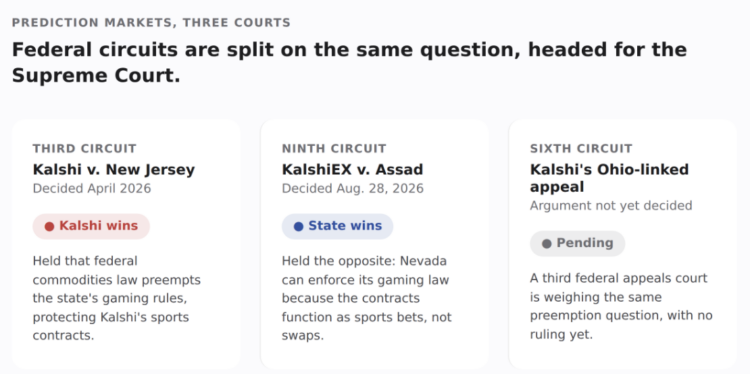
The reason both sides are talking past Nevada is what happened in April. The Third Circuit ruled on the same preemption question and reached the opposite conclusion, affirming an injunction that protects Kalshi’s sports contracts from New Jersey’s gaming law. The FlightAware Kalshi lawsuit shows that the company’s legal challenges extend beyond state gaming regulators and into disputes over the data used to power its prediction markets.
That is a very different situation from one more state regulator winning one more enforcement fight. It means two federal appeals courts have now looked at the identical legal argument and split on it, which is the kind of disagreement the Supreme Court typically has to resolve rather than leave to individual circuits. A third appeals court, the Sixth Circuit, is currently weighing a related Kalshi dispute and has not yet ruled.
Kalshi has already pulled its sports contracts out of Nevada and several other states following earlier enforcement actions, so Friday’s ruling changes little about where the company can currently operate there. The company is also expanding its financial-market offerings, including Kalshi US500 perpetual futures, as it broadens its product lineup beyond prediction markets. What it changes is the legal record the eventual Supreme Court petition will be built on.
What is still unresolved
The election-contracts piece of the case now goes back to the district court, which will have to apply this opinion’s reasoning to a different category of Kalshi product. Kalshi $1.12 billion funding also underscores the growing financial backing behind the prediction market as it faces expanding regulatory challenges. Kalshi has said it will seek further review of the sports-contracts ruling itself. Neither the timeline for that review nor the district court’s next move on election contracts has been set.
Disclaimer: Cryip's content is strictly for educational and informational purposes and does not constitute financial, legal, or investment advice. Cryptocurrency involves significant risk, and readers assume full responsibility for their own financial decisions. Asset references are never endorsements.
To make complex crypto topics accessible to readers at all experience levels, our team uses AI tools strictly to refine language, correct grammar, and simplify terminology. AI is never used to draft facts, source information, or form conclusions. Every article is fact-checked and approved by a human editor before publication. Read our full AI Use & Content Policy.