


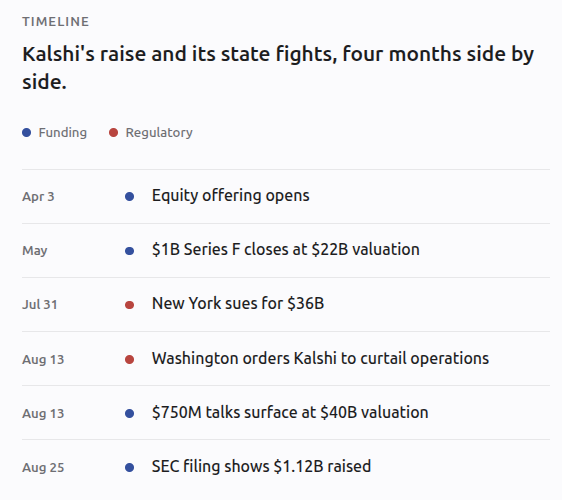
Kalshi has raised $1.12 billion in equity since April, a Form D filing the prediction market operator submitted to the Securities and Exchange Commission on August 25 shows.
The filing lists Tarek Mansour, Kalshi’s chief executive, as the person who signed it. It shows the company opened the offering on April 3 with a target of just under $1.5 billion, sold $1.12 billion of it to 71 investors, and has about $380 million left to place.
That total sits on top of a $1 billion Series F round Kalshi closed in May, led by Coatue with Sequoia Capital, Andreessen Horowitz, Paradigm, Morgan Stanley and Ark Invest also participating. That round valued the company at $22 billion, double its prior mark. Sequoia and Wellington Management are now said to be in advanced talks to put in a further $750 million at a $40 billion valuation, a price that would nearly double Kalshi’s worth again in three months.
A fundraising sprint through an active legal fight
The same stretch has brought Kalshi’s sharpest regulatory pressure to date. On July 31, New York Governor Kathy Hochul and Attorney General Letitia James sued the company, seeking at least $36 billion and arguing its sports contracts amount to unlicensed betting.
“No matter what they call themselves, prediction markets like Kalshi are gambling platforms, plain and simple,” James said.
Two weeks later, a King County Superior Court judge in Washington ordered Kalshi to stop offering contracts on sports, elections, politics and entertainment in the state, finding the company had likely violated its gambling and consumer-protection laws. Kalshi is contesting the scope of that order as geofencing deadlines set for August 19 and September 2 approach.
Nevada’s gaming board has moved on a narrower but sharper front. It is seeking $120,000 in daily fines after state investigators said they bought contracts from Nevada devices past an August 12 deadline the board had set for Kalshi to block state residents, arguing the company “has profited enormously from its continued violations of Nevada law.”
Sports contracts make up roughly 80 to 90 percent of Kalshi’s trading activity, by the company’s own past disclosures, which is what puts the New York, Washington and Nevada actions squarely against its main revenue line rather than a peripheral product. Investors pricing the company at $40 billion are betting that line survives the challenges largely intact.
That bet has some grounding in scale. Kalshi handled roughly $40 billion in trading volume in July, more than three times the combined volume of Polymarket and its regulated US arm over the same month. The company has also opened informal talks about a possible IPO as early as 2027. Kalshi $2 billion revenue is another marker of the platform’s rapid growth as trading activity and its business scale continue to expand. None of that changes what a court in New York or a fine in Nevada could still cost it.
Kalshi has commented on the $750 million talks. Neither the SEC filing addresses the New York or Washington actions directly. Kalshi US500 perpetual futures are also part of the company’s broader expansion into derivatives products.
Disclaimer: Cryip's content is strictly for educational and informational purposes and does not constitute financial, legal, or investment advice. Cryptocurrency involves significant risk, and readers assume full responsibility for their own financial decisions. Asset references are never endorsements.
To make complex crypto topics accessible to readers at all experience levels, our team uses AI tools strictly to refine language, correct grammar, and simplify terminology. AI is never used to draft facts, source information, or form conclusions. Every article is fact-checked and approved by a human editor before publication. Read our full AI Use & Content Policy.