


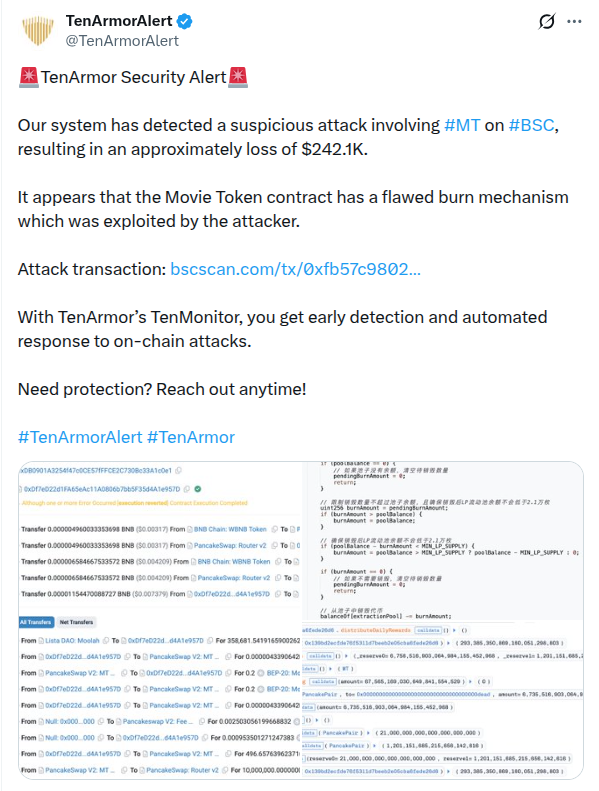
Security monitoring platform TenArmor flagged the incident early this morning on X, reporting a suspicious attack involving #MT on #BSC that resulted in an approximate loss of $242.1K. According to the alert, the Movie Token contract appears to have a flawed burn mechanism that was exploited by the attacker. The incident highlights the importance of real-time on-chain monitoring in identifying DeFi vulnerabilities quickly. In a stark reminder of the risks in decentralized finance (DeFi) protocols, the Movie Token ($MT) project on the Binance Smart Chain (BSC) was hit by a sophisticated exploit on March 10, 2026, resulting in losses of approximately $242,100 USD. The attack highlights persistent issues in smart contract design, especially token burning mechanisms and liquidity pool interactions.
The Incident: What Happened?
The exploit took place at around 12:05 AM UTC, as shown in BSCScan transaction records. The attacker, using wallet address 0xDB0901A3254f47c0CE57FFCE2C730B3c33A1c0e1, carried out a single transaction (hash: 0xfb57c980286ea8755a7b69de5a74483c44b1f74af4ab34b7c52e733fc62dfca6) that drained 381.75 Wrapped BNB (WBNB) from the project’s liquidity pool equivalent to roughly $242K at prevailing rates.
A detailed breakdown from DeFi security researcher @Defi_Nerd_sec
points to a vulnerability in the contract’s extractFromPoolForLpMining() function. This function subtracts tokens directly from the liquidity pair’s balance and calls pair.sync() to update reserves, but it lacks a reentrancy guard to block repeated calls in one transaction. Access is only restricted by lpMiningAddr, tied to the publicly callable MT_LP_RewardDistributor contract.
Technical Breakdown: How the Exploit Unfolded
The attacker used a flash-swap on PancakeSwap (a leading DEX on BSC) to start the attack. Step-by-step:
Flash Loan Initiation: Borrowed a massive amount of WBNB (358,681.54 WBNB) from Lista DAO’s Moolah pool via flash loan, no upfront capital needed.
Callback Manipulation: In the flash-swap callback, called distributeDailyRewards() on the Movie Token contract, burning ~6.74 million MT tokens from the liquidity pair.
Reserve Collapse: MT reserve in the PancakeSwap V2: MT 544 pool dropped to a minimal ~21,000 tokens, while WBNB reserves stayed intact, creating extreme price imbalance.
Arbitrage Extraction: Performed repeated MT sells to drain ~1,596 WBNB total. Key actions included large swaps (e.g., 10,000,000 MT via PancakeSwap Router V2), burns to dead addresses (e.g., 6,735,516.90 MT to 0x000…dEaD), and final transfer of 381.75 WBNB to the attacker.
The full transaction had 34 token transfers, internal calls (approvals, syncs, pool updates), used 1,029,112 gas, and succeeded with a tiny fee of 0.00005351 BNB. No funds recovered yet; stolen WBNB remains in the attacker’s wallet, possibly headed for laundering.
Impact on Movie Token and the Ecosystem
Movie Token, linked to entertainment-themed DeFi features (though roadmap details are limited), saw its liquidity pool devastated, likely causing a steep drop in $MT value and harming holders/liquidity providers. This adds to 2026’s DeFi exploit tally, after February’s quieter period with $26.5M–$37.7M total losses across ~15 incidents (per PeckShield and CertiK reports). Not the biggest (vs. February’s YieldBlox $10M or IoTeX $8.8M), but it spotlights BSC token risks like poor audits and reentrancy flaws.
Lessons Learned and Recommendations
Common pitfalls seen here:
No Reentrancy Protection: Use OpenZeppelin’s ReentrancyGuard for callback safety.
Flawed Mechanisms: Burn functions shouldn’t alter pool balances unchecked.
Flash Loan Exposure: Protocols need defenses against temporary borrow manipulations.
Teams should invest in full audits and monitoring. Investors: Diversify, use hardware wallets, and check audits before engaging low-cap tokens.As crypto matures, stronger oversight and community security practices are essential to safeguard the space. While the Movie Token exploit highlights ongoing smart contract risks on BSC, similar attacks are also emerging across the broader DeFi and NFT ecosystem.A recent Gondi NFT liquidity platform exploit on Ethereum resulted in the theft of NFTs worth nearly $230K from the protocol.
Disclaimer: Cryip's content is strictly for educational and informational purposes and does not constitute financial, legal, or investment advice. Cryptocurrency involves significant risk, and readers assume full responsibility for their own financial decisions. Asset references are never endorsements.
To make complex crypto topics accessible to readers at all experience levels, our team uses AI tools strictly to refine language, correct grammar, and simplify terminology. AI is never used to draft facts, source information, or form conclusions. Every article is fact-checked and approved by a human editor before publication. Read our full AI Use & Content Policy.