


- Project Glasswing launched by Anthropic with major tech partners.
- Claude Mythos Preview detects and exploits software vulnerabilities.
- Model has found thousands of high-severity vulnerabilities.
- Up to USD 100 million in usage credits committed.
- Global cybercrime cost estimated at USD 500 billion annually.
- Initiative focuses on defensive cybersecurity applications.
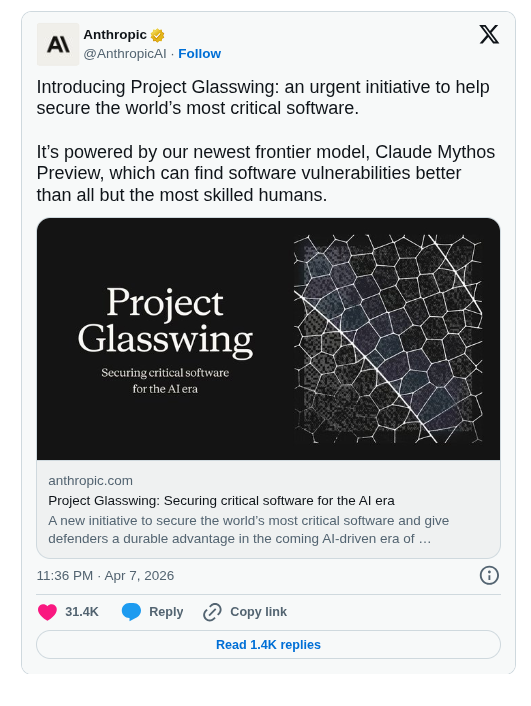
Anthropic has announced Project Glasswing, a collaborative cybersecurity initiative aimed at securing critical software systems worldwide. The project brings together major technology organizations including Amazon Web Services, Apple, Broadcom, Cisco, CrowdStrike, Google, JPMorgan Chase, the Linux Foundation, Microsoft, NVIDIA, and Palo Alto Networks.
The initiative is designed to address emerging cybersecurity challenges as artificial intelligence models reach advanced levels of coding capability. According to Anthropic, these models can now identify and exploit software vulnerabilities more effectively than most human experts.
Claude Mythos Preview Capabilities
The project is powered by Claude Mythos Preview, a general-purpose frontier AI model developed by Anthropic. The model remains unreleased but has demonstrated the ability to identify thousands of high-severity vulnerabilities across major operating systems and web browsers. Anthropic stated that these capabilities prompted the formation of Project Glasswing, as AI-driven vulnerability detection and exploitation represent a significant shift in cybersecurity dynamics.
Anthony Grieco, Senior Vice President and Chief Security & Trust Officer at Cisco, noted that AI capabilities have crossed a threshold that changes the urgency required to protect critical infrastructure. He stated that the scale and speed at which vulnerabilities can now be identified represent a shift beyond traditional security approaches.
Industry Collaboration and Funding
Anthropic has committed up to USD 100 million in usage credits for Claude Mythos Preview to support participating organizations, including an additional group of 40 entities working on critical infrastructure and open-source software. The company also announced financial contributions, including USD 2.5 million to Alpha-Omega and OpenSSF, and USD 1.5 million to the Apache Software Foundation.
The initiative aims to use AI for defensive cybersecurity purposes, such as vulnerability detection and penetration testing, before such capabilities become widely accessible to unsafe actors. Amazon Web Services confirmed it has begun testing the model within its internal security operations to strengthen critical codebases. Microsoft also stated that access to the model will support early risk identification and improve security across its systems.
Anthropic is also engaging with US government officials regarding both the offensive and defensive implications of the model. The company plans to publish findings on vulnerabilities identified and resolved within 90 days. Following the research preview, the model will be made available at pricing of USD 25 per million input tokens and USD 125 per million output tokens. Google stated that it supports the cross-industry initiative and will make the model available to participants through its Vertex AI platform, emphasizing the importance of collaboration on emerging cybersecurity challenges.
Recent AI and Blockchain Security Developments
Crypto losses reached $3.4 billion in 2025, driven by major incidents including the $1.4–1.5 billion Bybit breach. Just days ago in April 2026, North Korean-linked hackers drained approximately $285 million from Solana-based Drift Protocol in one of the largest DeFi exploits of the year. Anthropic’s December 2025 red-team study revealed that its AI models could autonomously exploit smart contracts and uncover novel zero-day vulnerabilities at low cost. Meanwhile, Ledger’s CTO warned that AI is making cyberattacks faster, cheaper, and more scalable.
Project Glasswing aims to reverse this trend by focusing on defensive applications of AI, potentially breaking the cycle of billion-dollar “code is law” failures and enabling self-healing blockchain security systems. Anthropic plans to publish resolved findings within 90 days, a timeline that could prove critical in strengthening on-chain resilience and preventing future exploits.
Disclaimer: Cryip's content is strictly for educational and informational purposes and does not constitute financial, legal, or investment advice. Cryptocurrency involves significant risk, and readers assume full responsibility for their own financial decisions. Asset references are never endorsements.
To make complex crypto topics accessible to readers at all experience levels, our team uses AI tools strictly to refine language, correct grammar, and simplify terminology. AI is never used to draft facts, source information, or form conclusions. Every article is fact-checked and approved by a human editor before publication. Read our full AI Use & Content Policy.