



- Rare two-block reorganization occurred on the Bitcoin blockchain
- Foundry USA mined seven consecutive blocks from 941879 to 941885
- Network split into two competing chains before resolving
- AntPool and ViaBTC blocks became stale after losing the race
- No attack or glitch; system worked as designed
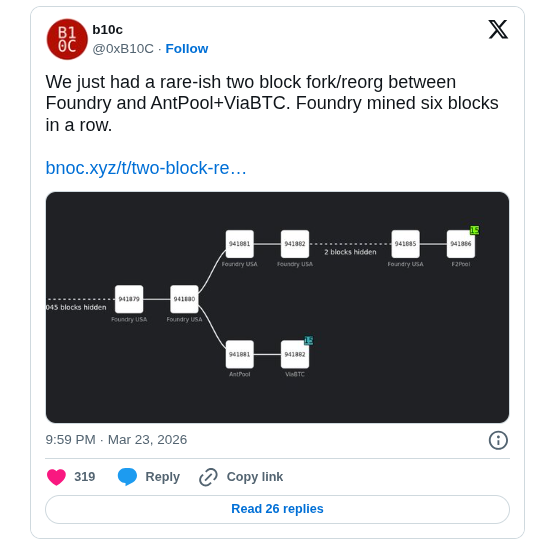
The Bitcoin blockchain recently experienced a “rare-ish” two-block reorganization (reorg), an event that can appear alarming but is a normal part of how the network operates. The incident was not caused by an attack or system failure, but rather by standard competition among miners. The mining pool Foundry USA emerged as the winner in a competitive multi-block race against AntPool and ViaBTC.
The Mining Race at Block Height 941880
Bitcoin miners continuously compete to validate the next block of transactions by solving complex cryptographic puzzles. This process occasionally results in multiple miners finding valid blocks at nearly the same time.
At block height 941880, the network briefly split into two competing chains:
- AntPool successfully mined block 941881
- ViaBTC followed on the same chain with block 941882
- At the same time, Foundry USA mined its own version of block 941881
- Foundry then mined its own version of block 941882
This created two parallel chains of equal length, each considered valid by different parts of the network.
How the Reorganization Was Resolved
The tie between the competing chains persisted until Foundry USA extended its chain further. The mining pool continued its streak by producing blocks 941883, 941884, and 941885.
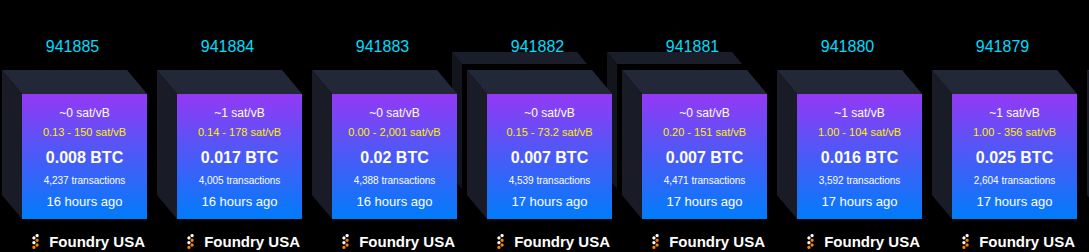
Once Foundry’s chain became longer, it was accepted as the canonical version of the blockchain. As a result:
- The blocks mined by AntPool and ViaBTC were discarded
- These discarded blocks became “stale” or “orphaned” blocks
Understanding Two-Block Reorganizations
Single-block reorganizations occur periodically on the Bitcoin network and are considered routine. However, a two-block reorg is significantly less common.
A two-block reorganization indicates that the competition between chains lasted for an additional block cycle before one chain gained a clear advantage. Despite its rarity, the event demonstrates Bitcoin’s decentralized consensus mechanism functioning exactly as intended, resolving temporary disagreements by selecting the longest valid chain.
Disclaimer: Cryip's content is strictly for educational and informational purposes and does not constitute financial, legal, or investment advice. Cryptocurrency involves significant risk, and readers assume full responsibility for their own financial decisions. Asset references are never endorsements.
To make complex crypto topics accessible to readers at all experience levels, our team uses AI tools strictly to refine language, correct grammar, and simplify terminology. AI is never used to draft facts, source information, or form conclusions. Every article is fact-checked and approved by a human editor before publication. Read our full AI Use & Content Policy.